In high-precision motion control systems, the performance of the entire closed-loop servo system often hinges as much on the quality and routing of the interconnecting cables as it does on the drive tuning or mechanical design. Poorly chosen or installed cables introduce electromagnetic interference (EMI), degrade signal integrity, and destabilize feedback loops, leading to position errors, oscillations, nuisance trips, or reduced machine throughput.
Custom servo motor cable solutions—whether separate power and feedback assemblies or integrated hybrid designs—allow engineers to optimize conductor sizing, shielding, insulation, flex life, and connector terminations for specific applications in CNC machines, robotics, packaging lines, and gantry systems. This guide draws on real-world motion control experience to explain the distinct requirements of power versus feedback cables and how thoughtful cable specification and installation preserve signal integrity.
Servo Power vs Feedback Cables – Different Roles, Different Design Rules
Servo systems rely on servo power, feedback, encoder, and brake cable types that must be engineered differently to avoid cross-interference and ensure reliable operation.
Servo Power Cables – The EMI Source
Servo power cables in VFD and inverter-driven servo cable considerations carry high-voltage, high-frequency PWM (pulse-width modulated) signals from the drive to the motor. The rapid switching creates significant EMI that can radiate and couple into nearby sensitive circuits.
Key design elements include appropriately gauged conductors for current and voltage, robust insulation rated for the drive’s output, and effective shielding (often braided copper) with 360° termination to the enclosure. In long runs or dynamic applications, custom power cables incorporate enhanced flex ratings, low-capacitance designs, and specialized jackets to handle mechanical stress without compromising electrical performance.
Feedback/Encoder Cables – The Nervous System of Motion Control
Feedback cables transmit low-level signals from encoders, resolvers, or other sensors back to the drive. These signals are highly susceptible to noise, making cable construction critical for maintaining accurate position, velocity, and torque feedback.
Typical high-performance feedback cables use twisted-pair conductors (often individually shielded “pairs-in-shield” configurations) plus an overall braid or foil shield. Protocols such as HIPERFACE DSL, EnDat, DRIVE-CLiQ, or RS-485-based links require controlled impedance (typically 100–110 Ω) and attention to maximum cable length to prevent reflections and jitter.
Hybrid Servo/Feedback Cables for Modern Drive Systems
Many contemporary drives support separate power and feedback cables versus hybrid servo cables, including hybrid cables that combine power and feedback conductors in a single assembly. These designs incorporate internal separation, multiple shielding layers, and precise geometry to minimize crosstalk while simplifying installation. Custom hybrid cables must strictly adhere to the drive manufacturer’s specifications for shielding, impedance, and pairing to avoid compromising closed-loop performance.

Signal Integrity in Feedback Loops – How Cable Design Supports Accurate Servo Control
Signal integrity directly determines how faithfully the drive receives feedback and closes the control loop.
Twisted Pairs, Shielding and Pair‑in‑Shield Constructions
Twisted pairs cancel common-mode noise through differential signaling, while braided, foil, and hybrid shielding for EMI control can provide layered protection through individual pair shields plus an overall shield. Proper 360° shield termination at both connectors and enclosures is essential; pigtail connections dramatically reduce effectiveness at high frequencies.
Low‑Capacitance Insulation and Leakage Currents
High capacitance in long cables can cause leakage currents, increase power dissipation, and degrade high-frequency signals. Custom servo cables often specify XLPE or other low-capacitance insulations to maintain performance over distance and support higher PWM frequencies.
Matching Impedance and Length Limits for Encoder Protocols
Encoder protocols have specific impedance and length requirements. Deviations cause signal reflections, timing errors, and loop instability. Custom cable manufacturers can tune geometry and materials to meet these parameters precisely for your drive and cable run lengths.
Routing, Grounding and EMI Control – Avoiding Noise in Motion Control Loops
Even the best cables fail without proper installation.
Physical Separation of Power and Feedback Cables
Follow servo cable routing best practices by routing power and feedback cables in separate bundles or trays and maintaining as much distance as possible. Cross them at 90° angles if they must intersect. Custom harnesses can be pre-engineered to enforce optimal separation.
Proper Shield Grounding and Star Ground Practices
Ground shields typically at the drive end only to avoid ground loops. Implement star grounding topologies that separate signal and power grounds. Custom assemblies can include integrated 360° shield clamps and strain relief for reliable, repeatable terminations.
Additional Noise Reduction Techniques (Ferrites, Filters, Layout)
Ferrite chokes on power lines, RC/LC filters on encoder signals, and careful panel layout complement high-quality cabling. Premium custom cables reduce reliance on these add-ons by providing inherent noise immunity.
Application Cases Where Custom Servo Cables Are Necessary
Catalog cables suffice for many standard installations, but custom solutions excel in demanding scenarios.
High‑Precision CNC, Packaging and Robotics with Long Axes
Long cable runs in multi-axis systems amplify noise and capacitance issues. Custom low-capacitance, heavily shielded cables maintain feedback accuracy and loop stability across extended distances.
Drag Chain and Torsion Applications in Motion Control
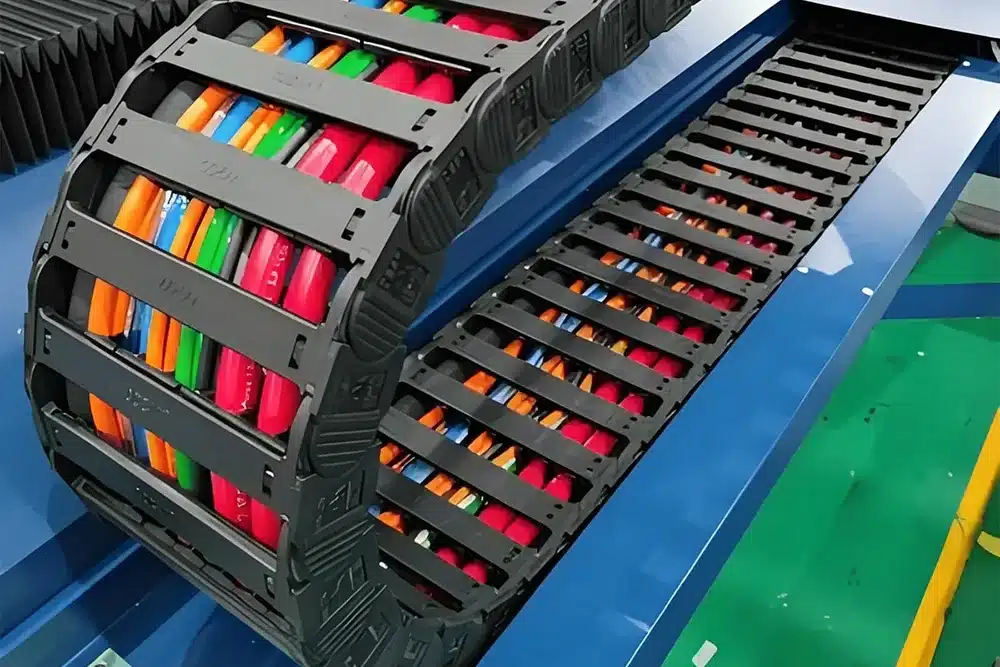
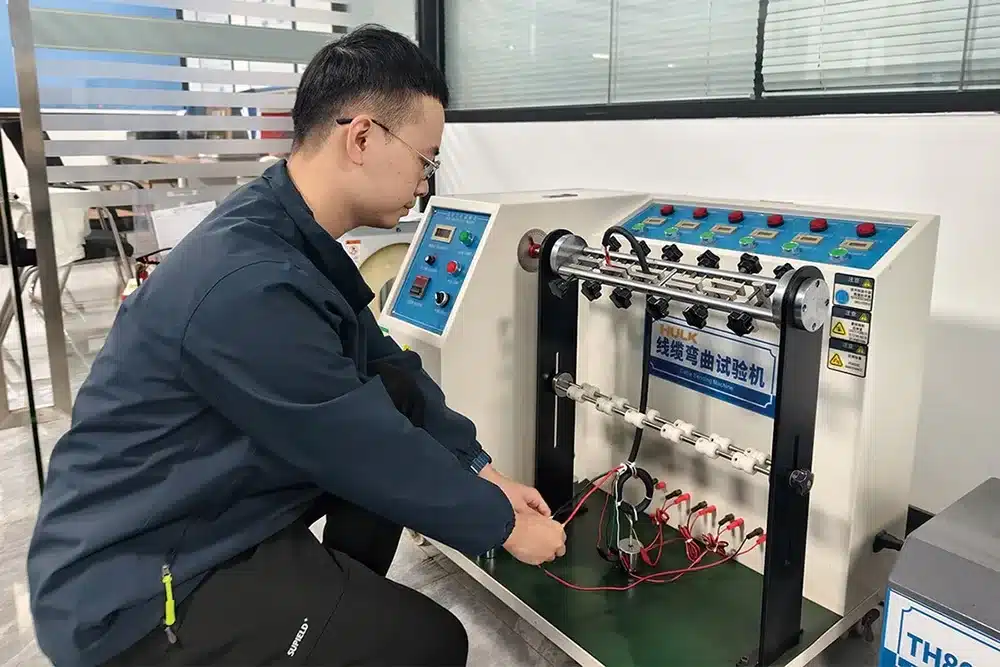
Servo cable specifications for static, flexing, and torsional motion are essential because continuous flex and torsional motion in robot arms, gantry systems, or high-cycle packaging machines require specialized constructions rated for millions of cycles. Custom cables incorporate optimized stranding, jackets (PUR, TPE), and torsion angles (±360° or more) to prevent conductor fatigue and signal degradation.
Harsh Electrical and Environmental Conditions
Environments with welders, high-power switching, oils, or extreme temperatures benefit from enhanced shielding, chemical-resistant jackets, and tailored routing in custom designs.

Specifying Custom Servo and Feedback Cables – What Engineers Must Define
Clear specifications yield reliable results.
Electrical Parameters
Provide drive/motor models, encoder protocol, voltage/current ratings, maximum length, target capacitance/impedance, shielding requirements, and applicable EMC standards.
Mechanical and Environmental Requirements
Detail installation type (fixed, drag chain, torsion), cycle life, bend radius, ambient temperature, exposure to oils/chemicals, and jacket material preferences (PVC, PUR, halogen-free, etc.).
Connector and Assembly Requirements
Specify servo motor OEM pinouts and connectors, including connector types, pinouts, overmolding, strain relief, labeling, and any hybrid or pre-terminated needs.
Reliability, Stability and Total Cost – Why Better Cables Are Often Cheaper Over Time
Proper cabling reduces noise-induced servo faults, following errors, and downtime. The incremental cost of custom or high-spec cables is quickly recovered through higher equipment effectiveness, faster commissioning, and lower maintenance.
Regular inspection of connectors, shields, and jackets—combined with cycle-based replacement schedules—extends system life.
Practical Checklist – Deciding When to Use Custom Servo and Motion Control Cables
- Are you seeing persistent noise-related errors or instability despite drive tuning?
- Do feedback runs exceed standard lengths or pass near EMI sources?
- Are cables subject to continuous flex, drag chain, or torsion motion?
- Do your encoder protocols have strict impedance or shielding requirements?
- What is the true cost of one hour of unplanned downtime versus optimized cabling?
RFQ Preparation Tips: Include drive/motor details, routing diagrams, environmental data, motion profiles, connector specs, and compliance needs. The more complete the brief, the faster and more accurate the custom solution.
At Hulk Electric, we specialize in custom cable design services and manufacturing high-flex, shielded servo power, feedback, and hybrid cables tailored to the exact demands of industrial automation. Share your application parameters with our engineering team, and we will deliver cables that enhance signal integrity, reduce EMI, and support stable, high-precision motion control.