Custom industrial cable solutions must withstand the real temperature conditions of the application, or they can contribute to system failures when temperature thresholds are exceeded. Engineers often find that a standard “90°C cable” is not suitable for radiant heat from a nearby oven, or that a standard flexible cable is too brittle for winter installations or freezer applications. Using appropriate temperature ratings, materials and constructions to manage extreme heat, cold and thermal cycling minimizes insulation degradation, conductor fatigue, jacket cracking and costly downtime in robotics, drag chains, machine tools and outdoor equipment.
For more than twenty years, Hulk Electric has manufactured high-flex and high-temperature silicone industrial cables, helping OEMs and system integrators specify cables that can perform reliably through extreme temperature variation. This guide provides practical advice on understanding ratings, material behavior, design strategies and specification best practices to help avoid common pitfalls and ensure long service life.
What Temperature Ratings Really Mean – Installation vs Operating Conditions
Temperature values listed in cable datasheets should not be taken at face value, because they are not always one-size-fits-all figures. Understanding industrial cable temperature markings helps prevent misinterpretation that can lead to premature failures even when a cable appears adequately rated on paper.
Installation Temperature vs Operating Temperature
Installation temperature is the range of temperatures at which the cable may be safely bent, routed and terminated when first installed. Operating temperature is the range of temperature that the installed cable can endure continuously under normal running condition of the machine. Not all cables can be bent at the same temperatures as they can be operated at—e.g., a cable that is rated for -40°C to +90°C operating temperature may only be able to be bent during installation to -15°C. Sharply curving in very cold conditions can form hidden microcracks that can start to grow when flexing or temperature changes.
Continuous vs Peak Temperature Ratings
Continuous Ratings – the temperature that the cable can withstand continuously throughout its expected life. Short-term or peak ratings are for short-time trips (startup or cleaning, for example). Design always based on continuous ratings of actual cable location temperature including ambient air temperature, radiant heat from hot surfaces and internal heat rise due to current flow. This difference is often ignored which leads to softening around hot machinery or brittleness during outdoor winter conditions.

Material Behavior Under Heat, Cold and Thermal Cycling
Insulation and jacket compounds have different temperature stress reaction. When using silicone industrial cables or silicone flexible cables for high temperature, or low temperature outdoors or in the freezer, the selection of material is very important.
How PVC, PE/XLPE, PUR, TPE and Silicone Respond to Temperature
PE and XLPE offer good electrical properties and higher thermal stability than PVC, but they may be less flexible in extreme temperatures or after long-term high-temperature exposure. PUR and TPE offer mechanical toughness and flexibility across a wider moderate temperature range, with grades available for colder applications. Selecting custom cable jackets and insulation for harsh industrial environments requires evaluating these temperature limits alongside chemical and mechanical exposure.
Silicone is a specialist material for extreme applications, maintaining flexibility and electrical properties from -60℃ to +200℃. When designing silicone cables for high-temperature applications, engineers can use its resistance to cold stiffening, hot softening and thermal aging, while providing additional mechanical protection in high-abrasion areas.
Thermal Cycling – Expansion, Contraction and Fatigue
Repeated heating and cooling stresses cause materials to expand and contract at differing rates, generating internal stresses, delamination between layers and increased fatigue, particularly in motion applications. The life of industrial cables can be shortened further by thermal cycling combined with torsion in drag chains or torsion from robot arms.
Low-Temperature Brittleness and High-Temperature Softening
Standard jackets can crack during movement in cold storage or outdoor winter conditions, while insulation may melt or flow near hot engines or ovens. These risks can be reduced by selecting appropriate industrial cables, such as silicone cables for high temperatures or low-temperature cable materials for freezing environments.

Designing for Extreme Heat – Cables Near Ovens, Furnaces and Hot Machinery
Special care is required for mapping on-site cable exposure in high-temperature environments.
Mapping Heat Sources and Real Cable Temperature
Measure not just ambient air but radiant heat from hot surfaces, convective airflow, and self-heating from current. Cables routed close to heating elements experience far higher effective temperatures than the room reading.
Material and Construction Choices for High-Temperature Cables
When exposure temperatures are likely to be above 90°C, consider silicone rubber insulation and jackets. Other features such as heat resistant braids, thick walls or other conductors enhance performance. Our custom high temperature silicone industrial cable has been designed to meet these challenging environments in the food processing, metal and automation industries.
Routing and Mechanical Protection in Hot Areas
Minimize cable exposure to heat sources as much as possible, use protective materials around cables such as conduits or shields, and maintain the proper bend radius. Good cable routing for high-temperature equipment can greatly extend cable service life.

Designing for Extreme Cold – Outdoor, Freezer and Cold-Climate Applications
Cables must be flexible and tough in sub zero conditions.
Low-Temperature Limits and Flexibility Requirements
Always test both installation and operating low temperatures, especially for flexing applications. Most cables become less flexible below -20°C, which can cause cracking during motion; review silicone cable performance at low temperatures when evaluating suitable constructions.
Material Choices for Cold Environments
PUR, TPE and silicone based compounds remain supple in extreme cold. These materials are used in low-temperature flexible cables for outdoor and freezer applications, offering a good performance in the fields of cranes, wind turbines, and refrigerated facilities.
Handling, Installation and Storage Considerations
Pre-warm cables for cold installations and never bend a cold cable into a tight bends on the cold material. Be sure to store cables in temperature controlled areas before deployment.

Thermal Cycling in Motion Applications – Drag Chains, Robots and Repeated Start-Stop Duty
Compound stress is caused by the combination of motion and temperature fluctuations.
Combined Mechanical and Thermal Fatigue
The metabolic stress on cables in drag chains is compounded by temperature swings, which can cause the conductor to break and/or cause wear to the jacket.
Selecting Flex-Rated Materials and Constructions for Thermal Cycling
Use fine-stranded conductors, high-flex designs and thermally stable compounds such as silicone. These are essential considerations for industrial flexible cables for high-cycle motion as well as robot and torsion cable constructions exposed to thermal cycling.
Testing and Life Expectancy Under Real Duty Cycles
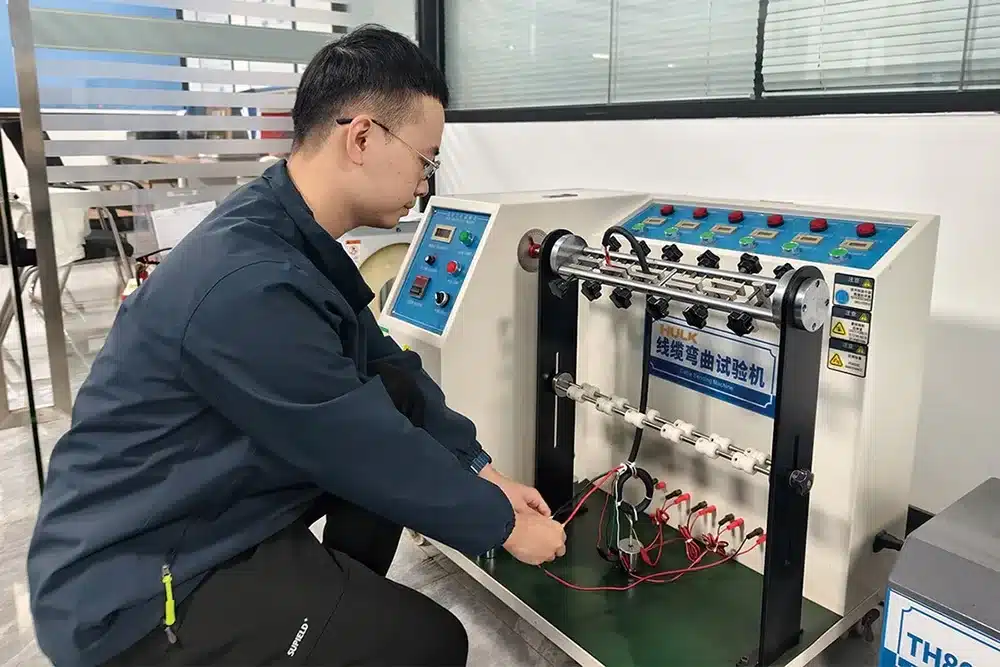
Collaborate with manufacturers on prototype testing for custom silicone cables that replicates the flex and thermal-cycling conditions of your application.

Integrating Temperature Ratings into Custom Cable Specifications
Present clarity results in best fit custom solutions.
How to State Temperature Requirements in RFQs and Drawings
Give accurate ranges of: installation temperatures, continuous operating temperatures, peak excursions, cycle frequency, duty type. Do not use “generic” words — be specific and reference measured conditions at cable routing points.
Coordinating Temperature Specs with Other Requirements
Consider temperature requirements, flex life, chemical resistance, voltage and certification. There are always compromises to be made, and expert manufacturers assist in optimizing.
Common Mistakes in Temperature Design—and How to Avoid Them
- Assume that the ratings for indoor conditions are satisfactory near hot processes: Measure the actual cable temperature instead.
- Failing to account for low temperature limits when installing in the colder weather: Plan and pre-warm accordingly.
- Thermal cycling as an afterthought: Embed it in design reviews and testing.
Practical Temperature Design Checklist for Custom Cable Projects
Questions to Answer Before Finalizing Temperature Requirements
- What are the real ambient, radiant and cable-location temperatures?
- What are the installation and operating ranges and are there any extremes and cycling?
- Is the cable in static, flexing or torsion?
- Do there exist chemical or mechanical stresses as well as temperature?
What to Ask Your Custom Cable Manufacturer About Temperature Performance
- The range of materials that are available and the temperature ranges in which they have proven themselves.
- The test data includes the following:The following test data is provided:
- Comparing to reference applications in similar environment.
- The District should provide recommendations for routing and protection.
The correct choice of temperature ratings for custom cables will depend on the application, temperature, and stresses from heat, cold and movements. Engineers can benefit from these issues addressed early for greater reliability and lower total ownership costs.
At Hulk Electric, our engineers develop high-flex cables, servo motor cables, robot torsion cables and high-temperature silicone cables for extreme conditions. Provide your application details—including temperatures, motion profiles and process conditions—and our custom cable design services team will develop a solution tailored for long-term performance.