In cold environments, cables need to remain sufficiently flexible, tough and have sufficient jacket strength at the coldest actual operating and installation temperatures. Materials used in low temperature cables which perform well at ambient or surface temperatures may also become stiff or brittle at low temperatures, increasing the risk of cracking during bending, pulling, impacting or moving operations of the cable. The answer to the question is not a single simple number on a datasheet. It must be compatible with the jacket compound, insulation, conductor stranding, shielding, connectors, bend radius, and installation procedure of the actual cold environment that the cable will operate in.
One of the misconceptions is that if a cable is rated for a low temperature, it can be bent or installed at the same temperature. The “Minimum Operating Temperature” is not the same as “Minimum Installation Temperature. A cable that conducts electricity when it is cold may be too stiff for dynamic applications, or for ease of winter handling. The whole assembly, not just the outside covering, is sensitive to cold, whether it is a conductor, insulator, shield, seal, gland, or a support for the cable.
How Low Temperatures Affect Industrial Cable Materials
At lower temperatures, most polymers’ molecules move less. The material is increasingly hard and has a reduced capacity to absorb stress before cracking. An easy-to-route cable at room temperature may become stiff when stored in a freezer, on an outdoor machine, or in a drag chain for cold storage. The same stiffness creates greater transfer of forces into conductors, shields and cable-entry points.
Stiffness and Loss of Flexibility
The colder it gets, the more torque is required to bend the jacket and insulation. This is something that is felt by the installers as soon as they install the cable or when they take it from a refrigerated space or outside in the night. The increased bending force also increases stress on connectors and strain-relief areas. The increased stiffness reduces the flex life of the cable in continuous motion applications, including outdoor conveyors or low-temperature automation, before the cable may crack.
Brittleness and Crack Initiation
After a polymer has entered into more brittle state, surface nicks, scratches, voids or thin sections become preferred locations of crack growth. Those can be opened by a sharp bend, impact from ice or a tool or a tight pull through a gland. This crack can be mistaken as a normal mechanical damage. Actually, it is a combination of embrittlement due to cold temperature and applied stress. The temperature history and the exact location of the failure is important in determining whether crack formation is due to cold or abrasion/ chemical attack.

Temperature Cycling and Condensation
This movement between warm and cold zones results in the generation of expansion/contraction stress at each interface (conductor and insulation, insulation and shield, shield and jacket, and jacket and connector/gland). Condensation is created when cold equipment is introduced to warm, moist air. That moisture can refreeze and enlarge in small pockets, can cause mechanical and electrical degradation. They are a reality of life for outdoor ports, agricultural equipment, and refrigerated logistics systems.
Conductor Ductility and Cold Flexibility
Even though copper is not as easily ductile at typical industrial temperatures as at room temperature, the construction is still important. The fine-stranded, annealed copper is able to distribute bending strain more evenly than solid or coarse-stranded conductors. Rigid core conductor cannot be replaced by a flexible outer jacket. Conductor stranding and lay design become significant when the cable needs to be moved while cold, in addition to the polymer compound itself.
Connectors, Seals, and Cable Glands in the Cold
Additionally, connector housings, elastomeric seals, strain-relief boots and cable glands become stiffened or lose their flexibility at low temperatures. If a cable has passed the cold test, it can break at the seal entry point if the seal cracks or the gland does not fit properly. The mating cycles, sealing material grade and the mechanical transition from cable to connector need to be considered along with the cable.
What Makes a Cable Material Suitable for Cold Environments?
The suitability is dependent on a combination of flexibility and toughness as well as electrical stability and dimensional control under the actual temperature range and movement profile. The ability of a material to perform adequately in a static cold service situation has no bearing on the material’s suitability for repeated bending or impact service. Engineers therefore consider various performance factors and do not simply use a temperature rating.
Minimum Operating Temperature
The minimum temperature to which the cable will be used to fulfill the manufacturer specified electrical and mechanical purpose. Does not automatically imply installation flexibility, continuous dynamic bending or a short-term impact resistance.
Minimum Installation Temperature
Higher temp needed for installation than continuous use. Cold materials are less resistant to uncoiling, bending, pulling and breaking. Prevents many field failures by following the manufacturer’s installation instructions and allowing the cable to reach the appropriate temperature when necessary.
Dynamic Cold-Flex Performance
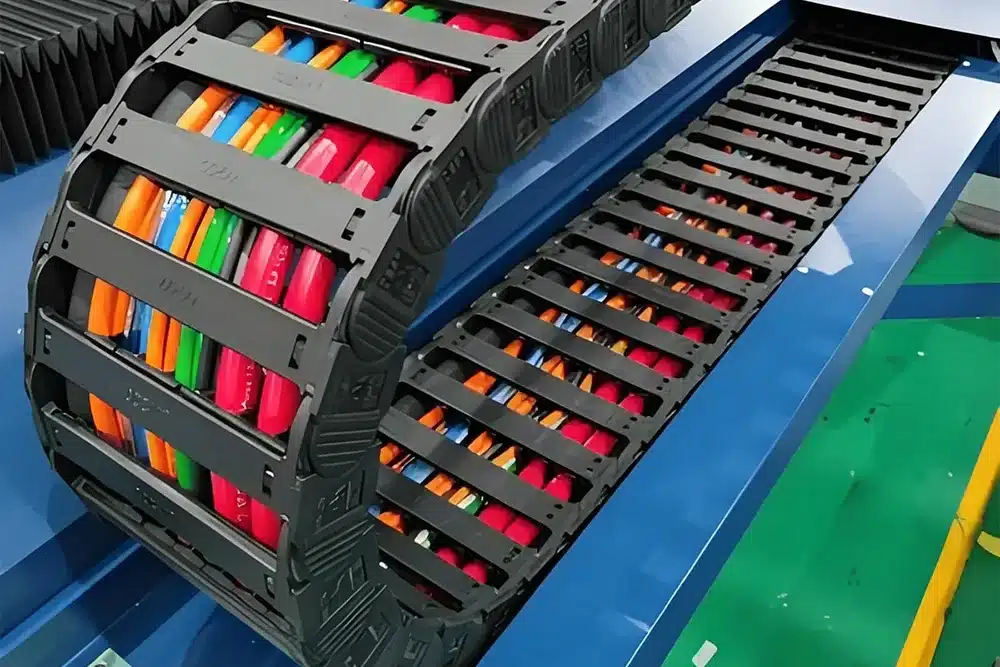
Static cold tests cannot ensure the ability of a cable to withstand bending, twisting or low temperature travel in an endless manner. When it comes to applications like drag chains in cold storage, robot arms for outdoors, or mobile machinery, verified cold-flex data at the real bend radius, speed and cycle profile is required.
Impact and Crack Resistance
Cables can be hit by ice, tools or moving parts of a machine in cold weather. Low temperature toughness and surface resistance needs to be taken into account as a combined property. A soft compound can be flexible but require mechanical protection from sharp edges and impact.
Electrical Performance at Low Temperature
Insulation resistance, dielectric properties, capacitance and impedance may vary with temperature. Particularly sensitive circuits are sensor, encoder, industrial Ethernet, fieldbus and servo-feedback circuits. Data on the product should inform choice, rather than assumptions about the product.
Moisture, Ice, and Water Resistance
Low temperatures are often accompanied by condensation, snow, freeze–thaw cycles and water ingress. Jacket, connector, gland, sealing system and installation route should be considered as a system. Outdoor and washdown suitability is not guaranteed if the machine is only flexible.
Low-Temperature Cable Material Options
There is no “best” polymer family for all cold applications. Performance is grade dependent and it will vary according to the complete cable construction.
PVC for Low-Temperature Applications
Normal PVC compounds can be brittle or stiff at temperatures below their design range. There are PVC grades designed for low temperatures and they could be used for protected, fixed use applications, where PVC movement is limited and exposure to cold temperatures is moderate. If the temperature has to be bent over and over or if it is really low, other families are normally chosen.
PUR and TPU for Cold Flexibility
Some of the polyurethane and thermoplastic polyurethane formulations selected are still sufficiently flexible and resistant to tear at sub-zero temperatures. They are commonly used in drag-chain, outside enclosure, mobile machinery and refrigerated-transportation cables. Cold performance is still dependent on the exact grade, hardness and cable construction so validation against the application is necessary.

TPE Materials for Cold and Dynamic Applications
Some thermoplastic elastomer formulations exhibit the characteristics of low-temperature flexibility, elasticity, resistance to abrasion and dynamic performance. There are a number of different types of TPE, and some are more sensitive to cold than others. Different compound data and intended motion profile should be reviewed by application engineers. For more information on TPE properties see our TPE cable materials guide.
Silicone Rubber
Silicone is often used when it is necessary to have a broad temperature range and flexibility at low ambient temperatures. The compromise is wear, cut, or tear resistance when it comes to industrial movement. Further mechanical protection may be required. Silicone’s wider temperature range is covered in our high temperature material selection resources.
XLPE and Polyolefin Materials
Depending on formulation and construction, cross-linked polyethylene and related polyolefins can provide useful electrical, thermal and low-temperature performance. They may not be inherently more flexible than elastomeric jackets in dynamic cold service.They do not necessarily have a higher degree of flexibility than elastomeric jackets in dynamic cold service. Need for insulation thickness, conductor stranding and bend radius is still important.
PTFE, FEP, and Other Fluoropolymers
The chemical resistance and temperature resistance of fluoropolymer can be enough to warrant their use in challenging applications. They can be quite functional cold, but are relatively stiff and more expensive. All mechanical and electrical requirements of the application need to be considered prior to selection.
| Material Family | Potential Cold-Environment Strength | Important Qualification |
| PVC | Cost-effective in selected moderate-cold fixed applications | May stiffen or become brittle below its specified range |
| PUR / TPU | Often suitable for flexible, low-temperature industrial cables | Grade, hardness, construction, and motion conditions must be verified |
| TPE | Can combine low-temperature flexibility and environmental resistance | Broad family; performance is formulation-specific |
| Silicone | Broad temperature range and low-temperature flexibility | May need extra protection against abrasion and tearing |
| XLPE / polyolefin | Useful electrical and thermal performance in selected designs | May be stiffer than elastomeric materials in dynamic cold applications |
| PTFE / FEP | Strong chemical and temperature performance | May be relatively rigid and higher cost |
How Conductor and Cable Construction Affect Cold Performance
Cold reliability is not a quality that is exclusive to jackets. During the construction, the full construction distributes the stress when the cable is cold and stiff.
Fine-Stranded Versus Coarse-Stranded Conductors
Fine-stranded copper spreads bending strain more evenly, and offers better flexibility when moving. When the surrounding polymers are stiff, solid or coarse-stranded conductors can withstand more local stress. In dynamic cold service, the design of the conductor should be selected to meet the anticipated flex life. For more information about stranding, see our copper stranding design resource and our stranded versus solid conductor resource.
Insulation and Jacket Compatibility
The various layers contract at different rates and become stiff at different rates. There are mismatches at the interface when cycling between temperatures. Conductor insulation, fillers, shields and outer jacket should not be considered alone.
Cable Lay, Shielding, and Overall Diameter
Tighter or more complex lay and heavier shielding increase stiffness. A larger overall diameter amplifies the force required to bend the cable when cold. Servo, motor, encoder, Ethernet, and fieldbus cables often balance shielding needs against low-temperature flexibility.
Minimum Bend Radius in Cold Conditions
Stiffer or more complex lay/heavier shielding means tighter. The greater the overall diameter, the more force it will take to bend the cable when cold. The need for shielding, low-temperature flexibility, and a variety of other factors are balanced in servo, motor, encoder, Ethernet and fieldbus cables.
Connectors, Glands, and Strain Relief
The practical bend radius may need to be larger when the cable is cold. Since cold-temperature guidelines are provided by the manufacturer, not a room-temperature rule of thumb, the risk of crack initiation is reduced when following the manufacturer’s guidelines.
Common Cold-Environment Cable Selection Mistakes
Using a Standard PVC Cable Below Its Design Range
Standard PVC can stiffen or crack when flexed or installed below its rated range. Verify the actual product data and consider a specially formulated PVC, PUR, TPE, TPU, silicone, or other construction where the application demands it.
Confusing Operating Temperature With Installation Temperature
A cable may operate successfully after it is installed yet still require warming before uncoiling, bending, or terminating. Installing cable inside a freezer or on outdoor equipment in winter is a frequent source of this error.
Assuming a Cold-Rated Cable Is Suitable for Dynamic Movement
Rigid jackets and insulation cause damage at high installation forces, tight bends and sharp entry transitions. Ensure the cable is warmed to the correct temperature for installation; use controlled routing.
Bending or Pulling the Cable While Frozen
Condensation, ice expansion and interface stress occur as a result of repeated freeze–thaw cycles. Sealing, water-blocking, drainage and enclosure design should all be included.
Ignoring Thermal Cycling and Condensation
Cable jacket may be able to withstand the temperature, while the connector housing, seal, boot and gland can not. Test the entire product.
Selecting the Jacket Without Reviewing the Connector
Connector housings, seals, boots, and glands can fail at temperatures where the cable jacket remains intact. Qualify the complete assembly.
Ignoring the Difference Between Flexibility and Service Life
Cold flexibility does not necessarily mean resistance to fatigue or abrasion during repeated movements. Validation for service-life is still required.
How to Prevent Brittleness and Cracking in Cold Environments
Select Materials for the Minimum Actual Temperature
Not only the lowest outdoor air temperature, but also the lowest temperature of the cable, connectors and the machine surface. Consider startup, shutdown, storage, transport and transition conditions.
Use the Correct Conductor Construction
Fine-stranded or suitably flexible (futuristic) copper conductors allow for cold motion. Assess conductor design, insulation, jacket, lay and dynamic testing for match. The range of high flexible, servo/motor and robot/torsion cable from Hulk has all taken these factors into account.
Increase Bend Radius and Reduce Mechanical Stress
Do not make sharp bends, make use of restrictive connectors, place too much tension, compression, impact and route against hard edges. The larger the practical bend radius, the less of a risk of cracking when the cable is cold.
Warm the Cable Before Installation When Required
Handle in accordance with manufacturer’s cold weather handling guidelines. Uncoiling, bending, stripping or terminating a cable will not be performed until it has cooled to an appropriate temperature if necessary. Warm-up procedure is dependent on construction, length, and surroundings.
Protect Against Moisture, Ice, and Condensation
Properly use connectors, glands and sealing systems, water blocking, drainage and protective routing. The moisture in the frozen state is expanded and results in mechanical and electrical stress.
Test the Complete Assembly at Low Temperature
Confirm cable, connector, gland, and machine routing together in an environment that represents the real world and cold temperatures. Add cold bend, dynamic flex, thermal cycling, impact, insulation resistance, continuity, and sealing as applicable.
How to Test Low-Temperature Cable Performance
Evidence for a temperature rating should be based upon matching intended use.
Cold Bend and Cold Flex Testing
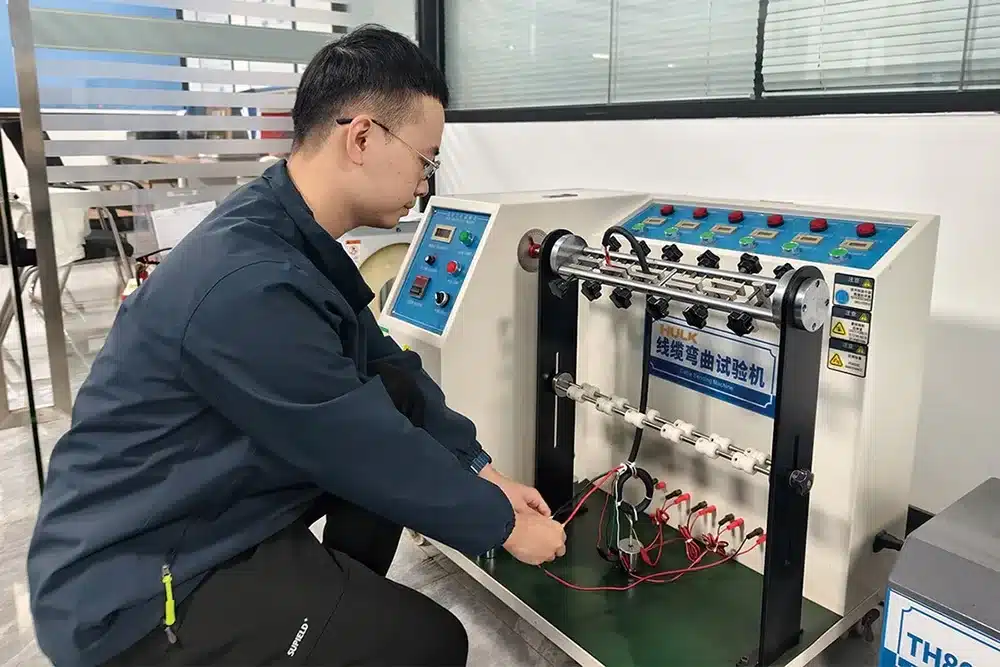
Cold bend tests determine if a cable will crack and/or fail electrically when bent at a given low temperature. For moving applications, Dynamic cold-flex testing includes defined bend radius, speed, travel, acceleration and cycle count.

Thermal Cycling Tests
Warm to cold cycling reveals cracking, seal failure and interface stresses that would not be seen in a single temperature test. The typical cases are freezer equipment that is brought into warm production areas and outdoor machinery that is exposed to day–night temperature fluctuations.
Impact and Mechanical Testing at Low Temperature
Low temperature impact, crush, abrasion, tensile, strain-relief, and connector-mating tests confirm that toughness is maintained under realistic mechanical loads. Note the temperature, load, cycle count and acceptance criteria.
Electrical Testing After Cold Exposure
Common post-exposure tests involve conductor continuity, insulation resistance, dielectric withstand, shield continuity, and, if applicable, capacitance, impedance and attenuation. Other cables, such as power, sensor, encoder, Ethernet or fieldbus may need different electrical specification.
Field Validation in the Actual Machine
Laboratory testing cannot simulate all combinations of chemical, vibration, movement and cold. For critical applications, there is still a controlled pilot installation with recorded temperature, movement and inspection data.
What to Include in a Low-Temperature Cable RFQ
Temperature Requirements
Specify minimum operating temperature, minimum installation temperature, transport/storage temperature, maximum operating temperature, typical temperature cycling, adjacent heat sources, fluid or surface temperatures, and start-up/shut down conditions. “Below zero” does not give a full specification.
Mechanical and Motion Requirements
Choose fixed or dynamic installation, bend radius, travel distance, speed, acceleration, torsion, cycle frequency, vibration, impact, drag-chain or robot configuration and connector/strain-relief requirements. The selection of materials and the type of stranding for conductors are both important.
Environmental Requirements
Recognize water, condensation, oil/chemicals, UV/ozone, abrasion/cutting risk, washdown, outdoor exposure, and enclosure/cable entry conditions. Cold is seldom experienced alone.
Electrical and Compliance Requirements
Include conductor size, conductor current, conductor voltage, conductor signal type, conductor shielding, conductor length, voltage-drop limitations, conductor insulation class, flame/halogen-free requirements, and UL/CE/TÜV etc. target-market certification requirements. The mechanical cold performance cannot be divorced from the electrical and regulatory requirements.
Testing and Validation Requirements
Specify any cold bend/cold flex, thermal cycle, impact, sealing, insulation resistance, dielectric, continuity, or field validation tests that are required. Hulk Cable is a direct manufacturer that can assist you with material selection, custom construction, sampling, testing and supply of these conditions.
Summary Guidance—Choose for Cold Flexibility, Not Just a Temperature Number
The prevention of brittleness and cracking in cold environments relies on materials and constructions which are able to retain flexibility and mechanical integrity at the lowest possible temperature for which the cable has to be exposed, particularly when it is installed or moved in cold conditions. All of these factors play a role: jacket compound, insulation, conductor stranding, cable lay, shielding, connectors, sealing, bend radius, movement profile, exposure to moisture, thermal cycling, verification testing, etc. Low temperature rating is essential but not enough.
For application where stiffness and cracking can be a problem such as cold storage, outdoor machinery, refrigerated logistics, low temperature automation, or any application where there is a moisture problem, bend radius, electrical requirements, and expected service life, the minimum temperature and installation conditions should be shared. Hulk Cable will examine the complete set of conditions and recommend and/or design an appropriate low-temperature construction.