In a real industrial machine, standard office Ethernet cables don’t last very long. These networks (PROFINET, EtherCAT, CANopen and others) transmit critical data between PLCs, drives, I/O and robots, and industrial automation cable solutions must withstand constant flexing, torsions, oil exposure, temperature fluctuations and significant electromagnetic interference from neighboring motors and drives. The cabling infrastructure will easily create CRC errors, packet loss or even total bus failures if it does not properly meet the mechanical, electrical and environmental requirements of the network segment.
For mission critical or extreme environment runs, custom industrial cables will be the dependable answer. This guide provides the practical criteria for controls engineers and system integrators to specify long lasting industrial Ethernet and fieldbus cables that ensure signal integrity and uptime.

Understanding the Network and Topology Before You Specify Cable
Knowing where you need to go from start to finish and what segments you need helps you not over-provision expensive custom cables throughout the house, or under-provision them where there is motion or noise.
Segmenting Cabinet, Machine, and Moving Cable Runs
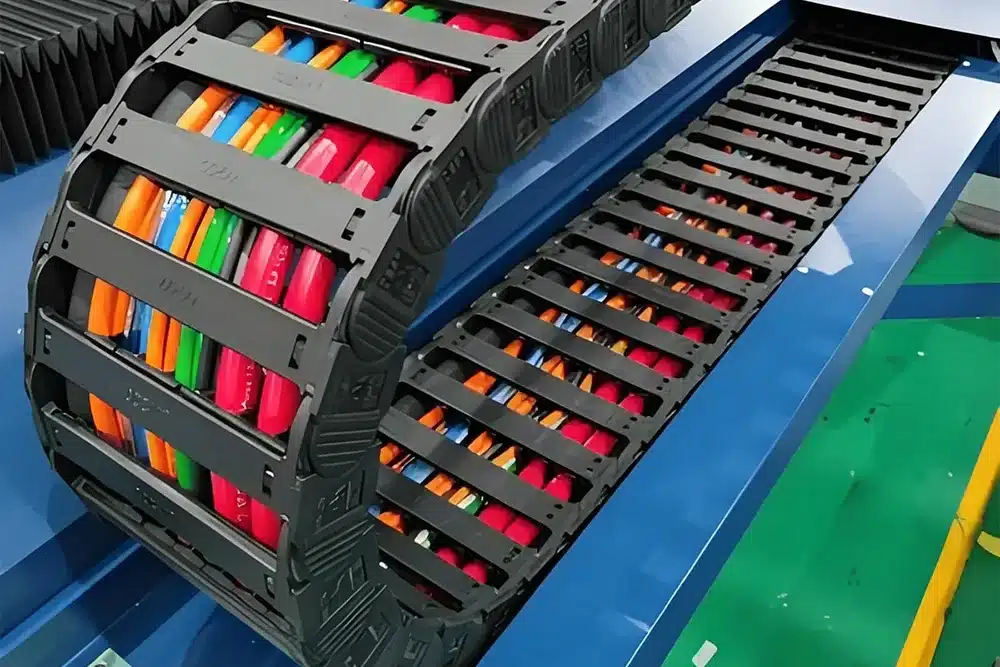
Separate the network into static and dynamic areas. Standard industrial-grade cables are compatible with cabinet-to-cabinet backbones and the in-cabinet patching of these cables. Machine-level drops to sensors and actuators need better environmental protection; see our guide to sensor and actuator cabling strategies for modern fieldbus and industrial Ethernet systems. To endure millions of cyclic operations without signal degradation, drag-chain and robotic parts require continuous-flex and/or torsion-rated builds.
Protocol Basics That Influence Cable Design
PROFINET and EtherCAT are based on Ethernet physical layers, which are usually connected using 100 Ω impedance, controlled pair geometry and shielding in 100 Mbps and above. Specific twisted-pair impedances (typically 120Ω with CAN-related fieldbus) are used for CANopen, DeviceNet, Profibus and other fieldbus types, and power and data can be carried on the same twisted pair. Once you know these baseline parameters, you will be able to maintain the signal quality of your custom design even when flex or harsh conditions are applied for customization when implementing protocol compliance.

Electrical Parameters for Industrial Ethernet and Fieldbus Cables
Stable communication is based on correct electrical properties.
Impedance, Pair Twist and Category Requirements (Ethernet-Based Systems)
The behavior of PROFINET and EtherCAT is usually CAT5e or higher, and 100 Ω ±15% characteristic impedance. Minimizing reflections and crosstalk by precision pair twist and geometry. If the parameters are customized for motion, make sure they remain as when stranding and insulating is performed and there will be intermittent faults that can only be determined after a lot of trial and error.
Bus Parameters for CANopen, DeviceNet, Profibus and Others
The balanced twisted pairs need to have consistent 120 Ω impedance in CAN based networks. Thick or Thin Trunk Cables are commonly used with DeviceNet, which carry the data and 24V power. Custom versions need to abide by these as well as provide flex friendly stranding and strong jacketing.
Shielding for Network Stability and EMC Compliance
Overall foil + braid (SF/UTP) or pair shielding provides the EMI immunity required near variable frequency drives. Learn when to use braided, foil, or hybrid shielding, because hybrid shielding can outperform a simple shield in noisy plants when combined with good grounding techniques.
Mechanical and Environmental Requirements – Where Custom Cables Stand Out
Catalog cables tend to fail here and custom designs are a good way to add value.
Continuous Flex and Drag Chain Requirements for Network Cables
Fine-stranded conductors, flex optimised insulation, small bend radius and PUR or TPE jacket are all required for drag-chain cables. Search for ratings that go for several million cycles. For fixed runs, static cables are adequate, but for motion runs, continuous-flex cable selection for high-cycle motion is required to eliminate conductor fatigue and impedance drift.
Torsion-Rated Cables for Robots and Multi-Axis Systems
In addition to bending, a robotic arm also adds twisting. Torsion-rated data and control cables are constructed with a special pair lay and shielding that will not be broken by repeated ± rotations or cause loss of signal. Purchasing custom designs here helps to avoid premature failures in 6 axis or SCARA applications.
Temperature, Oil, Chemicals and Washdown
PUR jackets are resistant to most cutting oils and coolants used in machine tools. Certain halogen free or high-temperature compounds might be necessary for food-grade/washdown lines. Follow the principles for choosing custom cable jackets and insulation for harsh industrial environments to match jacket and insulation materials to the actual process environment for long service life.

Shielding, Grounding and Routing for Ethernet and Fieldbus Cables
There is no such thing as a good cable without proper installation.
Choosing Shield Type for Different Network Segments
UTP can be used in short, static runs in clean cabinets, but most industrial segments will benefit from shielded designs.
Consistent Shield Termination and Connector Selection
Shield termination at RJ45, M12 or fieldbus using 360° shield termination. Try to not have pigtails that radiate as antennas. Choose connectors with appropriate ratings for your flex and environment.
Routing Rules to Avoid Noise Problems
Keep power and motor leads away from the routes of network cables, maintain separation between power, motor and network cables, and use a dedicated tray for network cables. Many intermittent communications problems reported after installation can be avoided through proper routing and drag-chain cable installation best practices.

Specification Steps – Translating Requirements into a Custom Cable Design
To create a clear RFQ for your manufacturer, follow these steps:
Define Segment Function and Protocol Parameters
For each segment, record protocol, data rate, max length, topology and connected devices. This establishes basic level of electricity.
Document Motion and Environment for Each Segment
Document static/flex/torsion classification, cycle counts, bend radius, temperature range, chemicals and space requirements. These are responsible for mechanical building.
Choose Core Layout, Shielding, and Materials
Compile the information into specific decisions: pair count and twist, shielding structure, conductor size, insulation, jacket compound and colour coding. Hulk’s custom cable design services can help translate these requirements into a manufacturable construction.
Compliance, Testing and Documentation for Custom Network Cables
Protocol and Standard Compliance (PROFINET, EtherCAT, CANopen, etc.)
Ask for documentation of the design that complies with applicable protocol, even if the design is customized.
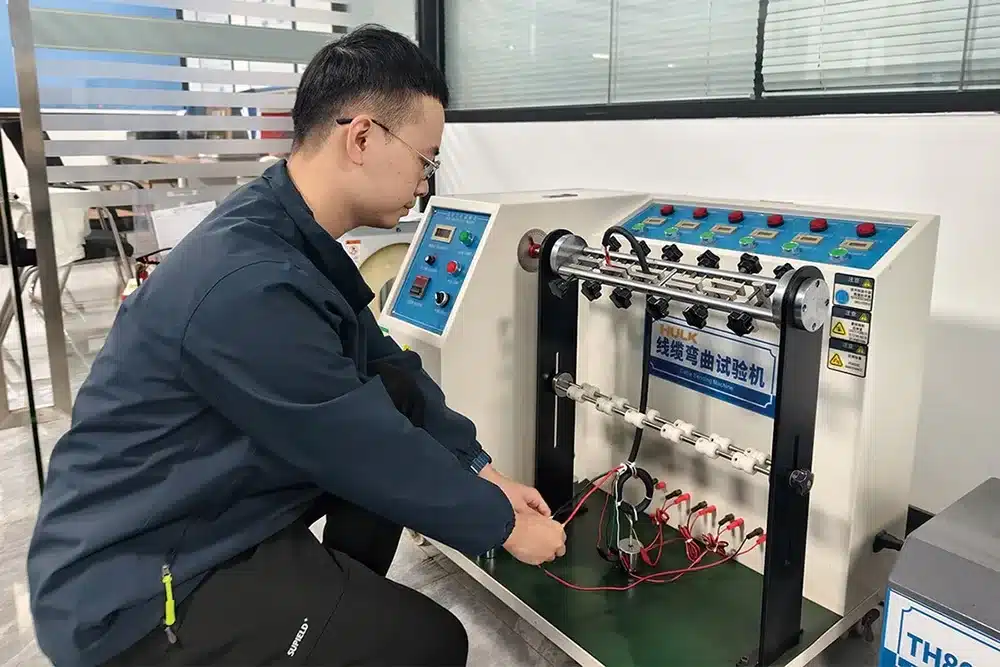
Performance Testing – Electrical and Mechanical
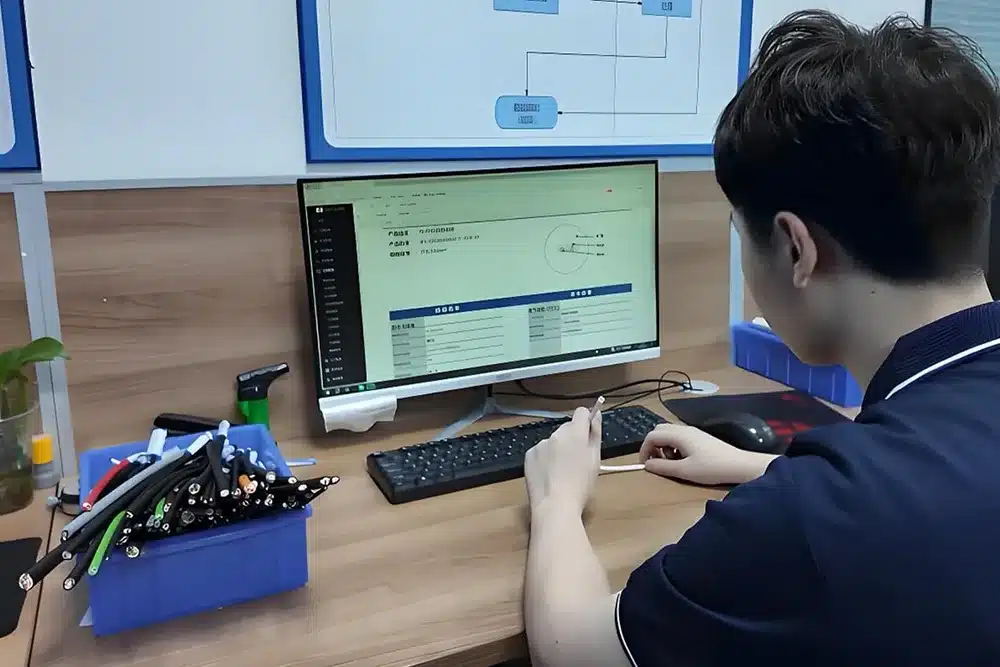
Ensure through supplier test reports and prototype testing for custom cable projects that correct impedance, attenuation, shielding, flex/torsion life are met.
Marking, Documentation and Traceability
Maintenance and future replacement is facilitated by clear markings, full datasheets and batch traceability.
Practical Checklist for Specifying Custom Industrial Ethernet and Fieldbus Cables
Key Questions to Answer for Each Network Segment
- What protocol and electrical parameters (impedance, category, pairs) does the cable have to comply with?
- Static vs continuous flex, or torsion? What is the bend radius and what are the anticipated number of cycles?
- Is it temperature, oils, chemicals, washdown or UV exposure?
- Protection for the noise source that is close by?
- Certifications or compliance requirements required?
What to Ask Your Custom Cable Manufacturer
- Any experience with moving the target protocol?
- Is flex/torsion test data available?
- How to keep impedance and shielding in custom designs?
- What materials are available for my particular setting?
- Availability of samples and documentation of full?
When it comes to industrial Ethernet and fieldbus systems, custom cables ultimately require matching electrical protocol demands with the real world of mechanical and environmental stresses. Proper upfront specification results in fewer network faults, a smoother commissioning process and reduced cost of long-term maintenance.
At Hulk Electric, we provide industrial Ethernet and fieldbus cable solutions for servo, robot, sensor and industrial Ethernet networks, with custom designs for PROFINET, EtherCAT, CANopen and other networks. Tell us about your segment, motion requirements and environment, and we will develop cables designed for dependable performance in your machines.