The cabling solution for sensor and actuator connectivity in modern fieldbus and Industrial Ethernet systems is a fundamental part of industrial automation and has a major impact on the reliability, downtime and scalability of the system. The solution for connecting proximity sensors, valves, drives or robotic arms to the network level, amid mechanical stress, EMI and harsh environments.
With more than 20 years of experience in high flexible cables, sensor & actuator cables, robot torsion cables and Industrial Ethernet solutions, at Hulk Electric we are helping engineers to transition from hard-wired I/O to efficient networked architectures. This guide presents practical solutions based on real-world experience in robotics, machine tools and material handling.
From Hard-Wired I/O to Networked Systems – What Changes for Cabling?
In the past the control systems used individual conductors to connect each sensor/actuator back to the PLC I/O cards. This simplifies the cabling but leads to very thick cables, long installation times and reduced diagnostics.
Networked systems with fieldbus and Industrial Ethernet mark the game-changer, sharing the same communication on fewer, smarter cables. Even though the device-level sensor/actuator cables are still important, they feed into local I/O modules for further communication to the top using either bus or Ethernet protocols.
Hard-Wired Panels – Many Wires, Simple Technology
Traditional installations call for a pair of wires for each signal, resulting in bulky multi-conductor cables and busy signal panels. This approach is consistent with simple machines but can be difficult to use for expansion and troubleshooting in more complex lines.
Fieldbus and Industrial Ethernet – Shared Cables and Smart Devices
Fieldbus protocols (like AS-i, PROFIBUS, DeviceNet, CANopen) and Industrial Ethernet (PROFINET, EtherNet/IP, EtherCAT) allow several devices to communicate through a single cable. Distributed I/O blocks are connected with local sensors/actuators through dedicated sensor/actuator cables, and are further connected to the main network.
Device-Level Cabling – Sensor and Actuator Cables Feeding Fieldbus/Ethernet IO
The backbone of a solid network is strong device-to-device connections. Hulk’s sensor & actuator cables are designed to withstand these extreme connections.
Sensor/Actuator Cable Families
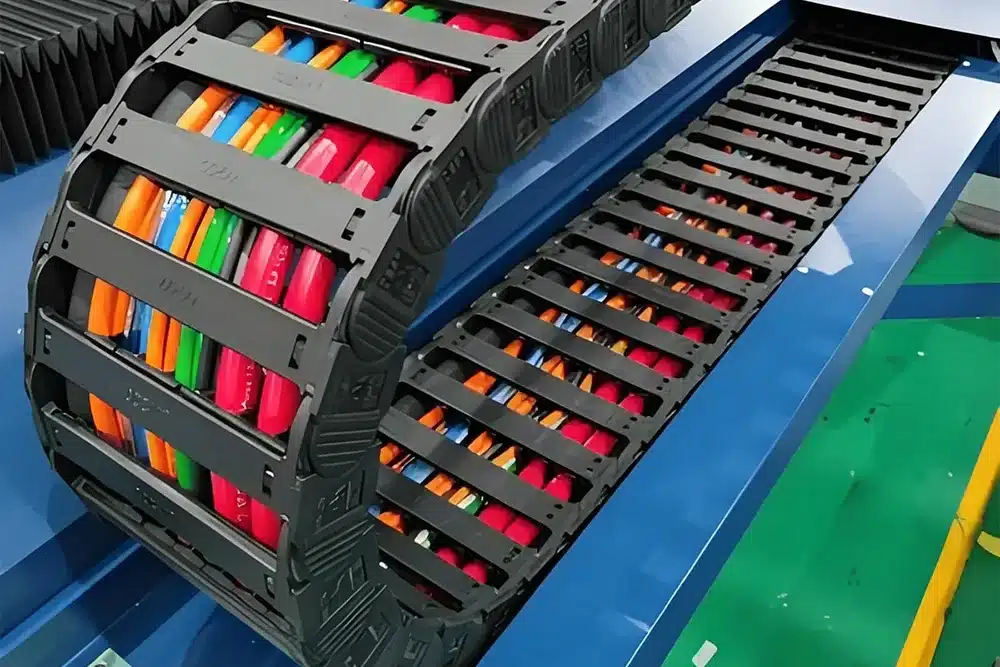
Select cables that are oil resistant, PUR or TPE; PVC for inexpensive stationary applications; and shielded cable to be used near drives. Quick installation and IP67 protection with M8/M12 connectors. Designs with a high degree of flex are very good in applications with millions of cycles, such as moving.High-flex designs from hulk are very good in moving applications with millions of cycles.
IO Blocks and Field Distributors
Devices are connected to local I/O modules or field distributors which are installed close to the devices with multiple sensor/actuator cables through M12 ports and then connected back to a single fieldbus or Ethernet trunk. This reduces long cables that can promote long home-runs.
Strategy: Keep Device Wiring Local, Network the IO
Connect short, good quality sensor/actuator wiring to local I/O locations and then connect with fieldbus or Industrial Ethernet to the backbone. This minimizes cabling size, enhances EMI performance and makes maintenance easier.

Fieldbus Cabling for Sensor and Actuator Networks
The fieldbus is still widely used for device networking at reduced costs.
Common Fieldbus Media and Topologies
Twisted-pair cables can be used in a bus, daisy chain or tree topology. For noise immunity, you need the proper termination and shielding.
AS-i – Actuator Sensor Interface as Low-Level Bus
AS-i is a simple, 2-core flat cable for power and data that is suitable for up to 100m dense sensor and actuator clusters.
DeviceNet/CANopen/PROFIBUS in Mixed IO Systems
These protocols are frequently used in conjunction with sensor/actuator cables to remote I/O, using trunk/drop layouts for efficient distribution.
Industrial Ethernet Cabling – PROFINET, EtherNet/IP and EtherCAT
Industrial Ethernet becomes the solution for more plants to support higher bandwith and integration.
Cable Types and Connectors
The CAT5e, CAT5e Shielded, CAT6e (CAT6), CAT6A Shielded, CAT7A (CAT7), and CAT7A Shielded Industrial Ethernet cables from Hulk feature M12 D-coded or X-coded connectors and are shielded for factory applications.
Topologies and Device Cabling
IO devices, drives and controllers are connected using line, ring and star topologies. There are many smart devices that have Ethernet and M12 sensor ports.
Shielding, Grounding and Ruggedization
In noisy environments such as those with motors and VFDs, shielding, grounding, and rugged jackets eliminate EMI problems.

Choosing Cabling Strategies by Layer and Protocol
Proceed from device up to the environment, aligning cable families to the environment.
Sensor/Actuator Layer – Local Device Wiring First
Choose the flex life, oil resistance and EMI requirements for Hulk’s flexible sensor/actuator cables. Minimize long runs to local I/O.
Fieldbus Layer – Trunk Cables and Distributed IO
Use high quality sensor cables at edge while designing robust trunk line for AS-i, PROFIBUS, etc.
Industrial Ethernet Layer – Backbone and High-Bandwidth Devices
Use HULK’s Industrial Ethernet cables as the backbone high-speed cabling system and link to fieldbus systems as required using gateways.
Integrating IO-Link and Low-Level Buses with Fieldbus/Ethernet
IO-Link is based on simple M12 cables that carry the data from smart sensors up to fieldbus or Ethernet, via masters.
Actuator/sensor clusters will utilize a high-level network layer over AS-i as an efficient low-level layer.
EMI, Shielding and Cable Selection Across Layers
Always use shielded sensor/actuator cables in the vicinity of drives. Proper routing and shielding on all layers provides signal integrity.
Hulk’s washdown-resistant, halogen-free and high-flex cables can meet these requirements.
Practical Cabling Strategies for Common Scenarios
Sensor arrays on packaging lines: Local IO blocks with short sensor cables plus AS-i or IO-Link, supported by a PROFINET trunk.
Motion systems and robots: Connect cables and motors shielded with EtherCAT or PROFINET, with the high-flex designs of Hulk. s.
Brownfield migrations: Add new Industrial Ethernet to existing fieldbus, with clear documentation of the sensor wiring.
Checklist – Designing Sensor and Actuator Cabling for Networked Systems
- Determine protocols and layers for new cable
- Choose the right sensor/actuator, fieldbus and Ethernet cable families
- Make sure the shield is appropriate for the environment and screening, the IP ratings are appropriate, and the flex life is appropriate.
- Design for expansion by using Modular I/O and labeled connections.
- Record all layers, for quick maintenance and future changes.
The proper selection of sensor and actuator cabling techniques provides cleaner installations as well as diagnostics and long-term reliability. Whether you’re working on the most intensive automation project, whether it’s a robot cable or a sensor/actuator cable, whether the fieldbus you’re using is an Ethernet or servo fieldbus, whatever — Hulk Electric’s complete line of cables is customizable and certified worldwide for your most challenging automation scenarios.
Send us your sample information and we’ll give you specific suggestions and more timely sampling.