al degradation, which is in contrast to traditional flexible cables used for static or occasional bending applications.
Such cables are essential in high-motion settings such as CNC machines, robotic systems and automated material handling lines to avoid any unexpected failures that can result in expensive downtime. As a provider of high flex cables to automation customers all over the world, Hulk Electric has been first-hand witness to the increased service life, reduced machine maintenance and increased machine reliability of the right drag chain cable.
What Is a Drag Chain Cable? Core Definition and How It Works
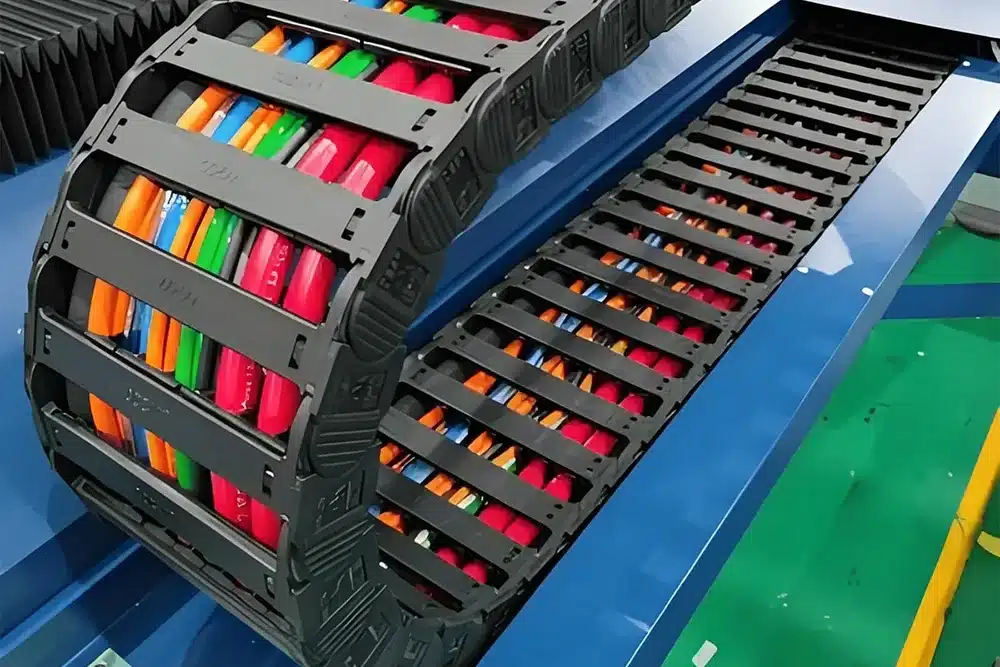
Drag chain cables also known as cable carrier cables, energy chain cables, and continuous flex cables are generally employed in protective drag chains. During repetitive linear or multi-axis motion, these chains route and protect the cables, allowing for organized routing, and reduce cable abrasion, tangling and mechanical stress.
The cable is bent in accordance with the machine axis motion and the chain movement, the bending cycles which are predictable, will be high at constant radius. As a repetitive motion, this type of fatigue is cumulative and conventional control or power cables can’t withstand it over time. The appropriate designed drag chain cables are designed to avoid the occurrence of stress concentration, to keep the electrical integrity and to avoid the influence of the environment in the factories.
Drag Chain Cable vs Standard Flexible Cable in Static Installations

The standard flexible cables that are twisted and simpler are typically employed for occasional moving or fixed routing. While they can be used in a short drag chain, they can eventually cause problems such as corkscrewing, cracks in the insulation or broken strands from uneven stress distribution.
Drag chain cables, on the other hand, employ the use of additional fine copper strands (usually Class 6), core design, fillers, and pressure extruded jackets. This construction eliminates the flattening, twisting and internal abrasion, and offers millions of cycles of reliable performance compared to the weeks/months of service life that are common with generic flexible cables.
Key Construction Features That Make a Cable “Continuous-Flex”
Strategic decisions made during the design of the cable produce a performance that is truly continuous-flex. Each of these are the most likely failure modes of motion applications.
Conductor Stranding, Core Lay-Up and Fillers
Very fine, highly-stranded copper conductors are used in drag chain cables to provide the maximum flexibility and minimum fatigue. The core lay-up (which may be layers or bundles on a core material) spreads the bending forces evenly through the cross section of the cable. A textile wrap or separator is used to keep the wire round and to prevent movement of the wire against each other and to prevent wire wearing over millions of cycles.
These features make for impedance stability of data or fieldbus pairs while helping to reduce the likelihood of “corkscrewing,” which can jam the carrier.
Jacket Compounds, Abrasion and Oil Resistance
The outer jacket is also of paramount importance. Typicals are PVC for general use, PUR (polyurethane) for abrasion and oil resistance or TPE for flexibility and durability in difficult conditions. Jackets should not crack or swell from coolants, chips, welding spatter or repeated mechanical contact.
Choosing the correct compound is directly related to long life in an oily machine tool bed, dusty conveyor or washdown area in food processing.
Relevant Standards, Testing Methods and Flex Life Ratings
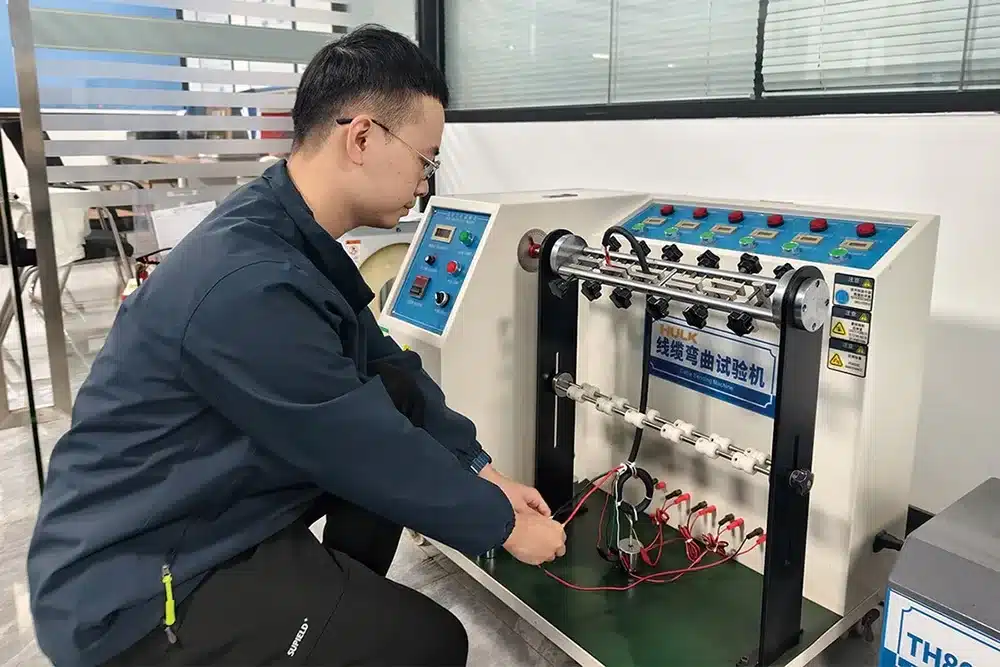
A reputable manufacturer will validate drag chain cables with in-depth testing, not theoretical ratings. Tests are conducted on double-loop or linear test rigs that mimic the travel distance, bend radius, speed and acceleration under which the product operates in the field.
The typical benchmarks used are: several million cycles, 20 million cycles, or more depending on the specific design. Compliance with electrical safety, flame retardant and mechanical durability standards including IEC/EN guidelines and manufacturer’s guidelines.
Understanding Flex Life Data and Test Conditions
Take into account the following when making flex life claims: The product that is rated for 10 million cycles at a large bend radius and moderate flex speed may not perform as expected at small bend radius and high flex speed. When selecting the cable for your specific use, be sure to check the datasheet for the same tests (e.g. travel length, bend radius, velocity, environmental conditions etc.).
Extensive and thorough endurance tests are carried out on our own test center at Hulk to ensure that cables work as published and under real world conditions, both in double loops and electrically.
Typical Applications for Drag Chain Cables in Industrial Automation
In any place linear or predictable motion requires reliable power, control or data transmission without periodic maintenance, Drag chain cables are required.
CNC Machines, Gantry Axes and Machine Tools

Dragging chain cables for moving on X, Y and Z axes for CNC, Laser, plasma and milling machines. The long distance between the spindle component and the electrical control panel, the high acceleration rate of the spindles and the need for oil resistance and high flexibility require oil-resistant high-flex cable to be used to power the spindles, drive servo motors and feed the information from encoders.
Robots, Pick-and-Place Systems and Material Handling
Drag chain cables are indispensable for linear sections which are utilized in 6 axis robots, SCARA, palletizers, AGVs and conveyor lines. The rotating joints cables are called torsion rated, while the linear run cables to the end effector are called continuous-flex. The right selection in this case prevents any signal or power loss to stop production.
Other widespread applications include automated warehousing, packaging machines and vision systems where the performance of the cable is directly related to throughput.
Common Failure Modes When Using the Wrong Cable in a Drag Chain
Standard cables are often used in drag operations and can cause:
- Occasional signals or loss of power from conductor strand breakage at stress concentration areas.
- Damage caused by multiple contact with chain links or debris, jacket cracking.
- Damage to the shield which affects EMC and data transmission being noisy.
- Twisting or corkscrewing of the cable that may lead to mechanical wear and also jam the carrier.
- Radioactive loss of encoder signal on CNC axes causing parts to be scrapped and unexpected stops.
The issues can quickly turn into more parts held, service calls and missed downtime.
How Proper Drag Chain Cables Reduce Downtime and Maintenance Cost
Investing right from the beginning in appropriate continuous flex cables pays off for the business. Downtime of machines is reduced, maintenance is predictable and overall equipment effectiveness (OEE) is improved. Design engineers at OEMs and system integrators will not need to face an expensive retrofit later on if they choose drag chain-rated cables.
Practical Selection Checklist: When Do You Need a Drag Chain Cable?
If you are thinking about providing a cable system for your motion system, use this cable system checklist:
- Is activity recurrent/repetitive or continuous instead of occasional?
- How many meters is the minimum bend radius and how many meters is the total travel length?
- Will the cable be in a cable carrier or energy chain?
- Is there a presence of oil, coolants, chips, dust, and/or washdown chemicals in the environment?
- Is it a specific certification or approval (UL, CE, TÜV etc. needed)?
- What is the expected life of the cable and will the cable flex rating withstand the actual use?
- Are you in need of power, control, Ethernet, field bus or hybrids?
This information in the early stages will help the manufacturer like Hulk to determine the most suitable cable construction, jacket material and shielding required for your needs.
From servo, motor, robot, sensor and industrial Ethernet drag chain cables to complete customization services, all of Hulk Electric’s products and solutions are built to meet the challenges of the most demanding automation applications. Providing clients with consistent quality and timely delivery of products to 30+ countries made possible by our cutting-edge testing and lean manufacturing.
Want to create or maintain motion systems – and stop cables from breaking down? Let our team know about your project and come up with a plan. We’ll help you decide or find the right drag chain cable to be long lasting.