In the modern world of robotics and automation, the connection between the drives, motors, and encoders is provided by servo power and feedback cables. Servo power cables carry the high-frequency electrical power necessary for the motor to move and feedback cables return accurate position, speed and status information to the controller for closed-loop accuracy. The wrong cables can cause overheating, signal corruption, EMC problems, early wear in drag chains or torsional fatigue on robot arms, all of which can result in unplanned downtime and impact the reliability of the system.
For more than 15 years, at Hulk Electric, we have been producing high quality industrial cables for worldwide automation leaders. This guide takes engineers and integrators through the practical considerations to specify servo power and feedback cables that meet electrical needs and mechanical constraints in fixed, drag-chain and robotic applications.
Understanding Servo Power and Feedback Cable Functions
Avoid mismatches (which cause field problems) by using clear terminology. Generic motor or signal cables are not typically used in a servo system due to the disparity between the electrical and mechanical stresses that occur in a typical application.
Servo Power Cables: Carrying High-Frequency Drive Output
Servo power cables are used between the servo drive (inverter) and the motor. They transmit power that is PWM modulated with steep voltage edges, high currents and high electromagnetic fields. Common uses include the larger conductor cross-sections for increased current capacity, extra conductors for motor brakes or as temperature sensors, and stronger insulation which will reliably withstand repeated flexing and voltage stress.
These cables need to dissipate heat, have low leakage currents and limit EMI to avoid interference with adjacent controls or feedback cables.
Feedback / Encoder Cables: Protecting Precise Low-Level Signals
Low-voltage differential signals from resolvers, incremental encoders, or digital systems (e.g., DRIVE-CLiQ or HIPERFACE) are sent back to the drive via feedback or encoder cables. These signals range in magnitude from millivolts to low volts, and are very sensitive to noise, impedance mismatching and mechanical damage. If the shields are not well designed or if there are gaps in the strands, errors in position, servo failures or unstable control loops quickly result.
For some applications hybrid cables with power and feedback in one jacket are available but separation for demanding applications may offer better noise immunity.
Key Electrical Selection Criteria for Servo Power Cables
Electrical performance is a direct impact on drive efficiency, motor torque accuracy and long term reliability.
Voltage Rating, Current Capacity and Temperature
Start with the drive and motor datasheets. The conductor cross-section should be selected according to the continuous and peak current, system voltage (usually 400-600V), and the conductor temperature rise under use. Consider environmental factors in cabinets or near motors, include safety margins for overloads, derating. Cables will also be required to deal with the extra heating as a result of high-frequency PWM switching.
Capacitance, Insulation System and EMC
Servo drives produce high voltage pulses that cause cables to act as capacitors. High capacitance leads to higher charging currents, can drive up operating temperatures, and puts strain on the drive. True servo power cables have low dielectric constant insulators (like special layers of PP or XLPE) to minimize the capacitance. Proper 360° termination at both ends, coupled with effective high coverage tinned copper braid shields, provide an effective EMC performance.
Key Electrical Selection Criteria for Feedback and Hybrid Cables
Feedback circuits require accuracy to keep the closed-loop system performing as required.
Impedance, Pair Construction and Shielding
The cable used with an encoder must have a controlled characteristic impedance and need to be twisted tightly to maintain signal integrity. Typical design is a set of shielded pairs and a general shield. Use only the recommended maximum Cable length provided by the Drive manufacturer and always use 360° low inductance connections to terminate the shields to avoid the entry of Common Mode noise.
Matching Cable Type to Feedback Protocol
When using a cable, make sure it is the correct cable for the type of encoder interface (analog versus high-speed digital or Ethernet). Refer to drive OEM compatibility lists, and consider the number of pairs, impedance, and shielding specifications for your protocol.
Mechanical and Environmental Requirements in Robotics and Automation
Electrical specifications are not sufficient. Cable survival is frequently determined by mechanical motion and plant conditions.
Motion Profile: Fixed, Drag Chain or Robotic Torsion
- Fixed installations focus on thermal and EMC performance.
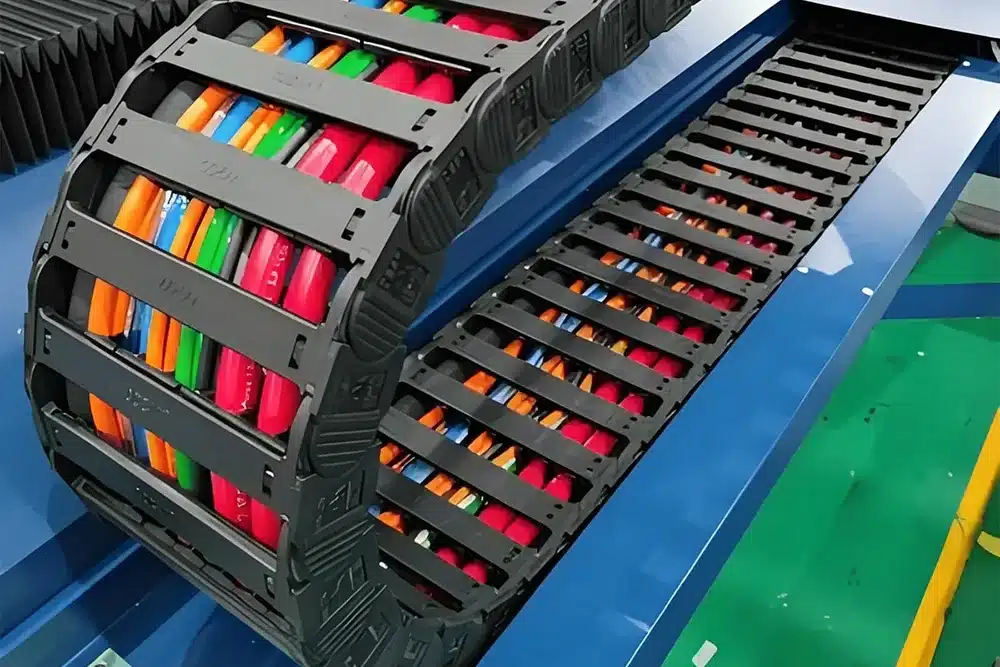
- High flex ratings, fine-stranded conductors, pressure-extruded jackets, and bend radii of 7.5-10 outer diameter are required for drag chain (continuous flex) applications.
- For Robotic torsion applications, twisting stresses are added to the stress. Cables here must have explicit torsion ratings (e.g. ±360° per meter) and be tough and compact enough to be used in robot dress packs
Environment: Oil, Coolant, Weld Spatter and Temperature
Use PUR or TPE jackets when exposure to cutting oils, coolants and abrasion occur, which is better than the standard PVC jacket. Check for UL and CE (and other relevant approving agencies). Hulk’s silicone competitors are available in high-temperature silicone, which will not soften in hot conditions.
Selecting Servo Power Cables for Drag Chains and Robots
The majority of cable failures are caused by dynamic applications with generic products.
Continuous-Flex Servo Cables in Drag Chains
Drag-chain servo power cables are designed to withstand millions of cycles, have low capacitance insulation and fine stranding, as well as optimized bend radius and a high coverage shield. Check Manufacturer flex-life data with travel distance, speed and acceleration profile.
Torsion-Rated Servo Cables on Robotic Axes

Complex, tight or confined spaces are achieved with robot arms that provide bending and torsion. Use cables that are specifically designed for torsional movement with adequate bend radius under tension/torsion, strong and flexible jackets, and small diameter. Typical drag-chain type cables tend to fail easily in this location because of twisting fatigue.
Selecting Feedback and Encoder Cables for Dynamic Motion
Feedback cables are required to withstand the same sorts of stresses and to safeguard sensitive signals.
Flex Ratings and Mechanical Design for Feedback Cables
Use feedback cables as “high-flex” or “torsion-rated” data cables. Just as with power cables, carefully consider flex-cycle ratings, bend radii and jacket durability. Periodic encoder failures and expensive downtime can result from a single broken strand or damaged shield.
EMC Practices: Routing, Separation and Grounding
Where possible, separate power and feedback cables. When they have to cross, cross at right angles. Use appropriate EMC clamps for shield termination and follow the manufacturer’s grounding instructions. Often, good physical routing can prevent problems, just as much as good cable construction.
Practical Sourcing Checklist for Servo Power and Feedback Cables
Structured approach eliminates specification gaps.
Information to Gather Before Contacting Suppliers
- The voltage, continuous/current, and peak current values on the motor or drive nameplates
- The feedback protocol and cable length.Feedback protocol and cable length.
- Motion type and parameters (travel, cycles, speed, acceleration, torsion angles)
- Exposures in the environment (oils, chemicals, temperature, abrasion)
- Certifications required and expected life of service.
Questions to Ask Servo Cable Vendors
- The following are questions to ask your servo cable suppliers:
- Specifically what are the flex or torsion ratings, and tested bend radii?
- What type of insulation system is used and what is the typical capacitance?
- What is shielding and how is it made, how much coverage does it provide?
- Will the cable work with our drive/encoder setup?
Is there a ready – made set of cables available which has been pre-assembled and tested?
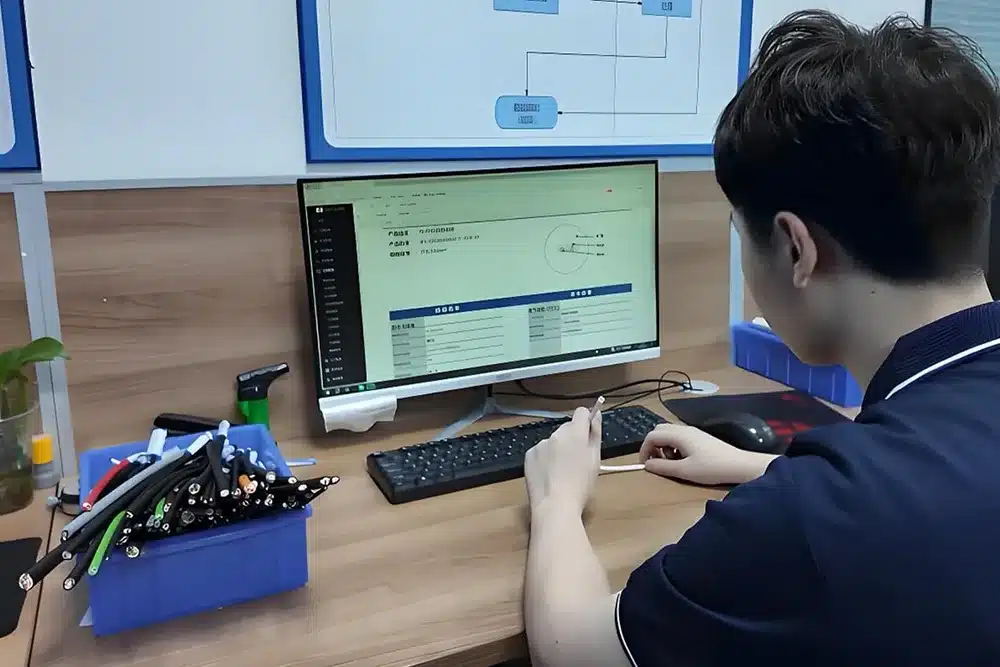
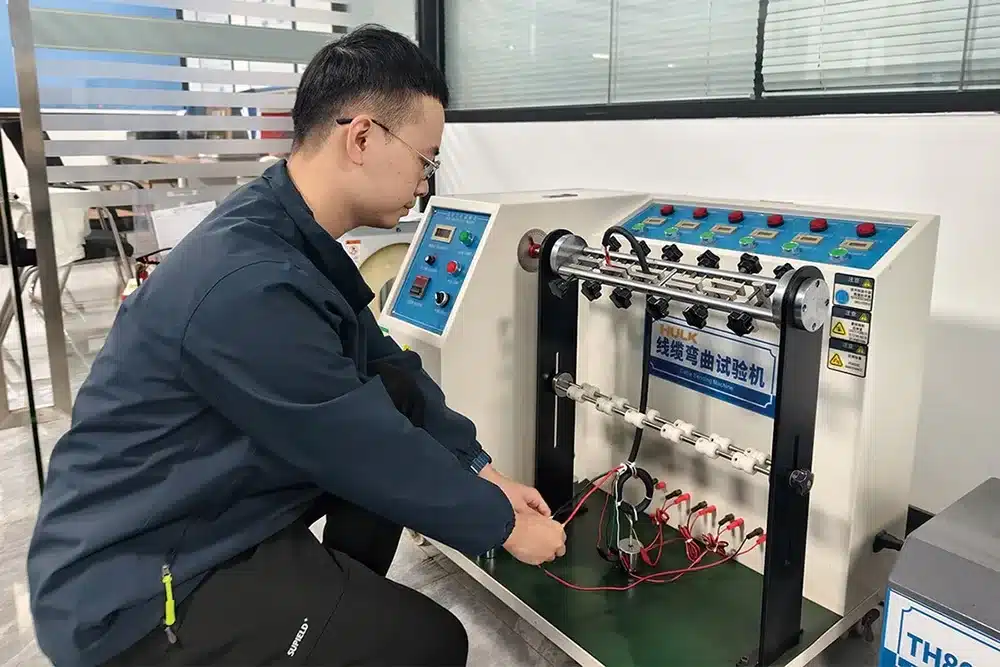
We have our own flex life, electrical and environmental resistance test facilities at Hulk Electric. We evaluate your electrical requirements as well as mechanical requirements to pinpoint the proper servo power and feedback cabling for your requirements—standard catalog or fully custom designs.
When selecting the right servo power and feedback cables, it’s important to consider electrical performance, mechanical strength, and environmental protection. Engineers can design automation systems to be reliable for years to come by systematically considering voltage, current, capacitance, shielding, flex ratings, torsion and routing.
Approach us with your new robotics project, upgrade to the drag chain, or any existing system with cable problems, and let us know your drive model, motion profile and environmental information. Our engineering team will define durable and high-performance solutions that meet your exact requirements.