When OEMs and system integrators specify LSZH cable, the requirement often appears as a single line: “use low smoke zero halogen cable.” Working with OEMs and system integrators on LSZH cable specifications regularly shows that this short instruction leaves standards, environments, mechanical limits, and documentation undefined. Manufacturers then fill the blanks with assumptions, which can produce mismatched quotes, delayed approvals, or installations that fail audit.
This guide examines the most common gaps that appear in those specifications and shows how engineering teams and cable suppliers can close them together. The aim is practical: clearer, testable requirements that protect people, satisfy auditors, and keep projects moving.
Why LSZH Cable Specifications Are More Complex Than They Look
LSZH is not a simple product label. It describes a set of material and fire-performance behaviours—limited smoke, near-zero halogen acid gas, and controlled flame propagation—that must be proven by defined tests. Many project documents treat the term as self-explanatory. In reality, the performance level required depends on the standards chosen, the location of the cable, and the mechanical demands of the installation.
LSZH as a Safety Specification, Not a Performance Grade
LSZH refers to the jacket and insulation compounds that reduce smoke density and eliminate halogen gases when exposed to fire. It says nothing about voltage rating, bandwidth, or flex life. Spec writers choose LSZH to protect people and equipment during a fire event, especially in enclosed spaces, tunnels, risers, or high-occupancy areas. Treating it as a vague “better cable” tag instead of a safety requirement with measurable tests is the first source of later confusion.
Multiple Standards Behind a Single “LSZH” Line Item
The core international tests are IEC 60754 (halogen acid gas), IEC 61034 (smoke density), and IEC 60332 (flame propagation). Regional frameworks add further layers: CPR Euroclasses in Europe and UL 1685 smoke tests in North America. When a specification simply says “LSZH cable” without naming the tests or the required class, the manufacturer cannot know whether a basic industrial grade or a full building-grade construction is needed. A building project that calls for LSZH yet omits the CPR class is a typical example of this ambiguity.
Common Specification Gaps When OEMs and System Integrators Call for LSZH Cables
These gaps appear repeatedly in RFQs, general specifications, and cable schedules. Each one creates risk or inefficiency.
“Use LSZH Cable” with No Standards or Test References
Many documents stop at the phrase “low smoke zero halogen cable.” No IEC 60754-2, no IEC 61034-2, no flame-test category, and no CPR or UL class. The manufacturer must guess the required fire behaviour. The result can be under-specified cable that fails an audit or over-specified cable that inflates cost. In one recent industrial project the OEM assumed full building-grade LSZH while the RFQ language allowed a lighter industrial grade; the mismatch only surfaced during submittal review.
No Clear Definition of Application and Environment
Specs often omit whether the cable carries power, control, data, or fieldbus signals, and whether it runs in tunnels, risers, cable trays, control cabinets, or open plant areas. Confined public spaces and ventilated technical rooms impose different smoke and toxicity limits. Without that context, the manufacturer may recommend a heavy LSZH construction where a simpler halogen-free compound would suffice, or miss the need for LSZH entirely on a high-risk escape route.
Ignoring Mechanical Requirements and Installation Constraints
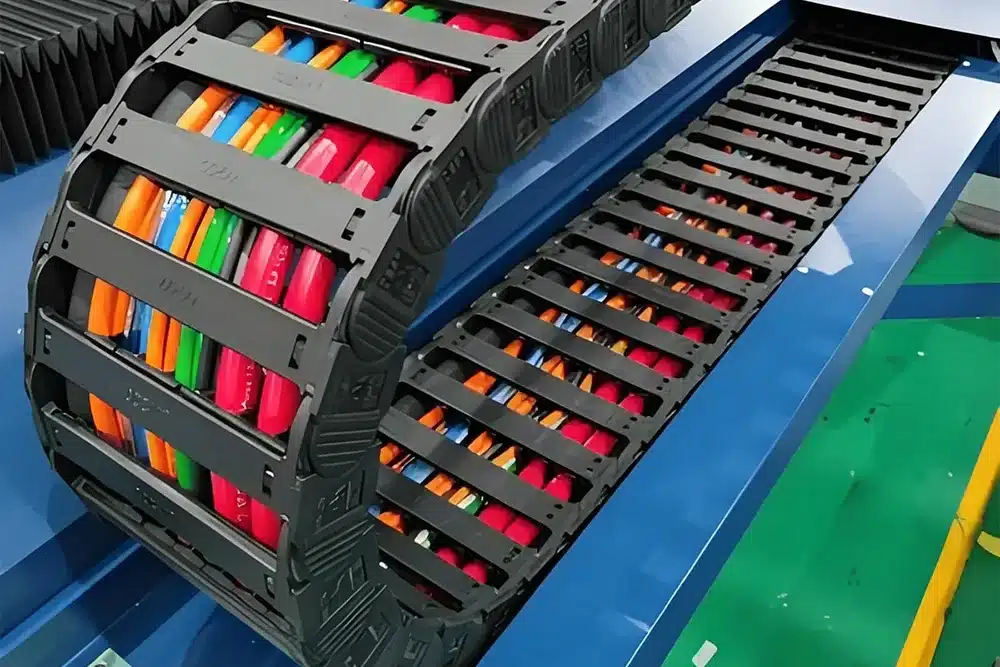
LSZH compounds are frequently stiffer than PVC. Specs that call for LSZH in drag chains, continuous-flex applications, or tight duct runs without stating minimum bend radius, torsion limits, temperature range, or flex life leave the door open to cracking or premature failure. A common example is an LSZH requirement for a multi-axis robot carrier with no mention of the required cycle life or bend radius.
Missing Compliance and Documentation Requirements
Some RFQs demand LSZH yet never request test reports, certificates, Declarations of Performance (for CPR), or material declarations. A datasheet claim is not evidence. Without explicit documentation requirements, lower-grade products can enter the supply chain unnoticed until an auditor asks for proof.
What a Complete LSZH Cable Specification Should Include
A clear specification removes guesswork and gives the manufacturer everything needed to design, quote, and certify correctly.
Safety and Standards Block – Tests, Classes, Jurisdictions
List the exact tests and classes required: IEC 60754-2, IEC 61034-2, IEC 60332-1 or -3, the applicable CPR Euroclass, or the relevant UL smoke test. Include the project or building-code section that drives the requirement. This single block tells the manufacturer the precise fire-performance target.
Application and Environment Description
Name the function (power, control, Ethernet, sensor, fieldbus) and the physical environment (riser, tunnel, data hall, control room, cable tray, outdoor tray) for each cable type. With that information the designer can select the correct voltage rating, shielding, and jacket construction while still meeting the LSZH safety targets.
Mechanical and Installation Parameters
State flexing or drag-chain requirements, torsion limits, minimum bend radius, installation method (tray, conduit, buried), operating temperature range, and any exposure to UV or chemicals. These details prevent the selection of an LSZH construction that cannot survive the actual installation stresses.
Documentation, Marking and Acceptance Criteria
Require permanent jacket marking that includes “LSZH” and the relevant standard codes. Make test reports, certificates, and material declarations part of the vendor deliverables. Define acceptance criteria so the integrator can verify compliance before the cable is installed.

How Cable Manufacturers Help OEMs and System Integrators Close LSZH Specification Gaps
Manufacturers who work regularly with OEMs and integrators can turn incomplete language into robust, testable designs.
Translating Project Requirements into Cable Designs
Given the safety codes, environment description, and mechanical needs, a cable engineer can propose a concrete construction: conductor class, insulation system, shielding layers, overall LSZH jacket, and the matching certification package. For a transit project requiring LSZH power and control cables in tunnels, the mapping would combine the relevant IEC tests, CPR or local authority class, and the mechanical demands of the tunnel route into a specific cable design.
Proactively Flagging Ambiguous or Risky Spec Language
Rather than guessing, experienced manufacturers return clarification questions when they see phrases such as “low smoke cable” without test references. Raising those questions early shortens RFQ cycles, prevents non-compliant proposals, and builds trust between the parties.
Providing Samples, Test Data and Application Notes
Sample lengths, fire-test data packages, and short application notes on handling LSZH in drag chains, risers, or tunnels give OEMs and integrators the evidence they need before committing to volume. This practical support turns a paper specification into a validated design.

A Practical Collaboration Workflow for LSZH Cable Specification and Design
The following sequence turns the principles above into a repeatable process.
Step 1 – Map Safety-Critical Routes and Functions
Identify every cable route and circuit where LSZH is truly required: escape routes, tunnels, data halls, control rooms, and high-occupancy zones. This mapping prevents both over-use and under-use of LSZH compounds.
Step 2 – Agree on Standards and Performance Targets
OEM, integrator, and manufacturer jointly confirm the required IEC, UL, or CPR tests and any project-specific smoke or acid-gas limits. Document the agreed targets in the specification and the RFQ.
Step 3 – Define Mechanical and Installation Constraints
Share installation drawings, routing methods, temperature ranges, and motion requirements so the cable designer can select an LSZH construction that will survive the real environment.
Step 4 – Prototype, Test, and Lock in Final Specs
Install sample lengths in representative routes or cabinets. Check handling, bend radius, terminations, and performance under trial conditions. Use the results to finalise the cable schedule and update internal specification templates for future projects.
Summary Guidance – Writing LSZH Cable Specifications That OEMs, Integrators and Manufacturers Can Trust
The quality of an LSZH cable specification directly affects safety, compliance cost, and project schedule. The most frequent gaps—missing standards, undefined environments, overlooked mechanical limits, and absent documentation requirements—are avoidable. A complete specification names the tests and classes, describes the application and environment, states the mechanical constraints, and requires verifiable evidence of compliance.
Treating LSZH specification work as an engineering responsibility rather than a purchasing checkbox produces clearer RFQs, fewer revision cycles, and installations that pass audit the first time. At Hulk Electric we support OEMs and system integrators by reviewing incomplete language early, proposing concrete LSZH constructions, and supplying the test data and samples needed to lock in the final design. Clear collaboration at the specification stage remains the most reliable way to deliver cables that perform as intended when it matters most.