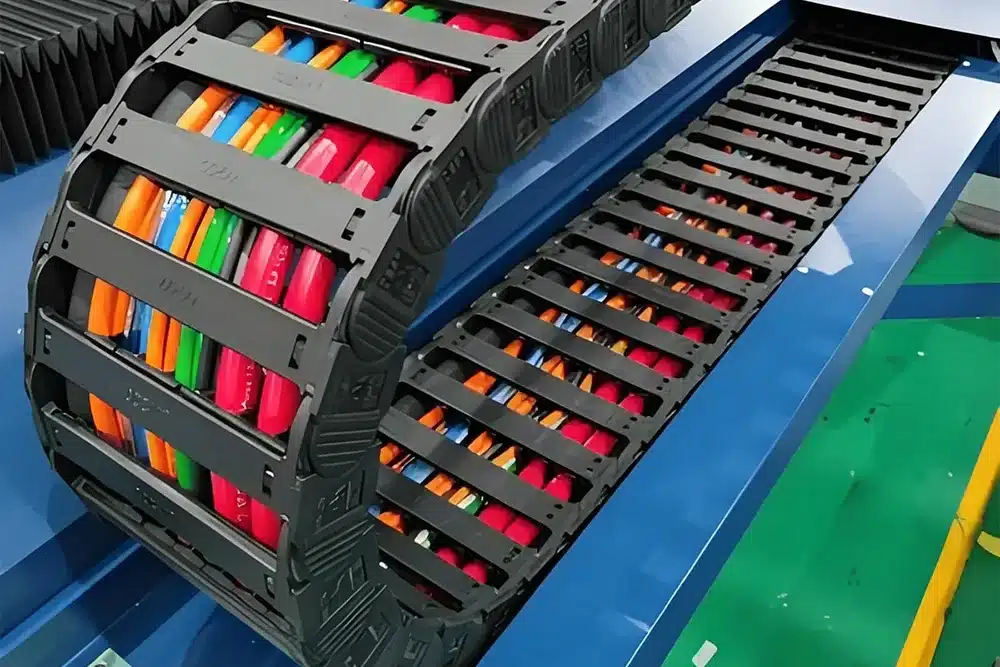
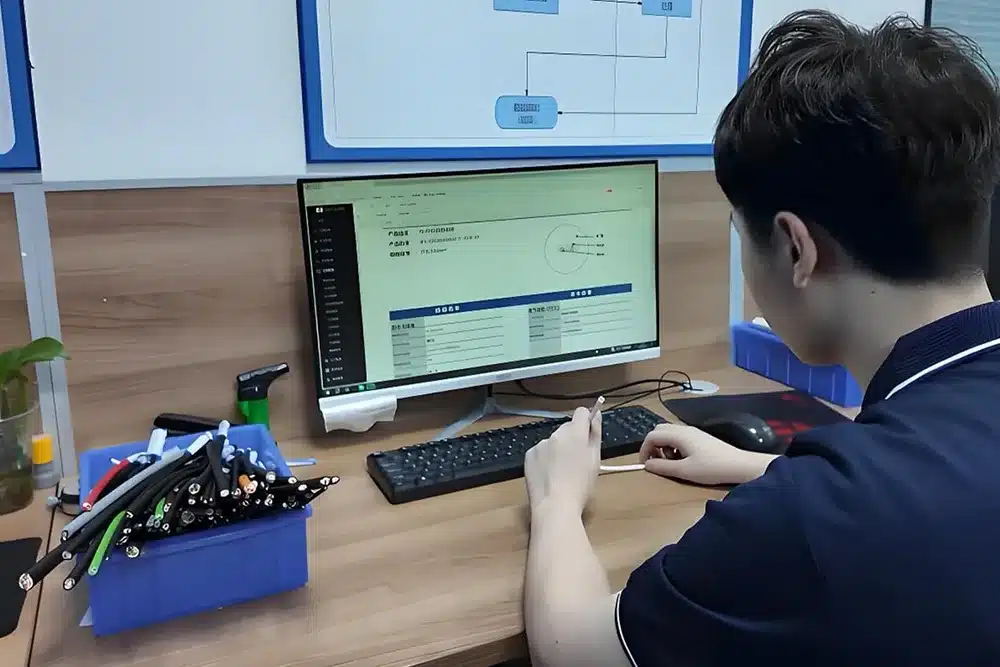
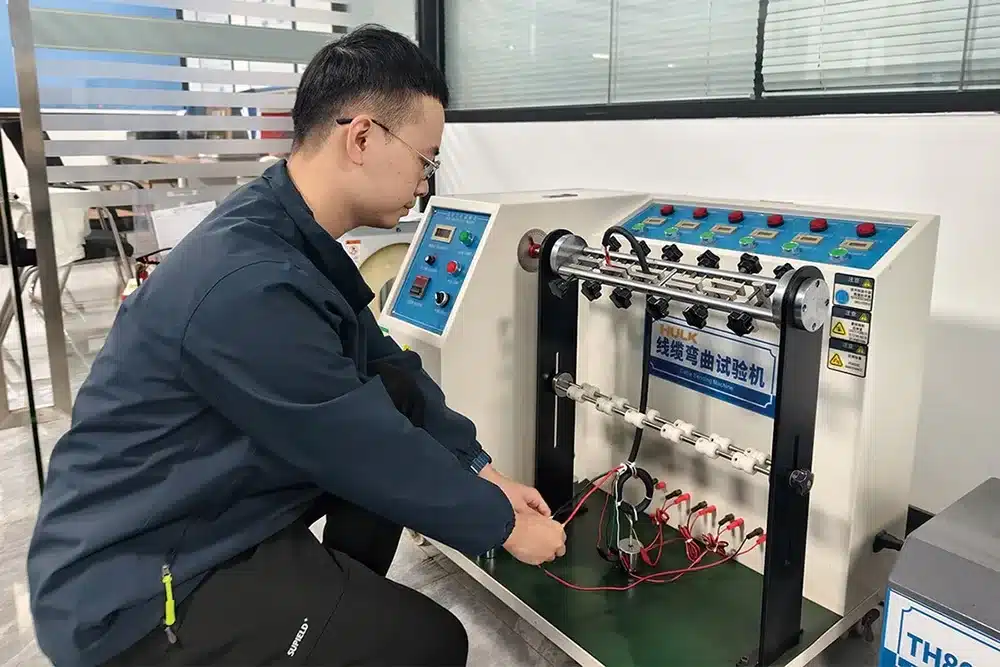
With sensors, cameras and actuators being added to the tiny spaces of end-of-arm tooling (EOAT), engineers frequently find they hit a wall: there isn’t enough space to route separate power, control and data cables through the narrow arm channels or wrist dress packs. Hybrid torsion cables get rid of this by incorporating both motor power cores, sensor/control pairs and high-speed data lines within a single torsion-rated jacket designed for 3D robotic motion.
Designed for robotics engineers, system integrators, and OEM designers, this guide provides insight into the use of hybrid torsion cables and helps them select the right cables for the job to ensure reliable operation in space-limited applications.
What Is a Hybrid Torsion Cable in Robotics?
Hybrid torsion cable is a more sophisticated variant of robot cabling which combines several signals and power types into a single compactized assembly, designed for continuous torsion and bending.
Combining Power, Control and Data in One Torsion-Rated Cable
Hybrid torsion cables are not the type of cables used in traditional applications;
- Actuator cores for power and/or motor applications
- The control and sensor pairs are for feedback and I/O signals.
- Data/bus elements like for example Ethernet, PROFINET or CANbus pairs
All in a single outer jacket with dedicated bending and twisting protection through a combination of stranding, protection and buffering for multi-axis robot arms.
Examples from Existing Hybrid Robot Cable Families
This architecture is well demonstrated by the real world products. An example of this is some hybrid cables with power and signal elements that achieve full EMC shielding and are capable of millions of torque cycles at angles such as ±180°/m. Hybrid Ethernet variants combine the CAT5e/CAT6 pairs with power cores, providing high-speed communications and power in one convenient package. The designs ensure that there are distinct core groups to reduce any interference between them and provide consistent mechanical performance.

When Hybrid Torsion Cables Make Sense—Key Use Cases
The hybrid designs are particularly suitable in areas in which space constraints and complex motion are coming together.
Space-Constrained Robot Arms and Internal Routing Channels
Many modern Cooperative and Compact industrial robots have narrow internal channels or a small dress pack volume. One hybrid torsion cable decreases the bundle diameter, eases routing and maintains the same bend radius as multiple separate cables.
Complex EOAT with Multiple Functions but Limited Cable Path
When there are to be multiple small paths, like those of a gripper, a vision system, and a force sensor, together with a welding tool, at the wrist, the EOAT (end-of-arm tooling) modules must be designed to direct all of this through one or two small paths. These zones requiring reliable power, control and data delivery without clutter and interference are served by hybrid torsion cables.
Rotary Axes and Cable Carriers with Strict Fill Limits
One hybrid cable assists in maintaining the mechanical limits when using rotary tables or drag chains with a strict fill ratio and ensures support for torsion. This way, it minimizes cable-on-cable wear and tear and can guarantee stable performance during 3-D motion.

Advantages and Trade-Offs of Hybrid Torsion Cables
Advantages—Space, Simplified Harnessing, Fewer Connectors
- A significant reduction in harness diameter for closer routing.
- Less connectors and potential failure points
- Single, all-purpose torsion/flex-life measurement
- More rapid installation and smoother motion operation.
The advantages create smaller robot footprints, lower weight and overall system reliability.
Trade-Offs—Complex Design, EMC and Failure Impact
Careful engineering of hybrid cables is required, to ensure that the cabling system is compatible with both power and sensitive data lines. If one part fails, it often means having to replace the whole cable, affecting several systems. The other disadvantage is that they aren’t as upgradeable as separate runs. Consider each of these in light of your particular architecture’s space savings.

Design Considerations—Combining Power, Control and Data Inside a Torsion-Rated Hybrid Cable
The engineering decisions made are the ones that make for successful hybrid torsion cables.
Core Grouping and Layout—Keeping Functions Physically Separated
Designed power cores are grouped together and located in the centre of the system or in separate core groups, data and control are located in separate pairs, and fillers are used to preserve the geometry during torsion. This separation allows for crosstalk prevention and flexibility.
Shielding for Data and Control Within Hybrid Cables
Good designs use separate shields for each pair of data wires and general shields of braids or foils. The shielding needs to be flexible and can flex and twist many times without compromising the transmission of the signal in a noisy industrial setting.
Jacket and Materials for 3D Motion and Harsh Environments
Good quality PUR or equivalent jackets offer weld-spatter protection, oil tolerance and abrasion resistance. All construction maintains tight bend radii and specified torsion angles (such as ± 180°/m or above) for millions of cycles.

When Separate Cables Are Still the Better Choice
Hybrid torsion cables are not a panacea.
Systems with Flexible Architecture or Frequent Upgrades
Separate cables can be used for protocol changes in R&D or frequently changing configurations without having to redesign the hybrid as a whole.
Long Linear Runs with Plenty of Carrier Space
However, when the application requires the drag chain to be large, and most of the motion is linear, the simplicity and cost of using individual cables may be preferred.
When Single-Function Cable Replacement and Diagnostics Are Priorities
Cable separation allows faster fault diagnosis and repair of specific cables, potentially reducing the impact on critical production lines.
How to Decide—Questions to Ask Before Choosing Hybrid Torsion Cables
Share this checklist with your mechanical and electrical team(s):
Space, Motion and Function Complexity Checklist
- Are your cable channels restricted to just one cable path because of arm channels or dress packs?
- What will be the angles (±180°/m or more) and number of times the cables will be twisted at the wrists and EOAT?
- What is the minimum number of moving things required for how many different functions of power, control and data?
EMC, Maintenance and Lifecycle Considerations
- Do the EMC requirements need to be high enough to warrant integrated methods of shielding?
- What is the difference between independent replacement and whole-harness swaps?
- Can the system be stable enough to sign for multi-year hybrid commitment?
Closing Guidance—Use Hybrid Torsion Cables as a System-Level Design Choice, Not Just a Convenience
Under complex, 3D motion, Hybrid Torsion Cables are ideal for power, control and data to coexist in space-efficient and space complex situations, as they are encountered in modern robotics. Having the decision a fundamental part of system design, taking into account space constraints, EMC, maintenance, and future-proof considerations will help engineers to create more compact, reliable robotic solutions.
Hulk Electric is an expert in custom hybrid torsion cables for robotics applications such as servo-motor hybrid, Ethernet-power or full torsion rated designs for your specific motion profile and environmental requirements. Describe your robot requirements and our engineering team will work with you to create the best cable solution.