Whether you’re looking for cable for robotic or rotary use, the right choice is the difference between smooth, long-lasting operation, and more frequent failures. A torsion cable is designed to resist repeated twisting along its own axis in dynamic motion systems, whereas a flexible cable or drag chain cable are mainly designed to resist bending.
We’ve seen how the right and wrong cables have caused corkscrewed jackets, broken conductors, and costly downtime with automation clients around the world at Hulk Electric in our 15-plus years manufacturing robot and torsion cables for clients throughout the globe. This guide covers what torsion cables are and why they are different from other flexible cable families, and how to get them to match the actual movement of your equipment.
What Exactly Is a Torsion Cable?
A torsion cable is a special kind of industrial cable used in situations where there is substantial rotational or twisting motion around the length of the cable. All flexible cables can withstand some degrees of twist, but some types are able to resist repeated turns (usually ±180° to ±360° per meter) and bending in three dimensional paths common in industrial robots.
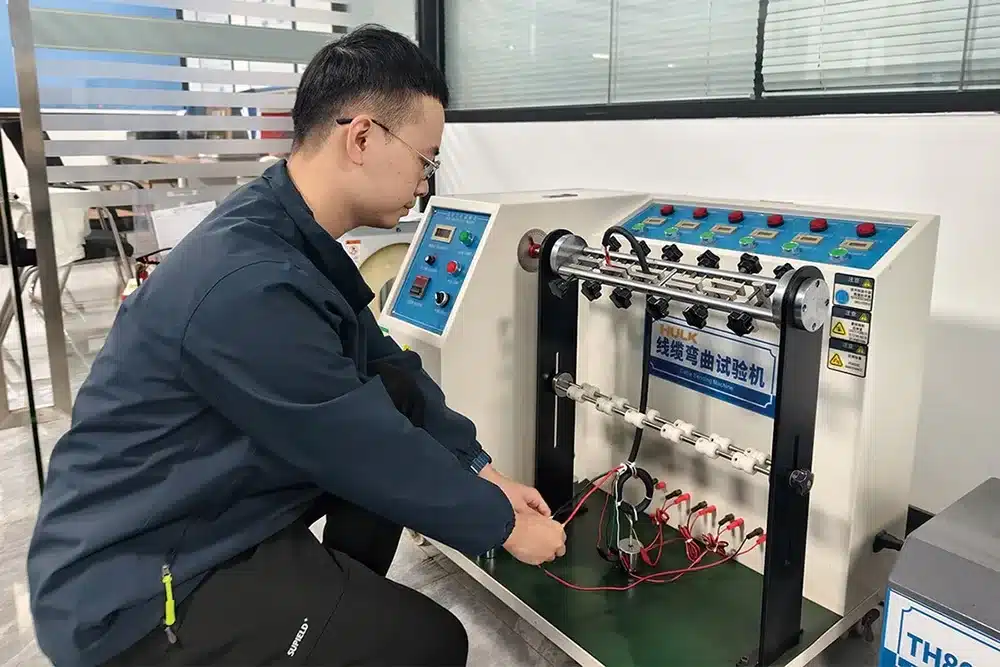
These cables are used to power servo motors, to carry signals or data in environments where standard wiring is prone to premature degradation. They are tested by manufacturers, such as Hulk, under real multi-axis torsion cycles instead of back-and-forth bending.
Typical Industrial and Robotic Use Cases for Torsion Cables
In several situations of high stress, torsion cables are a great choice:
- At the shoulder, elbow and wrist where cables twist as a result of the arm’s rotation and articulations.
- Collaborative robots (cobots): For internal routing needs, the most important consideration is for cables to maintain their flexibility when repeatedly twisted without becoming stiff.
- Rotary indexing tables and turntables: Pure torsional loads are generated by continuous or intermittent rotation.
- Continued spin of the grippers or sensor heads is called end of arm tooling (EOAT).
In every instance the cable will have to withstand simultaneous bending and twisting without the formation of spirals or mechanical stress.

Motion Types 101 – Bending vs Twisting vs Combined Motion
You can’t find the right cable without understanding how it moves.
Bending is predictable in a single plane, e.g., the cables which slide inside drag chains on linear axes.
Pure torsion is when the cable is rotated around the middle of the cable and is not bent much.
The most commonly used combined motion is when the arms move in both ways and along complicated 3D paths in robots.
How Bending Loads Stress a Cable vs How Torsion Loads It
Bending stresses the outside layers of a looped cable, and its primary test is to measure flex life and minimum bend radius. In Torsion, shear forces are applied throughout the cross section, where each conductor, shield, filler and jacket is twisted. If the cable is not balanced, this can produce a rotational strain that may cause the internal layers to shift or separate.
Combined Motion in Modern Robots—and Why “Just Flexible” Is Not Enough
In most applications for robots, combined motion is used. A cable that is only rated for linear flex will last in a drag chain but not long at a robot wrist. That’s why there are dedicated torsion-rated cables for industrial robots.

Inside a Torsion Cable – Key Design Features
The construction of Torsion cables differs from the inside toward the outside.
Conductor Stranding, Core Layout, and Symmetry
The cables are often made from extra-fine stranding and have optimum lay lengths and highly symmetrical core arrangements, typical of torsion cables. The uniform distribution ensures that none of the conductors or shields are subjected to torsional stresses, thereby achieving a much longer fatigue life than normal flexible constructions.
Jackets, Fillers, and Torsion Ratings on Datasheets
Special Resilient compounds (PUR or TPE) and appropriate fillers keep the roundness when twisted, and prevent corkscrewing. Check for explicit torsion ratings on datasheets: torsion angle per meter and total number of torsion cycles. Hulk’s robot & torsion cables are designed and tested for these parameters.
Standard Flexible Cables – Where They Belong and Where They Fail in Torsion
Regular flexible cables are appropriate for low motion or static applications such as control panels and basic machine wiring.
Appropriate Use Cases for Standard Flexible Cables
They are effective for fixed routing, infrequent repositioning or very low cycle applications. These cables are designed for easy installation and general flexibility, not for high cycle dynamic performance.
Symptoms of Misusing Standard Flexible Cables in Torsion Environments
Symptoms include sprialled jackets around connectors, uncovered shielding, sporadic weak signals, and localized hardening. These problems are eventually followed by frequent unscheduled halts and maintenance expenses.
Drag Chain Cables – Optimized for Continuous Bending, Not Pure Robot Torsion
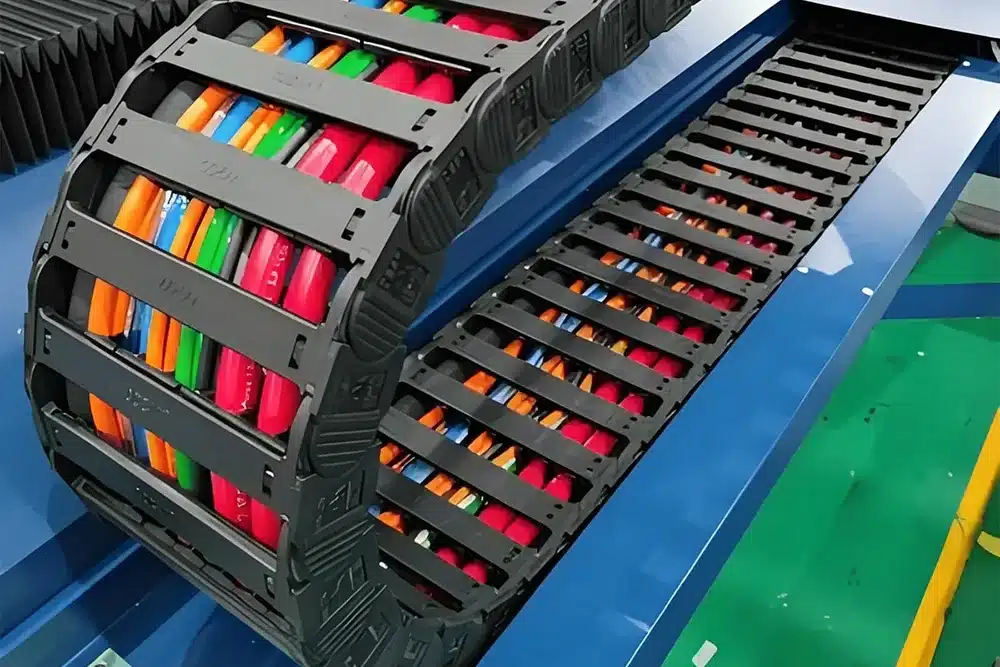
Chain cables (also referred to as continuous-flex cables) are suitable for linear, high cycle bending on cable carriers.
Where Drag Chain Cables Excel
They provide superb performance on CNC axes, gantries and conveyor systems, and have predictable planar motion, they are very abrasion and oil resistant.

Limitations of Drag Chain Cables in 3D Torsion-Heavy Robot Motion
They are designed to take into account, basically, only single plane bending. They can suffer damage due to twisting much sooner than specially designed torsion cables in robot joints that have multiple axis of torsion.
Torsion vs Standard Flexible vs Drag Chain Cables – Design Differences at a Glance
| Cable Type | Optimized Motion | Typical Applications | Key Design Focus |
| Standard Flexible | Static / low movement | Control cabinets, fixed wiring | Installation ease, basic flexibility |
| Drag Chain | Repeated linear bending | CNC axes, gantries, conveyors | Bend radius, high flex cycles |
| Torsion Cable | Twisting + combined 3D | Robot joints, rotary tables, EOAT | Torsion angle, symmetric cores, anti-corkscrew jackets |
Practical Rules for Choosing the Correct Cable Family
- Employ standard flexible cables on most static connections.
- Use drag chain cables in linear motion carriers.
- Use torsion-rated cables for robot joints, rotary systems or any other application that may require substantial twisting.
What Goes Wrong When Motion Type and Cable Family Don’t Match
Not matching the cables leads to accelerated wear, conductor breaks, loss of signal and frequent cable changes. For an automotive welding cell or packaging line, this means hours of lost production.
Real-World Failure Patterns in Robots and Rotary Systems
Watch for spiraling near joints, periodic faults from damage to the shield or kinking of rotary paths, which may be a symptom of cable family mismatch.

Impact on Maintenance Workload and Total Cost of Ownership
Even though the cost is higher up front, proper torsion cables can lower changeouts, troubleshooting and downtime, providing better overall value.
Quick Checklist – How to Tell You Actually Need a Torsion-Rated Cable
- Does the cable twist around itself during normal use?
- Do they move in more than one plane or 3D?
- Are there torsion angle and cycle ratings on datasheets?
- If you’ve had cables that have corkscrewed or been intermittent, have they been a while?
- Does it pass through rotary mechanisms or robot joints?
Key Questions to Ask Cable Suppliers About Torsion Design
- What do the torsion angle per meter and cycle life mean?
- Was it tested using combination of robot-like motions?
- What is the core structure and the jacketing’s ability to resist torsion?
- Have any application notes to share for similar 6 axis robots?
Closing Guidance – Always Start with Motion, Then Choose Cable Family
First, review the actual motion profile, and then pick the appropriate cable family. Hulk Electric’s robot/torsion cables are designed especially for these tough applications and tested and certified around the world.
Looking for the right torsion cable for your robot or rotary system? Let us know your motion parameters and we’ll give you recommendations from our high-flex cable range!