Legacy sensor wiring, typically hardwired pigtails, terminal blocks and butt-spliced harnesses, can be a hidden expense for food processing, packaging and automated manufacturing lines, in terms of downtime, maintenance and troubleshooting. When upgrading legacy sensor wiring to modern M8/M12 systems, you will gain both quicker installation and greater reliability and future-proof performance, particularly with high-flex industrial cables designed for continuous motion.
At Hulk Electric, we have more than 20 years of experience in servos, robot, sensor and actuator cables to assist manufacturers in making this transition. This guide offers practical information and tips on benefits, common pitfalls, and proven migration strategies to help minimise risk and ensure that you maximise uptime in your demanding industrial environment.
What Do We Mean by “Legacy Sensor Wiring”?
The legacy wiring system used by most sensors is done by direct hardwiring and is inefficient and outdated with older machines.
Hardwired Pigtails, Terminal Blocks and Sub-D Connectors
In older systems, many sensors provide pigtail leads that are plugged into a terminal block or Sub-D connector within the control panel. Typically, connections are made via manual butt-splicing, soldering, or shrink sleeves, which are time-consuming, labor-intensive and susceptible to human errors.
Limitations of Legacy Wiring
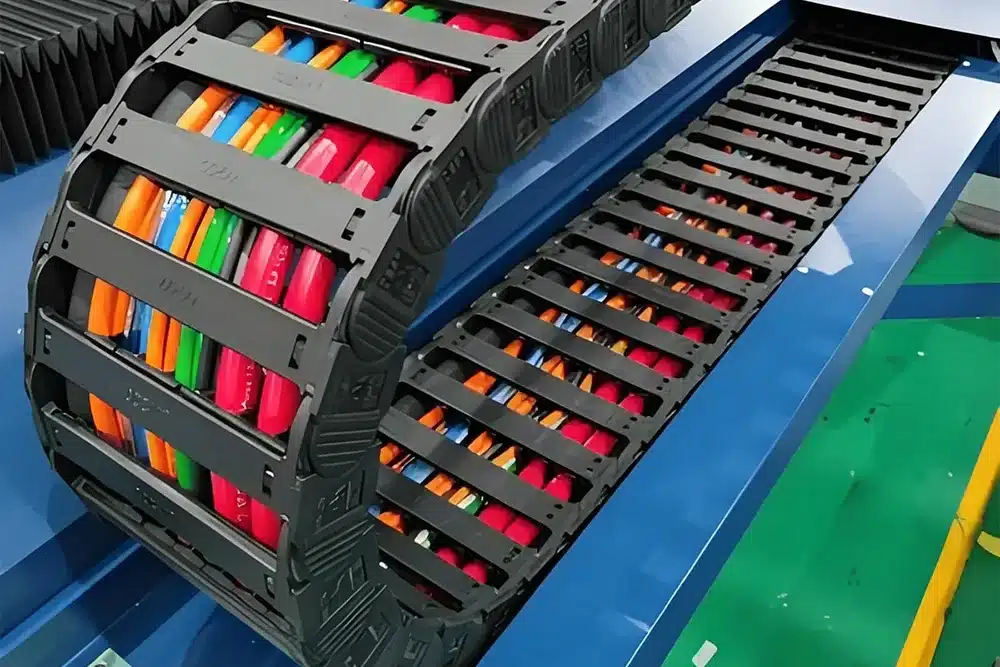
This causes slower assembly and test times, makes sensor replacement more difficult, and results in more downtime for faults. For high flex situations such as robotic arms or linear motion systems, repeated flex can cause splices to break over time, causing intermittent issues and expense of troubleshooting.
What Are Modern M8/M12 Sensor Connector Systems?
The M8 and M12 connectors are the industry-standard solution for reliable sensor and actuator connectivity in automation.
M8 and M12 Circular Connectors and Cordsets
The M8(8mm) and M12(12mm) circular connectors have several different pin configurations, for power, signal and data. They provide fast plug and play installation and rugged sealing to IP67/IP68/IP69K specifications, suitable in harsh industrial environments.
Overmolded Cable Assemblies and Field Attachable Versions
In most cases, overmolded cordsets with high-quality performance—usually with flexible sensor and actuator cables from Hulk—are factory-tested and sealed. Installability in the field gives flexibility in custom installations and provides durability.
Key Benefits of Upgrading to M8/M12 Systems
The introduction of standardized connectors, along with Hulk’s high flex cables revolutionizes maintenance and performance.
Faster Installation and Lower Labor Cost
Pre-assembled cordsets save huge amounts of time when wiring. What used to take days of hardwiring can now be done in hours, reducing project expenses.
Reduced Wiring Errors and Faster Startup
Assemblies tested in the factory ensure that there are no risks of miswiring. Sensors can change easily without the need to rewire, which accelerates commissioning and minimises the time for start up.
Robustness, Sealing and Vibration Resistance
The M8/M12 systems offer superior vibration resistance, moisture resistance and mechanical resistance when compared to legacy splices, which can increase the life of these cables in applications that are subject to motion.
Standardization and Future-Proofing
Easy expansion and ability to integrate with Industrial Ethernet (CAT5e – CAT7A), Fieldbus protocols and the next generation of robotics — in short, everything fits perfectly into Hulk’s wide range of cables.
Pitfalls and “Weak Links” When Migrating to M8/M12
Careful planning is required for successful upgrades, to prevent new issues.
Poor Harness Integration and Butt-Splices
Butt-splices result in weak points if they are used to connect new cordsets. Choose rather fully connectorized harnesses with Hulk’s tailor-made cables.
Inconsistent Wiring Standards and Pin Assignments
Pinouts cause confusion when it comes to maintenance. Set and write down standards early on.
Overlooking Environmental and Jacket Requirements
Not every cable is suitable for every application. High flex cables are needed for torsional or linear motion, with PUR or silicone jacketing from Hulk to avoid early life failure.
Choosing Between M8 and M12 in an Upgrade
M8 for Compact, Low-Current Sensor Connections
M8 connectors are ideal for applications that require space-saving and have reduced power consumption, especially for the smaller sensors.
M12 for Rugged, High-Flex and Data-Rich Connections
When used with Hulk’s shielded industrial Ethernet or servo cables, M12 variants are ideal for higher currents, more pins and protocols such as PROFINET or EtherCAT.
Mixed Systems – Where M8 and M12 Co-Exist
Many upgrades combine both for optimal layout: M8 for compact devices and M12 for main trunks.
Migration Strategy – From Legacy Wiring to M8/M12
A staged approach results in less disruption.
Step 1 – Audit Existing Wiring and Environments
Identify sensor locations, routes for cables, flex cycles and environmental stressors.
Step 2 – Standardize Wiring Schemes and Pinouts
Develop clear documentation for pin assignments and codings.
Step 3 – Choose Cordsets and Jackets Based on Application
Use the right sensor/actuator cables and appropriate shielding/oxygen resistance (e.g., PUR for oil resistance, silicone for extreme temperatures) for Hulk.
Step 4 – Plan Integration into Harnesses and Panels
All plug-and-play connectors are used to the full in the design, so as to decrease the amount of work done on site.
Step 5 – Test, Document and Train
Complete testing, advance schematics and train teams on the new system.
Practical Upgrade Scenarios and Tips
- Pigtail sensors: Quick wins by using flexible cables on M12 cordsets.
- Heavy equipment harness overhaul: Replace butt-spliced systems with full M8/M12 harness systems with vision and motion sensors.
- Tight robotic joints – space constrained retrofits: employ compact high-flex connectors with M8 cables in confined spaces.
Design Checklist – Upgrading Legacy Sensor Wiring to M8/M12
- Match connector type, pins and coding to application requirements.
- Designate correct flex, oil and EMI protection for cables.
- Have consistent pinout from machine to machine.
- Incorporate connectors into harnesses without additional splices.
- Train teams & update documents.
Converting existing sensor wiring to current M8/M12 wiring with high-performance cables from Hulk Electric can lead to significant improvements in reliability, efficiency and scalability. The sensor & actuator cables, robot torsion cables and Industrial Ethernet solutions we have developed are specifically designed for these challenging transitions.
Talk to our team about your machine parameters and we can make a custom cable and connectivity recommendation for you to ensure long-term machine performance.