In robotics, and automation in general, the difference between twisting vs bending in robot cables can be what makes or breaks cable life. Many engineers think that if this is a “flex” or “robot cable”, it will be able to move anywhere and when they get at the end of weeks or months into production, it fails them. The fact is that bending motion (usually drag chains and linear axes) is different from twisting or torsion motion (usually at robot joints). It is this understanding that guides everything else in the selection of cables, including the internal stranding, shielding, use of jacket materials and routing.
In the 20+ years we have been manufacturing high flex and torsion rated cables for global robotics applications, we’ve come to understand how cable design can match the real motion, and save money on costly replacements, downtime, and service life. This guide aims to explain the how, what, and what not to, for engineers.
Understanding Bending Motion in Robot Systems
Bending motion is when a cable bends repeatedly over a consistent radius, typically in cable carriers or along linear paths. This is the typical continuous flex in automation.
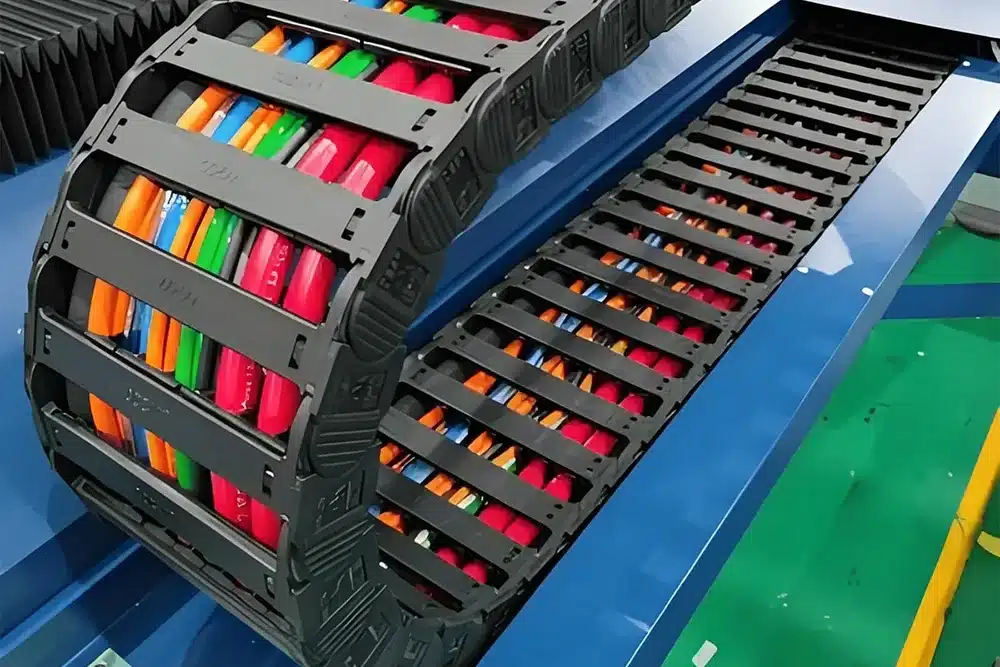
Typical Bending Applications – Drag Chains, Gantries, and Linear Axes
You’ll find dominant bending motion in:
- CNC machine tool axes and gantries with cables running back and forth in drag chains.
- Linear slides on assembly lines or material handling equipment.
- Robot base to control cabinet fixed runs with limited directional changes.
Here, the cable is subjected to regular cyclic flexing. Optimized by Hulk drag chain/continuous-flex cables with controlled stranding and abrasion resistant jackets in carriers.

Key Parameters for Bending – Bend Radius and Flex Life
Always use the manufacturer’s minimum bend radius. It is key to not exceed it even if using a high flex-life cable, or conductor fatigue and insulation cracking will accelerate. Flex life ratings (typically 5 to 10 million cycles or higher) are based on good routing and radius. In practice, you will measure your carrier’s tightest curve and select the cable to fit to prevent early wear.
Understanding Twisting (Torsion) Motion in Robot Systems
Torsion is the rotation of the cable around the cable’s own longitudinal axis. This is not the same as bending and much more challenging for the internal components.
Typical Twisting Applications – Robot Joints, Rotary Axes, EOAT Rotation
Common in:
- The axes of 6-axis articulated robot wrists, elbows and shoulders.
- Rotary tables or indexing stations.
- A swivel/continuous end of arm tooling.
In such environments, the standard bending optimized cables tend to degrade rapidly due to spiraling jackets, shield damage or conductor fatigue. Hulk’s robot cables have been specially designed and tested to withstand these continuous twist cycles.

Key Parameters for Twisting – Torsion Angle and Twist Radius
Check for torsion angle ratings (+/- 180° or +360° per meter) and cycle life. These specifications are needed along with appropriate service loop length and clamp placement to ensure that the cable will not get damaged if the robot is programmed to run through its paths.
Combined Motion – When Bending and Twisting Happen Together
For most real robot applications, both motions are used. A cable can bend in a local loop and the arm can rotate causing torsion – multiplying stress. That’s why flexible cables for the robot are not as effective as dedicated robot/torsion cables and that’s why they are made.
Examples of Combined Motion in 6-Axis Robots and Cobots
- Combined Motion in 6-Axis Robots and Cobots.
- Robots used for welding or painting where base-to-shoulder motion produces a bend in cables and wrist rotation generates twist.
- Small diameter internal routing that forces the complex 3D cable path.
Why Standard Bending-Only Cables Fail Under Combined Motion
Drag chain cables are highly suited to linear bending applications but are not sympatically stranded and built to be as flexible as needed for torsion applications. Outcome: corkscrewed jackets, sporadic signals and unplanned stops. For real projects, supported, they were converted to hybrid torsion designs and had their service life tripled.
How Motion Type Drives Cable Structure and Material Choices
After determining the dominant motion, cable construction is almost automatic.
Stranding, Pitch Length, and Core Layout for Bending vs Twisting
Tight pitch and controlled pitch are more typical of cables that are bend focused, as they are more stable in the carriers. To provide even distribution of twist stress and to avoid untwisting or bird-caging, the torsion-rated designs use special lay lengths and/or a symmetric core layout and in some cases featured reverse layering.

Shielding and Jacket Design under Different Motion Types
Bending cables should be able to bend without cracking shields. In applications involving torsion, they must be made in helical or wrapped forms to fit the rotational needs. The materials of jackets, whether it’s PUR, TPE or silicone blends, are selected for their abrasion resistance in chains, and their elasticity and oil/chemical resistance in robot arms.
Motion-Type-Driven Ratings – Bend Radius, Flex Life, Torsion Angle, Cycles
Datasheets tell the story—if you know what to read.
How to Read Bend Radius and Flex Life for Drag Chain Cables
Use a cable whose rated minimum bend radius fits your carrier’s design. The 10 million cycle rating is only as meaningful as the installation does tighten the radius.
How to Interpret Torsion Angle and Torsion Cycles for Robot Cables
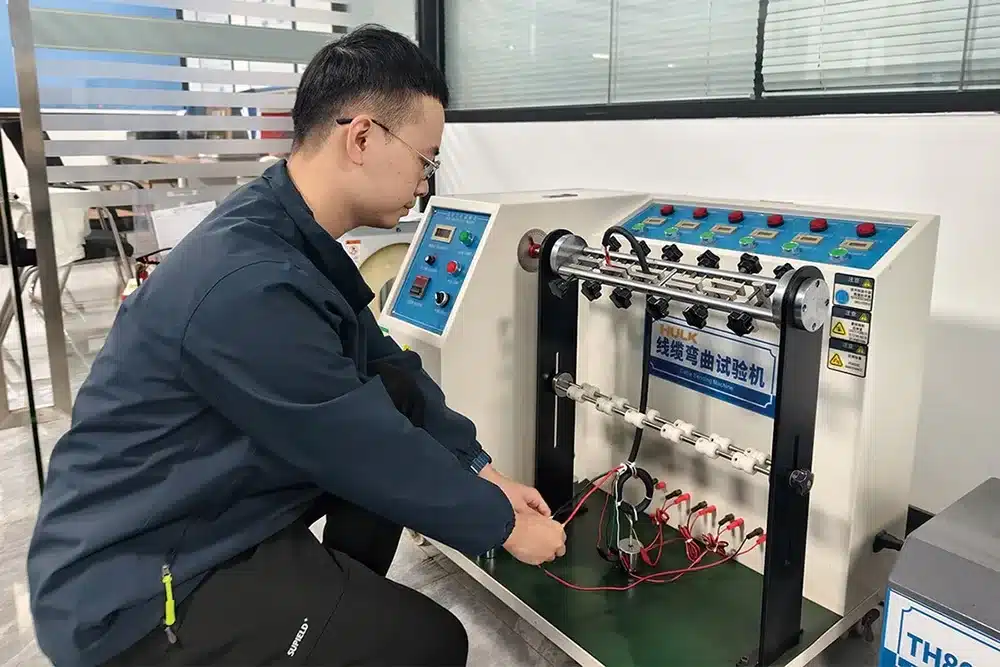
Check worst case joint rotation against the cable’s torsion angle/m and total cycle rating. Hulk offers comprehensive test data for composite movements that are typical with 6-axis robots.
Design and Routing Decisions That Change with Motion Type
In addition to the choice of cable, the routing itself is of paramount importance.
Routing Best Practices for Bending Motion (Drag Chains and Guides)
- Keep chain fill even and do not cross chain.
- Make sure it has enough length so that it will not pull at the endpoints.
- Use separators to prevent power and signal cables from coming into contact.
Routing Best Practices for Twisting and Combined Motion (Robot Arms)
- Plan for service loops with ample space for natural twist.
- Avoid using fixed clamps for rotating or sliding clamps as they may cause stress concentrations.
- Use the neutral axis of an arm, if available, to route cables.

Failure Modes – When You Misread Motion Type
A bending-only cable on a twisting joint is likely to result in spiraled jackets and fractured shields. On the other hand, cables with excessive bends in the routing crack at the point of stress. Both of these result in loss of signal, safety halts, and maintenance issues.
Practical Checklist – Matching Motion Type to Cable Design in Robotics
- Bend, Torsion or both dominant?
- For bending segments: choose continuous-flex cables that are proven to have a bend radius and flex life.
- Twisting/combined: Use hulk robot/torsion cables that have identical angles and cycles.
- Test routing and service loops at an early stage of design.
- Ask for test reports specifically for the motion the supplier will be providing.
Questions to Ask Robot Cable Vendors About Motion and Design
- Which types of motion (bending, torsion, combination) were the cable tested on?
- What are the bend radius, flex life, torsion angle and cycle data for my application?
- Have you done reference runs with robots like my robot, and movements like my robot?
Closing Guidance – Start with Motion, Then Choose Cable and Routing
Always begin with motion analysis in robotics. Drag chain/continuous-flex designs are required when bending. Twists require cables that are torsion optimized. For combined motion, hybrid constructions are used which are tested for both. Good cable specs become reliable years of service with proper routing.
Hulk Electric’s Robot & Torsion Cables and High Flexible Cables are designed specifically for these differences. Eliminate motion-related failures with UL, CE and other certifications, fast sampling and custom options. Give us your requirements for maximum uptime, and we’ll recommend the most suitable robot motion profile and/or axis requirements.