Unlike other pre-made cables that were built to try and satisfy average needs, custom industrial cables have a firm economic basis and are designed to meet specific requirements. The minimum quantity and minimum leadtime for industrial custom cables are not random commercial rules, but instead they are the result of considerations, such as the extrusion set-up, the quantity of material in the batch, the certification work, quality protocols that decide if the design can be extruded at a sustainable cost. Planning ahead around these constraints prevents OEMs from falling into common pitfalls, such as running out of stock, missing machine launch dates or changing suppliers at the last minute.
There are still many teams that believe they will receive “a few meters next week” of a new multi-core servo or torsion cable. But that is not always the case with cable plants. The natural batch floors and time windows are created through the tooling change, compound purchase and test documentation process. It provides practical ranges and planning strategies for engineering, project management, and purchasing to deal with reality rather than battle it.
What Actually Drives MOQ and Lead Times in Custom Cable Manufacturing
Minimum and schedules set by factories, concrete operational reasons. Being aware of those reasons allows OEMs to ask better questions and negotiate smarter structures.
Setup and Tooling Costs on Extrusion Lines and Assembly Cells
Extrusion line changes (new conductor layout, insulation compound, or jacket color) must be accompanied by die changes, temperature calibration, tension changes and first-article inspections. New jigs, crimp tooling and test fixtures are required for assembly cells. These fixed costs—central to any custom cable design process—remain approximately constant for a 50 m run and a 2 000 m run. Distributed over a useful length or number of units makes the unit cost reasonable. Plants use hundreds of meters for their extrusion floors and tens to low hundreds of pieces for their assembly floors, which is why.
Material Batching, Procurement, and Inventory Economics
All jacket compounds, shielding tapes, special conductors and connector reels come in bulk packages. A 30 m pilot requires ordering a unique construction, which means that there is surplus stock and increased risk of scrap. Suppliers thus like runs that use a whole lot of material or a substantial part of a lot. This can be 500–1 000 m minimums for fully custom constructions and 50–100 pieces for assemblies, depending on the use of special connectors.
Certification, Testing, and Documentation Timelines
UL/CSA file updates, CE/EMC reports and customer-specific test protocols are often required when new construction or private label branding is involved. When the actual extrusion process is quick, weeks are still consumed for scheduling lab time, creating lot traceability and preparing declarations of conformity. When a cable is highly regulated, then the total lead time could be much longer than just the actual manufacturing.
Typical MOQ Ranges by Project Type
The ranges are indicative of the industry standards of Chinese and global custom-cable suppliers. They are not taking rule-based actions, they’re making benchmarks, and when the long-term picture in volume is clearly defined, there’s always a chance to negotiate.
Prototypes and Engineering Samples
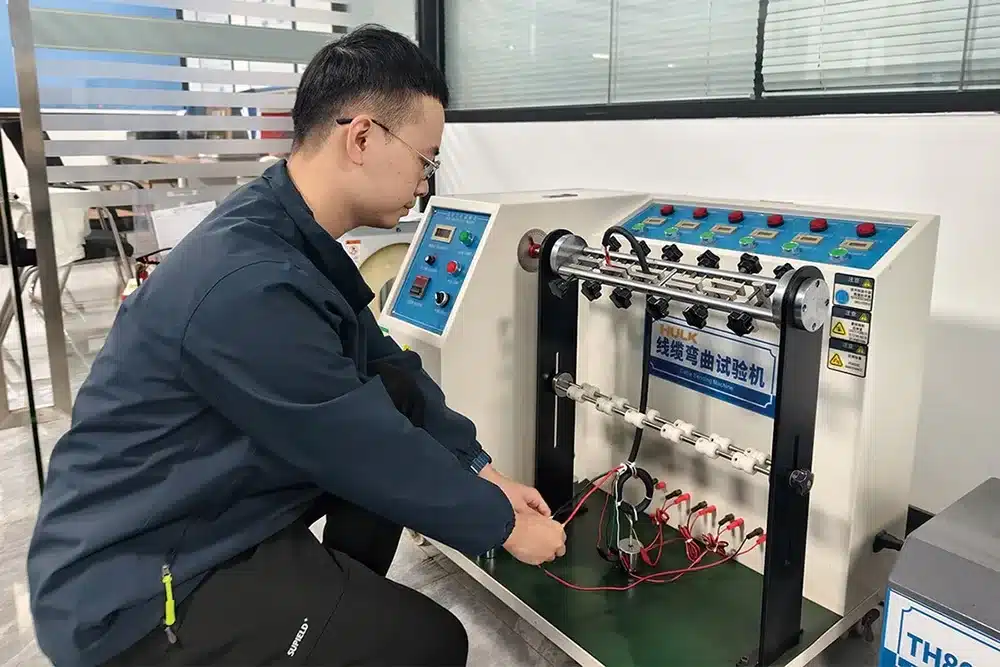
Most manufacturers allow very low quantities to be used for design validation. For first articles, typically 10-20 cable assemblies or 10-50m of bulk cable. The objective of these runs is not to meet cost target but to verify fit, flex life and electrical performance. There are some sample builds that are designed for low MOQ for NPI and R&D.Low MOQ sample builds are offered by some plants specifically. It is normal for these samples to be paid ones, and free ones are typically limited to standard catalog samples.
Low-Volume Custom Cable Assemblies for OEMs
After prototypes are accepted, mid-size harness houses and specialized assembly shops typically have a normal 50 to 100 parts per design. The size of this volume is adequate to cover set up but not so large as to discourage the purchase of new equipment by OEMs. There is room for making it simpler in some cases or if the supplier believes he can clearly see a recurring order path.
Full Custom Industrial Cable Extrusion and Private-Label Projects
Many OEM cable manufacturers begin at 500–1 000 m per type for new structural designs or private label bulk cable. The floor will reach 1 000 m in the case of complex multi-core constructions, special compounds or armoring. Where annual volumes are only tens of meters or less, a full custom extrusion is often not cost-effective; instead, semi-custom or modified standard constructions are more likely to be appropriate.

Typical Lead Time Ranges for Custom Cable Work
The specific lead time might vary based on the maturity of the design, availability of the material, and the scope of certification. Ranges are presumed to be in relation to clear specifications and standard materials on hand.
Sampling and Prototype Lead Times
When designs are finalized and materials are ready, prototype and sample builds for custom cables and assemblies typically occur in the 2-4 week period. Agile suppliers can provide you with a simple harness or some minor variations in 3-7 days. When the construction is within our standard process capability, we aim for 7-day rapid sampling for the new specifications at Hulk.
Standard Custom Production for Low- to Medium-Complexity Designs
Following the prototype approval, many custom cable companies are able to provide a 3-10 week turnaround for industrial orders. The practical examples are made-to-order cables (less than 1 km) delivered in 2–3 weeks, assembly orders (approx. 100 pieces) delivered in 2–4 weeks. Our target is 15 days after materials and tooling have been confirmed.
High-Complexity, Certified, or Multi-SKU Projects
When new compounds are needed, multiple layers of shielding, or heavy certification projects (such as updating a UL file, conducting full EMC testing), are required they can typically take 6–14 weeks or more. The additional time typically doesn’t get devoted to the actual extrusion line but instead to testing queues and documentation. These schedules should be locked in the overall project plan early by the OEMs.

How Customization Depth Changes MOQ and Lead-Time Expectations
Minimum quantity and calendar time is best predicted by the depth of change requested.
Branding-Only vs Structural Customization
Jacket printing, labels and carton branding on an existing construction typically require lower MOQs (tens to a few hundred units or moderate footage) and 2-5 weeks lead time. With the new conductor, insulation, shielding or geometry, the project moves to a higher MOQ level (hundreds to thousands of meters or pieces) and to multi-week schedules or multi-month schedules.
Simple Dimension or Connector Adjustments
Finally, there are connectors that change in varying lengths and have been replaced in standard families. Typically, MOQs are in the tens to hundreds of assemblies, and the lead time is similar to a standard custom build. These changes still need tooling and procurement, but don’t often cause complete material or certification rework.
Fully Engineered New Constructions and Private-Label OEM Cables
New multi-core designs, novel insulation compounds or unique shielding schemes turn into new products. They require engineering plans, test plans and sometimes new regulatory documents. These are the highest values for MOQ and lead time and should be used on strategic platforms with high forecasted volumes and product life.
Practical Strategies for OEMs to Manage MOQ and Lead Times
Using Prototypes and Pilot Batches to De-Risk Before Committing to MOQ
Begin using 10–20 assemblies/cable lengths. These low-MOQ runs respond to inquiries regarding installation, flex performance, and supplier quality preceding a bigger commitment. Carefully document the results, which will aid in design freeze and reorder for the future.
Negotiating Phased Deliveries and Call-Off Orders
Allow for general MOQ but package shipments accordingly to the equipment ramping up. Call-off or blanket orders is a method of providing the supplier with volume certainty and helps to avoid overloading the OEM’s warehouse. Planning capacity and inventory together is advantageous to both parties.
Matching Supplier Profile to Volume and Complexity
Extruders that are large are ideal for making complex structural designs with high volume. Mid-size harness houses are excellent for creating custom harnesses of medium size. Low-MOQ prototyping experts are for low-moq prototyping. Do not select a partner based on the lowest offer, but on the typical MOQ and lead-time profile that matches the expected annual volume and engineering depth—see our guide on how to evaluate a custom cable manufacturer for a structured checklist.

Planning Checklist – What OEM Engineering Teams Should Clarify Up Front
Internal Questions to Answer Before Contacting Suppliers
- What is the annual and first-year volume for this cable/harness?
- Do we need some branding, some light customisation or full structural reworking?
- What are the required certifications, tests, and documentation requirements and which are the hard dates?
- How many versions of prototypes and pilot batches will we make before mass production and how much?
Clear answers to these questions form the foundation for preparing a complete RFQ and realistic MOQ/lead-time discussions.
Information to Share When Discussing MOQ and Lead Times
- Set production and launch dates based on availability of cable (machine FAT, customer delivery).
- Both preferred MOQ and delivery pattern, as well as acceptable alternatives (higher MOQ with phased shipments).
- Design maturity (concept, prototype, validated) and existing test data that could enable smaller timelines.
- Long term roadmap (platform life, number of expected design changes) so that supplier can see if deep customization is warranted.
Balancing the level of customization to the anticipated volume of custom industrial cable and realistic schedules to the project plan are key considerations for selecting the best minimum order quantities and lead times. Plants that view these constraints as design constraints, not as constraints, experience less surprises, smoother audits, and overall lower Total Cost of Ownership.
High-flex, servo, robot and industrial Ethernet cables are all made as a direct source factory at Hulk Electric. Rapid sampling is available for new specifications (7-day delivery) and standard production is available (15-day delivery) once materials and tooling are confirmed. Provide volume profile, certification requirements and launch dates; we will manage MOQs and delivery to ensure the cable side of the project remains on schedule.