The selection of the proper torsion angle and cycle life ratings for robot cable is a critical decision in determining the reliability of your automation system, or whether you will end up with repeated harness failures at wrist and rotary joints. For high speed 6-axis robots and collaborative systems, these ratings provide engineers with the actual strength of the cable per metre and the number of cycles it will last.
By understanding and mastering these specifications, engineers and integrators can save time and money, preserve signal integrity for servo and encoder lines, and improve overall service life, especially in more demanding torsion applications. This guide explains the meaning of the ratings, how the ratings are tested, what real world performance the ratings represent, and how to match the ratings to your robot motion profiles.
What Do Torsion Angle and Torsion Cycle Life Ratings Actually Mean?
The rating is based on the maximum number of twists per meter (plus or minus, 90, 180, 360 degrees or more) that the cable is able to withstand repeatedly without damage. Torsion cycle life rating is the number of cycles of full twist that the cable will endure at that angle under test conditions while being held to a controlled state of stress, prior to the critical conductor resistance and/or shield effectiveness limitations.
These ratings are directly related to robot kinematics. Multiple movements of the 180° rotation of a robot wrist cause high twisting stress along the length of the cable. The margin for a cable with only ±90°/m is not sufficient in that case, but a cable with a rating of ±360°/m would wear out slowly.
Typical Torsion Angle Ranges for Robot Cables
The majority of quality robot cables are in these ranges:
- Moderate torsion: ±90°/m or less dynamic routing.
- Standard 6-axis robot wrists and end of arm tooling: ±270°/m to ±360°/m.
- Extreme rotary joints or humanoid robot applications for higher ratings up to ±450° or even higher in shorter segments.
If no specific torsion angle is given on the datasheet, it is a warning sign! Specialist cable manufacturers producing cables such as Hulk make these cables with optimised stranding, fillers and shields to deliver these angles whilst maintaining electrical performance.
How Torsion Cycle Life Relates to Service Life in Production
Typically, the estimate of operational life is based on a torsion cycle life rating, which is often measured in millions of cycles. For instance, with a cable which has a life of 10 million cycles for ±180°/m in a robot using 400,000 cycles per year, the cable should last about 25 years, with actual use typically limited by a safety factor due to combined bending, temperature and speed.

How Vendors Test Torsion Angle and Cycle Life (and Why It Matters to You)
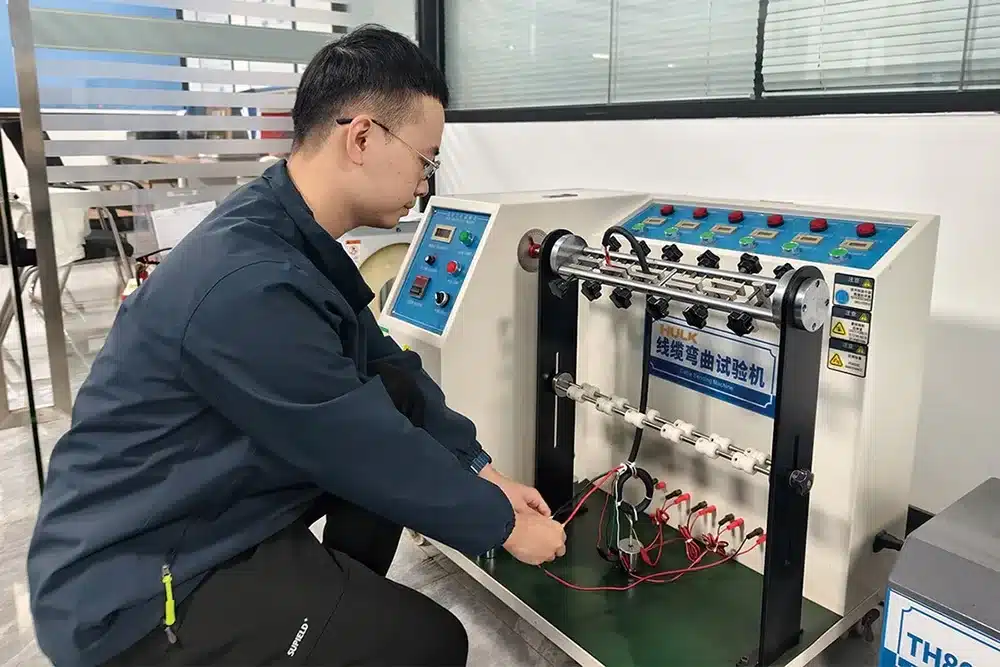
Advanced manufacturers use specialized torsion test rigs to apply tension to the cable at a specified angle multiple times to test electrical continuity, insulation resistance and mechanical strength. These will simulate years of robot operation in a shorter period.
Torsional Cable Testers and Accelerated Life Testing
Testers are used for mounting cable segments in fixtures which simulate robot routing and allowing for precise angular displacement at controlled speeds and temperatures. Failure is characterised by measurable change, e.g. conductivity of the conductor, rise in shield resistance or damage to the jacket.
Accelerated tests shorten the actual duration of cable use and performance in the field into laboratory times, producing an understanding of which cable components—whether stranded conductors, braided shields, or outer jackets—have the greatest impact on overall cable durability.
How Torsion Test Standards Translate into Published Ratings
Vendors publish ratings based on proprietary or industry protocols that specify test length, temperature, combined bend radius, and exact failure criteria. Always ask for the underlying test conditions to ensure the numbers align with your application rather than idealized lab setups.

How Torsion Angle Affects Robot Cable Performance in Joints and Rotary Axes
The greater the torsion angles, the greater the mechanical stress to all the internal parts. Cables designed for higher angles are built with special lay lengths, anti-twist fillers and flexible shielding to ensure performance.
Shield Continuity and Signal Integrity at High Torsion Angles
Shields must not open, or break the wire, under twist for braided or served shields. With servo, Ethernet or vision systems, noise and communication faults result from even slight decreases in shield quality. High-torsion designs are a means of spreading stress uniformly to maintain EMC performance through millions of cycles.
Jacket Behaviour, Corkscrewing, and Strain Relief at Large Angles
Cables with jackets can suffer from spiral deformation (corkscrewing) or cracks at high torsion angles which can result in strain on connectors and eventual failure. The use of proper materials and internal construction prevents diameter changes and keep routing clean.
How Torsion Cycle Life Ratings Translate into Service Life and Maintenance Planning
The cycle life ratings standardize reliability engineering calculations and replace assumptions with data.
Estimating Service Life from Torsion Cycle Ratings and Motion Profiles
Follow these steps:
- Determine or calculate the actual torsion angle per meter of your cable routing.
- Calculate the number of production cycles per year for the relevant joints of the robot.
- After comparing with the number of cycles listed in the cable’s specifications at that angle, multiply by a safety factor (for temperature and contaminants).
The cable’s rated life is 8 million cycles for a cell operating 300,000 cycles per year, which equates to approximately 25+ years theoretical life (accounting for combined stresses).
Preventive Inspection and Replacement Strategies Based on Cycle Life
Conduct comprehensive tests at 40 to 60% rated cycle life. Monitor for changes in a jacket or cable stiffness, or electrical parameter drift. Proactive replacement by cycle tracking avoids unexpected failures and facilitates planned maintenance window.

What Happens When Torsion Angle and Cycle Ratings Don’t Match Real Robot Motion
In high-torsion areas, under-specified cables fail at random, leading to shield cracks, conductor breaks, intermittent signals and production stoppages.
Typical Failure Modes in Under-Rated Torsion Applications
- Fatigue of the shielding which causes noise feedback to the encoder.
- Jacket corkscrewing and splits at rotary joints.
- Open circuits due to a breakage in the conductor strand.
- Damage to data cables that causes internal distortion to the impedance of the cable.
These ratings seem to be earlier than the bend-only ratings would indicate.
Case Examples Where Correct Torsion Ratings Improved Reliability
One automotive integrator replaced the standard flex cables on its robot wrists, which had a failure rate of 6-9 months. The change to the Hulk torsion rated cables with ±360°/m and equivalent cycle life service intervals of more than 3 years resulted in no unplanned downtime. Such enhancements are also available for high-speed pick and place cells, where motion profiles are used to specify.
How to Specify Torsion Angle and Cycle Requirements in RFQs and Design Reviews
To get good, engineering solutions, you must include the torsion information in each robot cable RFQ.
Key Parameters to Include When Requesting Torsion-Rated Robot Cables
- Specific rotation angles of the joints and axes of a robot.
- Meter of required required torsion angle, target cycle life.
- Combined dynamic bend radius and routing details.
- Requirements for shielding and type of signal.
- Environmental factors (temperature, oil, abrasion).
- Limits on cable diameter and connectors.
Questions to Ask Vendors About Torsion Rating Data and Test Conditions
- Which test rig/standard yielded these ratings?
- What is the specific failure criteria that is applied?
- Have any applications for similar joint motions?
- What happens to the published cycle life when the temperature or speed is changed?