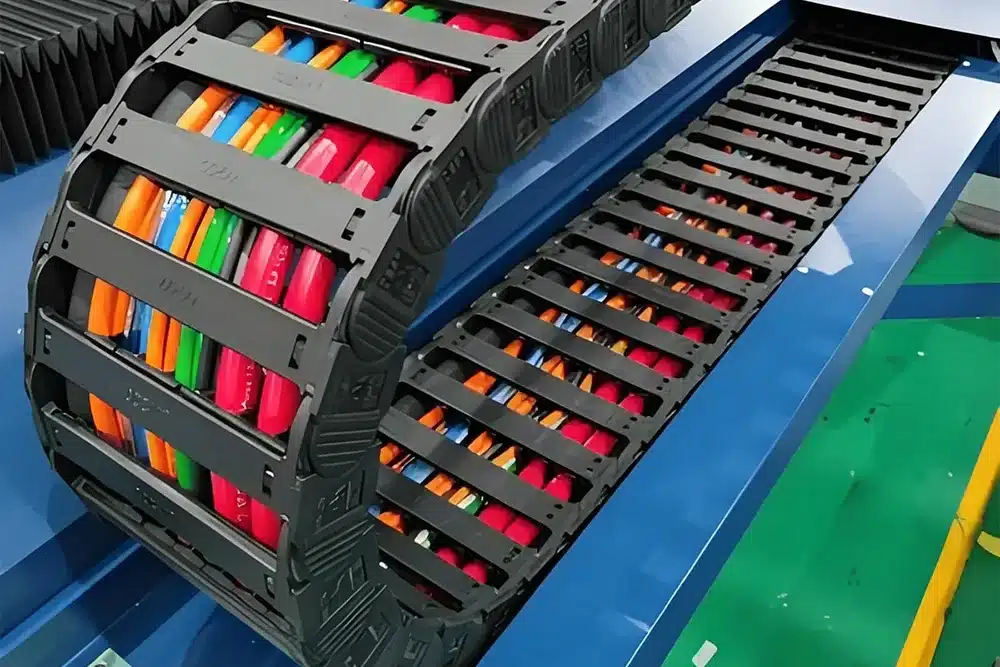
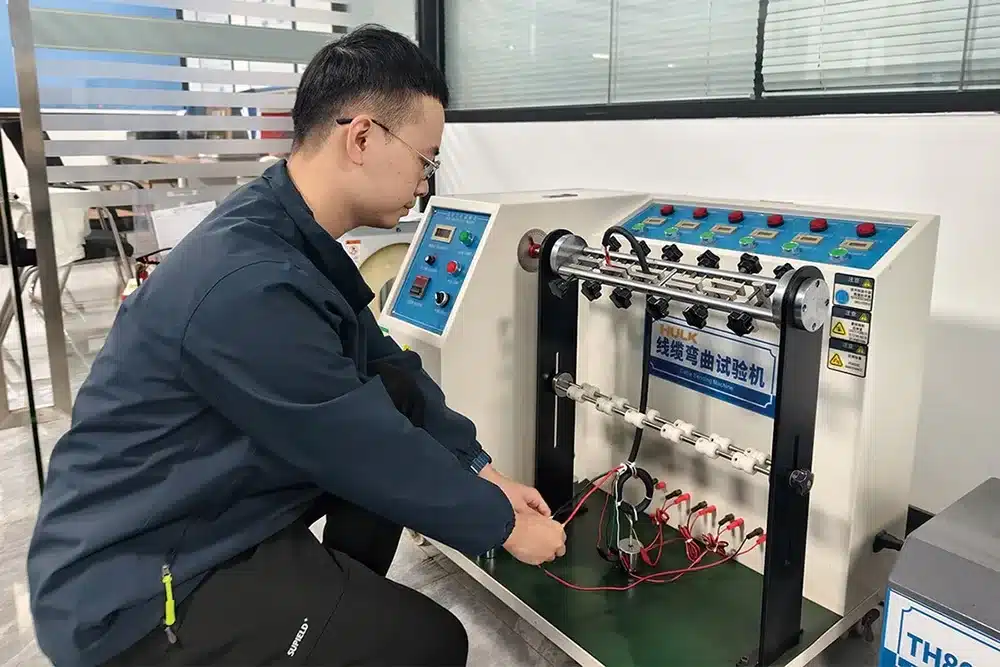
In dynamic industrial environments, shielding for drag chain cables is rarely a simple checkbox. Cables running through energy chains near VFDs, servo motors, and robotic arms face both electromagnetic interference (EMI) and millions of flex cycles. Choosing the wrong shield type—foil, braid, or hybrid—can lead to signal noise, premature cable failure, or costly downtime.
Engineers and machine builders need clear guidelines based on real motion profiles, noise sources, and performance demands. This guide explains the practical differences and helps you specify shielding that holds up under continuous movement.
Shielding Basics – What Foil, Braid and Hybrid Shields Actually Do
Effective shielding protects sensitive signals while withstanding the mechanical stresses of drag chains. Each type has distinct electrical and physical characteristics.
Foil Shields – 100% Coverage and High-Frequency EMI Control
Foil shields, typically aluminum laminated with polyester, deliver nearly 100% optical coverage. They excel at blocking high-frequency interference such as RF signals, Wi-Fi, or data crosstalk above 100 MHz.
Pros include low weight, compact diameter, and cost-effectiveness, making them suitable for internal pair shielding in data cables. However, the thin metal layer makes them prone to cracking and loss of continuity under repeated bending—often disqualifying foil-only designs for true continuous-flex drag chain use.
Braided Shields – Mechanical Strength and Low-to-Mid Frequency EMI Control
Braided shields, usually tinned copper, offer 70-95% coverage and superior durability. They perform best against low- to medium-frequency noise from motors, VFD switching, and power lines.
Their woven structure provides a robust low-impedance ground path and flex life measured in millions of cycles, which is why braided shields are the go-to for dynamic applications.
Hybrid Shields – Combining Foil and Braid for Broad EMI Protection
Hybrid constructions layer foil (for high-frequency) with an outer braid (for strength and lower frequencies). This delivers broadband protection and excellent mechanical reliability, ideal when cables must handle mixed EMI while surviving constant motion.

Why Dynamic Applications Change Shielding Requirements
Static cables behave differently from those in drag chains. Repeated bending, torsion, and acceleration stress every layer.
Mechanical Fatigue of Shields in Drag Chains
Foil shields often develop micro-cracks after thousands of cycles, breaking continuity and reducing effectiveness. Braided designs, with optimized angles and wire gauges, maintain integrity far longer in continuous flex.
Grounding, Shield Termination, and Movement
Movement can loosen terminations or create pigtails that act as antennas. Braided shields support reliable 360° clamping and strain-relieved connections, preserving ground paths critical for EMC compliance in vibrating or accelerating systems.
Matching Shield Type to Signal and Noise Characteristics
Selection starts with understanding your dominant noise and signals.
Low-Frequency Motor Noise and VFD Environments – Why Braid or Hybrid is Preferred
VFDs and servo drives generate significant low-to-mid frequency noise. Braided or hybrid shields provide better attenuation here while enduring the associated motion.
High-Frequency Interference and Data Lines – Role of Foil and Pair Shielding
For Ethernet, fieldbus, or encoder signals, foil on individual pairs handles high-frequency crosstalk effectively. In drag chains, combine these with an overall braid for full protection.

When to Use Foil, Braid, or Hybrid Shields in Drag Chain Cables
When Foil-Only Shields Are (and Are Not) Appropriate
Foil-only is generally unsuitable as the primary shield for continuous drag chain duty due to fatigue risk. It works for short-travel, low-cycle applications or as inner pair shields backed by an overall braid.
When Braided Shields Are the Default Choice in Dynamic Systems
Choose braided shielding for most servo, control, and power cables in drag chains—especially near VFDs. It balances EMI rejection with the flex life needed for reliable long-term operation.
When Hybrid Shields Justify Their Cost and Complexity
Specify hybrid when cables carry sensitive signals in high-EMI zones with strict compliance requirements. The combination minimizes both noise and mechanical risks, reducing overall system downtime.
Integrating Shielding with Overall Drag Chain Cable Design
Shielding must work with stranding, jackets, and bend radius. Higher braid coverage improves EMI performance but can reduce flexibility if not optimized. Work with suppliers experienced in continuous-flex designs to balance all parameters.
Shield Termination, Grounding, and Cable Routing in Dynamic Systems
Use proper clamps, avoid sharp bends at entries, and ensure consistent grounding at both ends. Route cables to minimize torsion and maintain recommended bend radii.
Practical Specification Checklist for Shielded Drag Chain Cables
Checklist: Application, EMI, and Motion Inputs Before Choosing a Shield
- List signal types (power, analog, digital, communication) and sensitivity levels
- Identify EMI sources (VFDs, motors, welders) and frequency ranges
- Define motion profile: travel distance, cycles, speed, torsion
- Note environmental factors: oil, temperature, chemicals
Questions to Ask Cable Suppliers About Shielding in Drag Chain Cables
- What shield type and construction is used, and why for this application?
- Has the design been tested for millions of flex cycles in drag chains?
- What EMI performance data (frequency-specific attenuation) is available?
- What are the recommended termination and grounding methods?
At Hulk Electric (Dongguan) Co., Ltd., we engineer custom drag chain cables with precisely tailored shielding—foil, braid, or hybrid—to match your exact motion, EMI, and compliance needs. Our high-flex designs deliver reliable performance in demanding automation environments across 30+ countries. Contact our team with your parameters for rapid sampling and optimized solutions.