Industrial cable certifications such as UL, CE, TÜV, RoHS and REACH are vital evidence that the cable performs in the expected manner and is safe and suitable for international markets. These marks are important for OEMs, integrators, and procurement teams working to buy cables for automation, robotics, and motion control systems because they can help minimize compliance risks, expedite approvals, and provide performance reliability throughout regions.
As a company with more than 20 years of experience producing high-flex, servo, robot and high-temperature silicone cables, we know the importance of certification on a successful project. Each major certification is described in practical terms: what it is, its applications and when/where to employ it when specifying industrial cables for international deployments.
Why Cable Certifications Matter for Global OEMs
There are a number of challenges industrial cables face such as constant flex in drag chains, torsional stress in robotic arms, exposure to heat, chemicals and moisture. Certifications aren’t decorations; they’re a testament to whether the cable construction, materials and performance meet regional safety codes, fire codes and environmental requirements.
The right certification reduces installation risk, makes machine declarations and NEC compliance easier, prevents customs delays and fosters end customer confidence in quality with a documented certification. These certifications offer a universal language for engineers and buyers, regardless of what they are selling to, whether it be North America, Europe or elsewhere.
UL Certification – North American Safety and Fire Protection
UL (Underwriters Laboratories) is a benchmark of electrical safety in North America. UL is an independent testing laboratory that applies rigorous tests to cables to verify that they will not be a fire, shock or mechanical risk in the field.
What UL Covers for Industrial Cables
Most of the time, UL certification for cables is done to ensure insulation integrity, voltage rating, flame resistance, and mechanical strength. Examples of common standards are UL 44 for thermoset insulated wires, UL 1277 for tray cables, and UL 758 for appliance wiring. Vertical flame propagation, dielectric resistance, aging under heat and abrasion resistance are often measured in a test for cables, such as servo and drag chain cables that are subject to millions of cycles.
UL recognition of a high-flex industrial cable assures it can perform the dynamic stresses of an automated machine without affecting safety.
Where UL Applies and Why OEMs Need It
UL and cUL are expected throughout the United States and Canada. A variety of specifications make reference to the National Electrical Code (NEC) or NFPA 79 for industrial machinery, with UL-listed or recognized cables making the process easier on inspections and approvals.
When it comes time to exporting industrial machines to North America, OEMs are often faced with a requirement that mandates UL certification.When it’s time to ship an industrial machine to North America and meet customer requirements, it is often necessary to have UL certified industrial cables to avoid costly field changes. In a real world application, this certification provides procurement teams assurance of reliable operation in control panels, material handling applications and robotic applications.
CE Marking – Access to the European Economic Area
The CE mark is not a test result, it is a statement of conformity. It means that the cable meets the requirements of certain EU directives, which enables free movement within the EEA.
What CE Means for Industrial Cables
Cables are marked with CE, which certifies compliance with the Low Voltage Directive (LVD), EMC Directive and possibly also with the Construction Products Regulation (CPR) in relation to the fire performance. EN and IEC standards are harmonised and supplemented by technical files, risk assessments and in some cases by involvement of notified bodies by manufacturers.
This guarantees that cables are suitable for installation in European industrial automation applications and satisfy the necessary safety and electromagnetic compatibility standards.
When OEMs Must Care About CE
While machine builders are ultimately responsible for the declaration of CE complete equipment, choosing of CE compliant cables is definitely a great deal easier. Wiring contributions to overall machine safety and EMC are controlled by using cables which are tested to EN/IEC standards.
In food & beverage lines, or packaging lines, destined for Europe, CE marking and appropriate fire ratings are often a requirement for regulatory acceptance.
TÜV Certification – Independent German Testing and Durability Focus
TÜV organizations (including TÜV Rheinland or TÜV SÜD) are known for meticulous and independent verification, especially in markets where rigorous verification from a third party is important, such as Europe.
What TÜV Tests on Industrial Cables
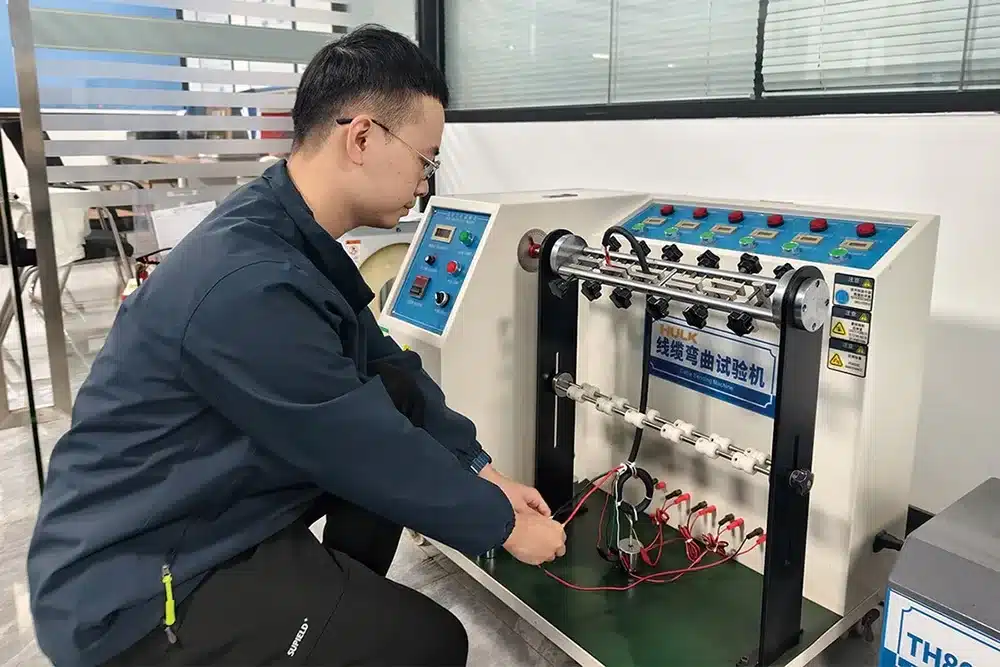
Mechanical durability, environmental protection and durability are the focus of TÜV certification. Typical tests are thermal aging, damp heat cycling, UV exposure, high voltage endurance, and flame behavior. For instance, the TÜV certified robot torsion cables or high-temperature silicone cables are tested for an extended period of time, flexing and climate testing to simulate years of service in the field.
The emphasis on durability is particularly important for cables used in outdoor, high cycle or severe industrial applications.
How TÜV Marks Support Global Market Acceptance
Based in Germany, TÜV certifications are valid throughout the EMEA and Asia regions as proof of excellence in testing. TÜV is often used in addition to UL or CE by many large industrial buyers as an added layer of security beyond the self-declaration. In case of global OEM projects, these marks can get linked with TÜV to add value to bids and lower the risk for the customer during the qualification of suppliers.
RoHS – Restriction of Hazardous Substances in Electrical Products
The RoHS limits dangerous materials in EE equipment, addressing environmental and health concerns.
What RoHS Limits in Cable Materials
The directive prohibits the use of lead, mercury, cadmium, hexavalent chromium and certain brominated flame retardants in insulation, jackets, conductors and pigments. Compliant industrial cables are made with the proper compounds and plating to meet these low limits while maintaining electrical and mechanical characteristics.
In the case of high-flex and silicone cables, it means continual testing of materials to make sure that additives do not affect flexibility or heat resistance.
Global Reach of RoHS-Style Requirements
RoHS was originally a European Union Directive, but has now shaped standards in other parts of the world. This is now an expectation by many international buyers, even outside of Europe. It is important to any manufacturer making products for export as it can prevent market access or result in product recalls.
REACH – Managing Chemicals Across the Supply Chain
REACH is a more comprehensive EU-wide legislation on the registration, evaluation, authorization and restriction of substances employed in the production of goods.
What REACH Requires from Cable Manufacturers
The producers of cables need to find and manage substances of very high concern (SVHC), and need to disclose information when thresholds are being approached, and need to keep supply chain declarations. This involves regular testing and documentation of materials used in the manufacture, to ensure that finished cables meet standards.
This is achieved by having comprehensive supplier audits and traceability systems in place, which are consistent with ISO 9001 requirements, in facilities such as ours.
Why REACH Compliance Matters to OEMs
OEMs comply with their own regulatory requirements and can avoid unpleasant surprises in audits and due diligence with REACH compliant cables. It is an additional indicator of safer materials along the product lifecycle, along with RoHS, and is becoming more critical for sustainable procurement in the automation and renewable energy fields.
How These Certifications Work Together on Industrial Cables
There is no one universal mark. UL, CE and TÜV are mostly applied to safety, fire characteristics and mechanical properties, whereas RoHS and REACH are used primarily to check for chemicals and environmental impact. The best products are triple-certified, and provide complete protection for applications throughout the world.
Safety and Performance vs Environmental Compliance
For engineers assessing industrial cable certifications, there are two aspects to take into account. A cable may pass UL/TÜV requirements and fail to meet RoHS/REACH requirements for complete market readiness. It is a sensible balance that ensures the safety of installation, reliability of operation and responsible material composition of cables.
Regional Market Access and Customer Expectations
- UL/cUL are a priority for North America.
- For Europe: CE is required; TÜV is an added value.
- Global projects: Multi-certified cables make logistics and approvals easier on an international scale.
These days, many system integrators are using cables with overlapping marks to make it easier to support machines purchased from different regions without redesigning the machines.
Using Certifications When Specifying and Sourcing Industrial Cables
Effective sourcing translates certification knowledge into action.
What to Include in Cable Specifications and RFQs
Make sure it is clearly specified that it is “UL Recognized per UL 758,” “CE compliant to relevant EN/IEC standards,” “RoHS and REACH compliant,” or “TÜV approved for drag chain use.” These are to be tied to your target markets, application (e.g., robotic torsion, servo drive, high temperature), and any extras such as halogen-free or food-grade sheathing. This avoids over-specification resulting in higher costs or under-specification, leading to non-compliance.
Questions to Ask Cable Suppliers About Certifications
- What UL file numbers or TÜV certificates are referenced by the markings?
- Are you able to offer test reports and declarations of conformity?
- What is your process for tracking and documenting RoHS/REACH compliance?
- How will material or design changes be notified that may impact certifications?
Buyers can trust suppliers that have a solid in-house testing lab, ERP traceability and transparent processes, such as our 30+ advanced instruments and annual endurance testing.
The right certified cables can ultimately help you to safeguard your projects, customers, and reputation. Familiarity with the terms UL, CE, TÜV, RoHS and REACH in context enable procurement and engineering teams to make informed decisions that promote safe, compliant and competitive global automation systems.
When it comes to custom industrial cables for motion control, robotics, or high-temperature applications, our team at Hulk Electric is ready to discuss the specifications with you, armed with the full range of these certifications.We will know all your needs and make sure that your cables perform to the highest market standards.