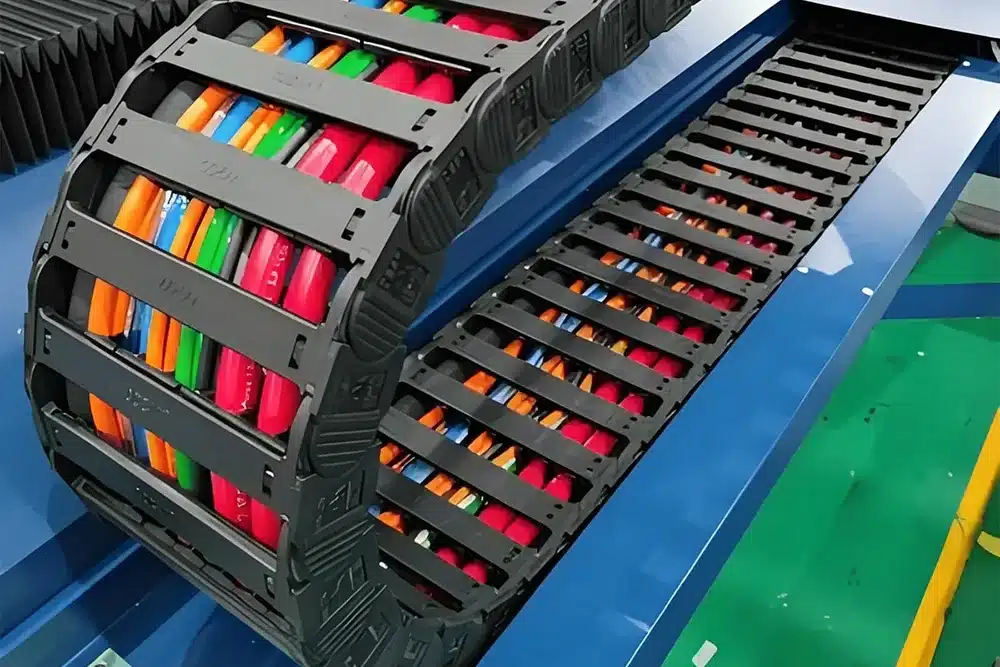
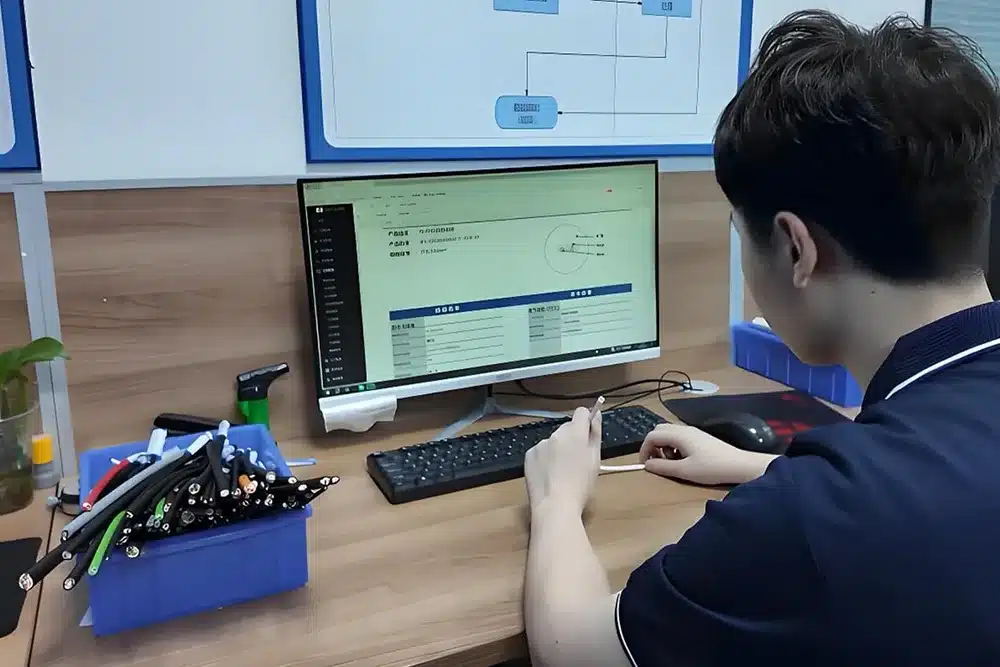
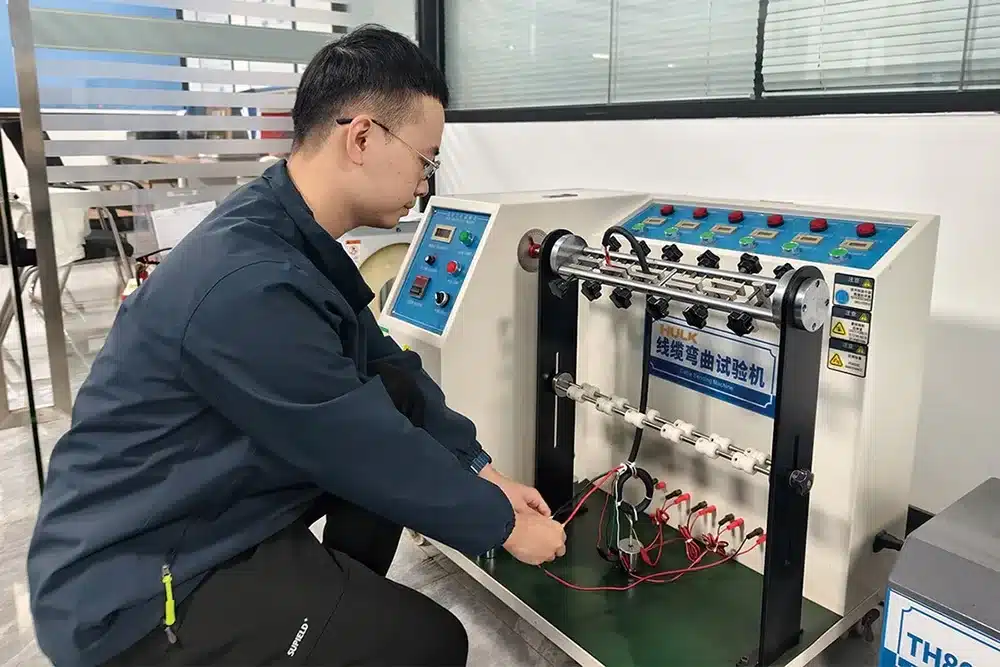
One of the most significant processes that OEM engineers undertake when designing continuous-flex solutions for automation equipment is a motion analysis and documentation of the required motion. Measuring speed, travel, acceleration, bend radius, motion type and environmental conditions, cable manufacturers can now recommend, or even design, the right type of cables to meet the demands of their high flexible cables, servo cables, or robot torsion cables for delivering millions of cycles of reliability.
Every day at Hulk Electric, we collaborate with OEM teams on custom drag chain projects. With the correct information at the beginning, conductor stranding, shielding, jacket compounds, and overall cable construction can be optimized to get the longest service life. This application guide and template will enable mechanical and electrical engineers to describe to suppliers exactly what they are looking for to ensure cables are durable and high performing, reducing downtime and maintenance.
Why Motion Documentation Matters in Custom Drag Chain Cable Projects
Custom drag chain cable design will vary depending on the application. Even top quality cables may experience conductor breakage, abrasion of the jacket, or failure of the insulation without the full motion and environmental information. Good documentation minimizes design iterations, proper chain sizing, and validation testing to match actual operating conditions.
Properly prepared requirements result in optimal cable selection, precise bend radius recommendations and longer service life in the challenging linear motion systems found in CNC machines, robotic arms, material handling and automated assembly.
The Minimum Motion Data Every OEM Engineer Should Record
Travel Distance / Stroke Length
Write the actual distance traveled or stroke length of the axis. This is one of the basic inputs that suppliers use to establish the length of the chain, estimate the push pull forces and evaluate dynamic loading. The longer the travels, the higher the friction and cable stress, especially at high-speed continuous-flex applications.
Speed and Acceleration
Record the maximum and expected speeds and accelerations for travel. These parameters have direct impact on dynamic stresses on conductors and jackets. Applications can be moderate speeds (around 1 m/s) or highly dynamic speeds (above 10 m/s) with accelerations exceeding 40 m/s2.
Cycle Frequency and Duty Profile
Record cycles per minute, daily operating hours and annual duty cycle. This data can be used to estimate complete life cycles and establish suitable test goals for endurance validation.
Motion Type
Describe the type of movement: linear, oscillating, vertical, torsional, multi-axis, and combined. Specially designed robot torsion cables are required for torsion or 3D robotic motion, which can include the right stranding and shielding methods.
Bend Radius and Geometric Envelope – The Most Commonly Under-Documented Inputs
Minimum Bend Radius
The minimum bend radius is very essential. This is used by suppliers to choose the construction of cable used and the geometry of the chain to avoid conductor fatigue and insulation cracking. Always give the tightest radius that it will come across while in full motion.
Installation Space and Routing Envelope
Provide available height, width, routing path constraints, connector exit space and sharp transitions. This data is used to make decisions with regard to cable outer diameter, chain size, and internal separators.Be sure to list the Cable Package, NOT the Motion!

Document the Cable Package, Not Just the Motion
Cable Count, Type and Outer Diameter
Write all cables and hoses in the package, their type (servo, motor, encoder, Ethernet, fieldbus), number, outer diameter and sheath material. Overall chain requirements are frequently the most decided by the stiffest or thickest cable.
Power, Signal, Data and Hose Mix
Determine the varying types of power cables, signal lines, industrial Ethernet (CAT5e to CAT7A), fieldbus, pneumatic tubes or other media. Splitting or special shielding of cable types may be required to avoid interference.
Fill Ratio and Layout Notes
Provide preliminary fill ratio targets (usually 30-60% depending on guidelines) and placement preferences (e.g., parallel routing, functional separation). This helps to keep cables bound or to wear out the chain within.
Environmental Data the Template Must Capture
Temperature, Indoor/Outdoor and Contamination
Take note of the temperature range, indoor/outdoor installation, level of dust and exposure to chips or particulates. These factors will affect the selection of the jacket material to be flexible and durable.
Oil, Coolant, Chemicals and UV
Be aware of exposure to cutting oil, coolants, cleaners, moisture or UV. Hulk’s high flexible cables can be created using specific compounds to withstand outstanding chemical resistance.
Special Mechanical Risks
Write down hazards including abrasion from chips, side loads, shock or repeated impact. This is to guide the choice of reinforcement options and protective jacketing.
Validation Inputs – What to Include So the Supplier Can Recommend Testing
Required Service Life
Set the target machine life (in years) and determine the number of cycles (cycles/day × operating days/year × years).
Test Conditions That Must Match the Application
If possible, ask the supplier to test with the same parameters: travel distance, speed, acceleration, bend radius and environment.
Prototype vs Production Notes
Understand the difference between prototype assumptions and final production requirements, to enable an appropriate evolution of testing.
Practical Template – What OEM Engineers Should Put in the Form
Use or adapt this structured template when requesting custom drag chain cables from Hulk Electric or other suppliers:
1. Project and Machine Information
- Machine type/name
- The axis name and application description.The name of the Axis and description of the application.
- OEM contact, timeline of the project.
2. Motion Profile
- The distance traveled / length of the strokes and distance covered.
- Maximum speed (m/s)
- Maximum acceleration (m/s²)
- Frequency of cycle (cycles/min or per day)
- Number of hours or days per year as required.
- Motion type (linear, torsional, multi-axis, etc.)
3. Geometric Constraints
- Minimum bend radius
- Installation height/width limits
- Routing path notes
- Connector and termination clearance: the distance between the connector and the termination.
4. Cable Package Details
- The table below is a list of cables/hoses: type, function, OD, conductor specs.
- Quantity per type
- Power/signal/data/hose mix
- The Fill ratio target and layout notes are filled with text.
5. Environment
- Temperature range (operating & storage)
- Indoor/outdoor
- Exposure to oils, coolants, chemicals, washdown
- Dust, chips, abrasion, UV, moisture risks
6. Lifecycle and Validation Goals
- The number of cycles or years needed for the required level of performance.
- For prototype or production testing, you will need the full length of the cable or cord, as well as the appropriate power source.
Common Documentation Mistakes That Lead to Wrong Cable Recommendations
- The most frequent documentation errors that result in incorrect recommendations for the cable.
- Only giving nominal rather than peak speed/acceleration values.
- Not specifying an exact bend radius or relying on the assumption that the supplier can deduce from the drawings.
- Not listing the complete bundle of cables, but listing incomplete sets of cables.
- Generalizing the descriptions of the environment—for example, use of the phrase “normal industrial” rather than an actual oil or coolant type and grade.
- Forgetting to include cycle counts or duty profile
These holes can cause several design changes or cables to fail in the field.
Final Guidance – Better Input Documentation Produces Better Custom Drag Chain Cables
One of the best approaches OEM engineers can use to enhance cable selection, shorten development cycles, and ensure the best long-term reliability is to thoroughly document motion requirements for custom drag chain cables. An internal template that is standardized provides consistency at the beginning of every request – getting engineering data that is high-quality.
Our engineering team specializes in the design of high-flexible drag chain cables, servo motor cables, robot torsion cables and industrial Ethernet solutions at Hulk Electric Dongguan (Dongguan) Co., Ltd. Send us your filled-in motion requirements and we can give you the best advice based on our extensive testing and more than 20 years in manufacture.