As the need for complete fire safety, low smoke emissions and protection of the equipment grows, halogen-free cables are becoming more and more common in industrial automation systems. When designing halogen-free cables for industrial automation, it is essential to weigh the various demands on cable performance: flame resistance, drag chain flexibility for robot axes, and performance and safety of electrical signals for servo drives, control signals, and Industrial Ethernet.
Engineers and OEMs are facing material choices that can impact long-term reliability in dynamic applications. With more than 15 years of experience in manufacturing custom high-flex and robot cables, we have helped our clients choose solutions to effectively accommodate demanding safety requirements while maintaining motion performance and signal integrity.
Halogen-Free Cable Basics in Industrial Automation
Halogen Free cables are cables with compounds in their jackets and insulations that do not contain chlorine, bromine or other halogens (often referred to as LSZH or HFFR). They release much less toxic and corrosive gas in fire and the amount of smoke is much less dense than that of conventional PVC cable.
This makes them indispensable in areas where there is a lot of cabling, control rooms or close by other occupied spaces where automation is required. With proper design, these compounds are combined with optimized stranding, shielding and geometry for servo motors, feedback systems, fieldbus and multi-axis robotics, and unlike simple material swaps, all of the above are optimized to deliver the highest performance possible.
Typical Halogen-Free Materials Used in Automation Cables
Typical materials used are halogen-free PUR (polyurethane), TPE (thermoplastic elastomers) and specialized LSZH polyolefin compounds. Materials that are resistant to burning, oil and chemical resistance, abrasion resistance and flexible for use in industrial applications.
In drag chain applications, the mechanical strength and self-extinguishing properties of PUR jackets are superior, and some TPEs can provide improved low-temperature flexibility along with good performance in moderate duty cycles, in addition to their lower cost.
Where Fire-Safety and Industrial Requirements Intersect
Halogen-free cables can be lit up and used in common facilities such as cable trays between machines, tunnels, control rooms or production lines. Low-risk areas may avail of traditional materials for internal wiring, while safety-critical applications, particularly in evacuation or costly electronics areas, can be supplied with or even require LSZH specifications.
Fire Performance Requirements – What Automation Engineers Need to Consider
When it comes to fire protection in automation cabling, it’s all about minimising smoke obscuration, limiting flame spread and any corrosive by-products that may lead to damage in drives, PLCs or communication hardware. Halogen-free designs are made possible by special fillers systems and polymer matrices instead of the use of halogen-based retardants.
The engineer should consider cable selection in the context of the overall fire-safety strategy, such as tray routing and system layout.
Flame-Retardancy vs Flame-Resistance vs Fire-Resistance in Automation Cables
Unlike fully fire-resistant cables, most halogen-free automation cables are flame retardant, meaning that they are able to withstand fire for a certain amount of time without burning through and maintaining circuit integrity. They work well for stopping flames from spreading across bundles of cables in trays or harnesses and are usually adequate for industrial automation applications but not for emergency power circuits.
Smoke and Corrosive Gas Behaviour Around Automation Equipment
Older halogenated cables produce voluminous smoke and acidic fumes which can harm sensitive electronics and impair visibility during an incident. These risks are greatly mitigated when using halogen-free alternatives, with superior protection of control cabinets, robot controllers and network infrastructure and enabling quicker recovery and safer evacuation.

Designing for Flexibility and Motion – Halogen-Free Cables in Drag Chains and Robot Axes
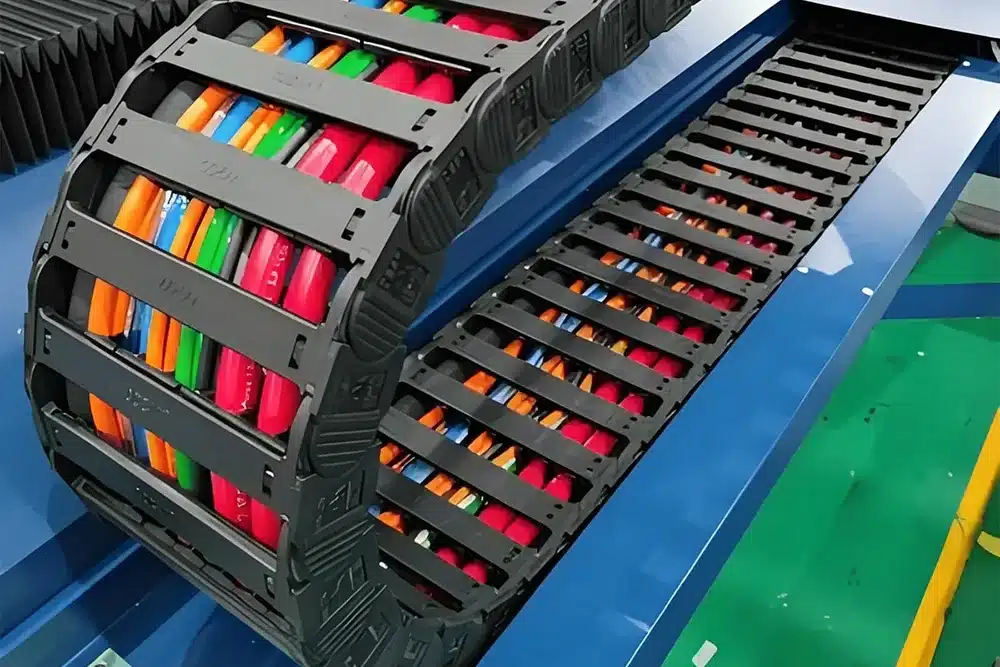
Drag chains and robot arms are constantly flexing and rotating and require cables that will withstand millions of cycles of flexing. However, halogen free compounds have to be formulated and built in ways that do not lead to cracking or increases in stiffness which are a problem in poorly adapted designs.
Halogen-Free Jackets in Drag Chain and Movable Applications
Halogen-free PUR and advanced TPE jackets are engineered to provide a balance of flame resistance, low smoke and excellent industrial fluid resistance. When carefully engineered, these conductors provide high flex life equal to best available PVC products by using fine-stranded conductors, optimized lay lengths and appropriate fillers.
Replacing a PVC jacket without changing the entire cable design may result in poorer mechanical performance.
Torsion, Bend Radius and Flex Life in Halogen-Free Cables
In robot applications, check the minimum bend radius, torsion and cycle rating data for halogen-free construction. Manufacturers such as Hulk can optimize these parameters to exact 3D motion profiles, eliminating flex point wear.
A basic understanding of electrical requirements, such as voltage, EMC and signal integrity, in halogen-free automation cables.
Electrical Requirements – Voltage, EMC and Signal Integrity in Halogen-Free Automation Cables
Transitioning to halogen-free must preserve dielectric strength, insulation resistance, and shielding effectiveness critical for power, control, and high-speed data transmission.
Insulation Performance and Voltage Ratings
LSZH insulations have high volume resistivity and are stable over the temperature range and under overload conditions. This helps to operate the standard voltage ranges of the automation and helps to guarantee reliability in servo power and control circuits.
Shielding, EMC and Noise Control in Halogen-Free Cables
Highly effective EMC performance depends on the use of compatible braids, foils, or hybrid shields with halogen-free jackets that will not interfere with the signal. It is essential for Industrial Ethernet, encoder feedback systems and fieldbus systems in noisy factory environments.

Material Choice and Environmental Resistance for Halogen-Free Automation Cables
In addition to fire resistance, jackets need to resist oils, coolants, temperature extremes and abrasion common to automation plants.
Oil, Coolant and Chemical Resistance in Halogen-Free Jackets
For exposure to cutting oils and hydraulic fluids, a high quality halogen-free PUR compound offers excellent protection, often equal to or superior to many conventional materials in actual applications. Always refer to chemical compatibility charts for particular plant conditions.
Temperature Range and Climatic Performance
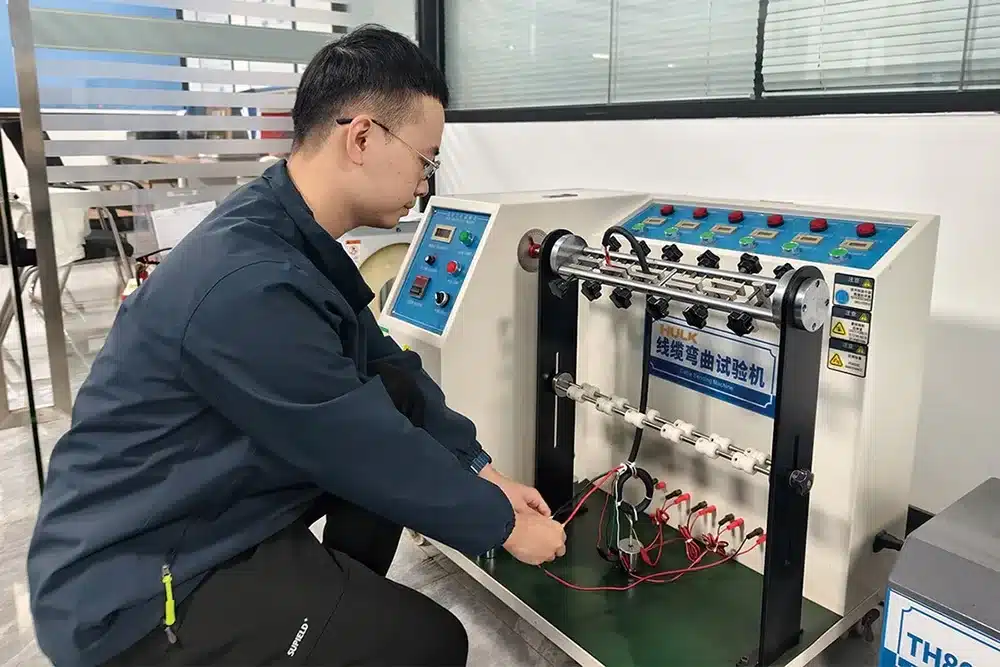
Modern halogen free cables can be flexible at low temperatures in cold storage or operate under the heat in the machine. Long-term elasticity and electrical stability is confirmed with thermal cycling tests in dynamic use.
Specifying Halogen-Free Cables in Automation Projects – Practical Steps
The success of this implementation begins with the requirements capture and close interaction with company experienced manufacturers.
Capturing Motion, Environment and Safety Requirements in RFQs
Provide details on halogen-free/LSZH requirements, bend radius, number of times bent, chemical exposure, voltage rating, EMC performance and life expectancy. This allows for personalized proposals instead of general ones.
Working with Cable Manufacturers on Custom Halogen-Free Automation Cables
Co-development enables optimization of the compound, geometry and shielding in a hybrid servo/feedback or multi-protocol robot harness. Our engineering team at Hulk Electric collaborates directly with the OEMs to provide seamless integration of cable into drag chain and robotic system to satisfy fire safety objectives.

Balancing Trade-Offs – Cost, Complexity and Performance in Halogen-Free Automation Cabling
Although halogen free cables can be more expensive due to the superior materials and testing, they can actually save on total ownership costs through equipment protection, reduced downtime and compliance benefits. Target deployment instead of universal use.
Where Halogen-Free Cables Add the Most Value in Automation Systems
Locate them in dense packing trays, control rooms, near people, or around valuable electronics or equipment. Where appropriate, it may be possible to leave the internal wiring satisfactorily in PVC for low-risk machines.
Avoiding Over- or Under-Specification
An application-specific approach, well thought out, will avoid unnecessary expense or missed risks. Working with the specialists guarantees well-balanced layouts customized to your specific automation issues.
Ultimately, the answer lies in the knowledge of these interconnected requirements and the engagement of manufacturers with extensive knowledge and automation skills. Hulk Electric’s high-flex, servo, robot and fieldbus cables have been designed with care to meet these tough balances: For 30+ countries, serving with reliability. .