Warehouse robots and AGVs operate almost nonstop in modern fulfillment centers, executing millions of motion cycles while navigating tight spaces, handling heavy loads, and enduring constant vibration, impacts, and environmental stresses. Standard off-the-shelf cables often fail under these combined demands of continuous flexing, torsion, abrasion, and signal integrity requirements. Custom cables for robotics and AGV systems—engineered as specialized material handling cables—become essential to prevent conductor breakage, jacket wear, connector failures, and costly downtime that can halt entire warehouse operations.
At Hulk Electric, we have supported numerous warehouse automation projects by engineering flexible cables that match exact motion profiles, environmental conditions, and electrical needs. This guide shares practical design considerations drawn from real deployments to help engineers specify reliable solutions that maximize uptime and lower total ownership costs.
Mapping Warehouse Automation Use Cases – Robots, AGVs, Shuttles and Conveyors
Different warehouse systems impose unique mechanical and electrical stresses on cables. Understanding these helps engineers select or design the right custom solutions from the start.
Robotic Arms and Pick/Place Systems
Robotic arms in picking, packing, and palletizing stations perform complex 3D movements with frequent twisting at joints and wrists. These applications demand torsion-rated robotics cable solutions capable of handling multi-axis motion while maintaining signal integrity for encoders and vision systems. Fine-stranded conductors and specialized shielding protect against fatigue near servo motors and drives.
AGVs/AMRs and Mobile Warehouse Robots
Autonomous guided vehicles and mobile robots travel long distances repeatedly, often with onboard lifting mechanisms, sensors, and batteries. Cables here must support power delivery during frequent acceleration and charging cycles while routing through compact chassis exposed to floor vibrations and occasional collisions. Custom designs ensure reliable operation without snagging or premature wear.
Shuttles, AS/RS Systems and Conveyors
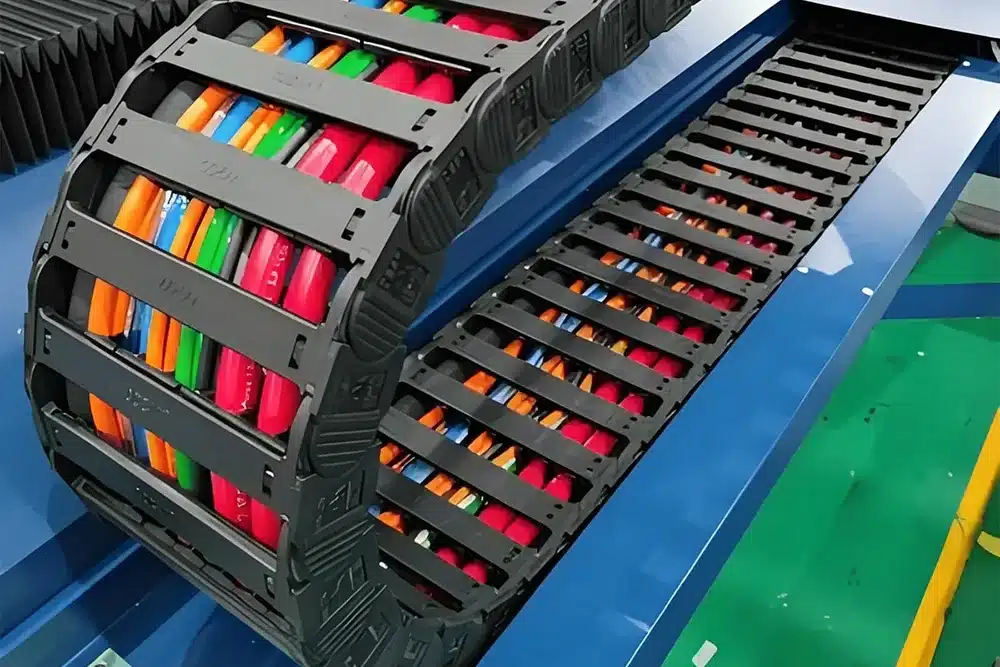
Automated storage and retrieval shuttles plus conveyor systems rely on linear flexing cables in energy chains for carriage movement, feedback signals, and safety circuits. These demand high-cycle continuous-flex cables with optimized bend radii to survive thousands of daily traversals along racking without signal degradation or mechanical failure.

Mechanical Design Considerations – Flex Life, Torsion and Bend Radius
Mechanical performance determines whether cables survive the intense duty cycles of warehouse automation.
Continuous-Flex Life Targets in Warehouse Robots and AGVs
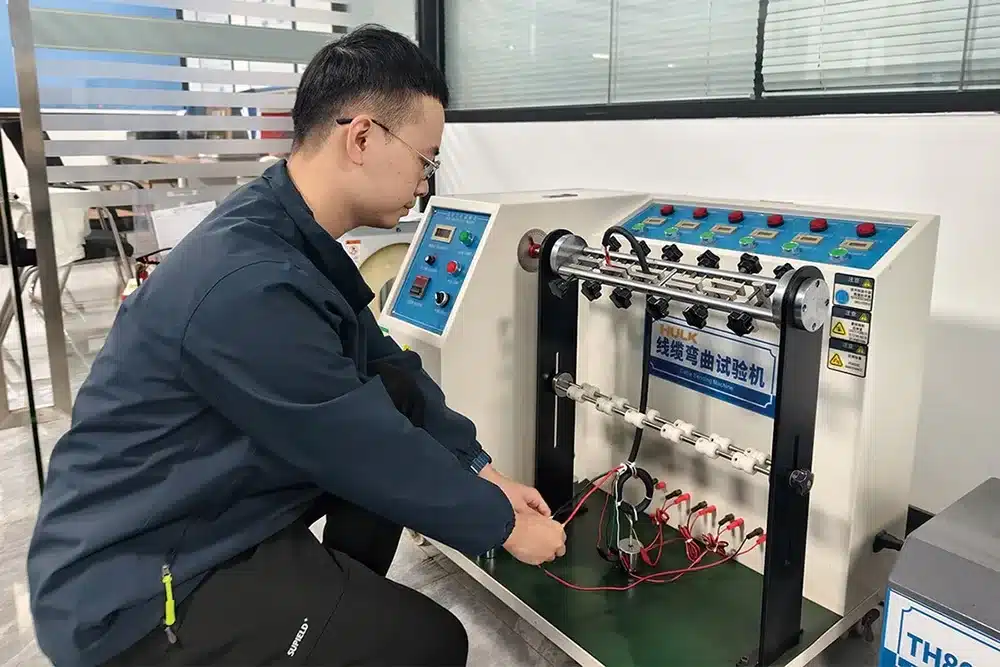
High-duty warehouse applications typically target 5–10 million or more bending cycles. Engineers calculate required flex life by multiplying cycles per minute by operating hours, then applying a safety factor. Custom cables achieve these targets through ultra-fine conductor stranding, high-quality insulation, and robust yet flexible jackets developed via rigorous high-flex cable engineering and tested under simulated warehouse conditions.
Designing for Torsion in 3D Robotic Motion
Torsion occurs when cables twist around their axis during robotic wrist or joint rotation—often combined with bending. Torsion-rated cables use special lay configurations and shielding to prevent internal stress buildup. For warehouse robotic arms requiring ±180° or more rotation, these designs significantly outperform standard flex cables and reduce failure risks at dynamic joints.
Bend Radius and Cable Management in Carriers and Guides
Maintaining the manufacturer’s minimum bend radius (commonly 4–7 times the cable outer diameter depending on type) is critical for longevity. Proper energy chains or triflex guides protect cables from kinking, abrasion, and crushing while controlling movement. Early CAD routing checks at full motion extremes prevent field issues.

Electrical and Signal Integrity Considerations – Power, Control, Feedback and Data
Warehouse systems combine high-power drives with sensitive sensors and networks, requiring careful cable segregation and shielding.
Power and Drive Cables for Motors and Actuators
Servo and motor cables must handle peak currents during rapid starts and stops without overheating. Custom constructions with appropriate conductor sizing, insulation, and VFD-rated shielding minimize electromagnetic interference with nearby control lines in dense AGV or robot chassis.
Feedback, Sensor and Safety Signals
Encoder, proximity, and safety interlock signals operate at low voltages and are vulnerable to noise. Twisted pairs, individual shielding, and physical separation from power cables prevent false trips that could stop AGVs or robotic operations unexpectedly.
Data and Network Cables for AGVs and Warehouse Robots
Industrial Ethernet and fieldbus cables (PROFINET, EtherCAT, etc.) in mobile robots require motion-rated designs with precise impedance control and robust shielding. Office-grade cables quickly fail in dynamic warehouse environments, leading to communication dropouts and fleet coordination problems.

Material Selection – Jacket and Insulation for Warehouse Environments
Jacket and insulation materials must withstand warehouse-specific stresses like dust, impacts, temperature variations, and occasional cleaning.
TPE/PUR vs PVC for High-Flex Warehouse Applications
TPE and PUR jackets excel in warehouse robots and AGVs due to superior flexibility, abrasion resistance, and performance under repeated motion and moderate oils/greases. PVC jackets tend to stiffen and crack faster in high-flex drag chain applications, making TPE/PUR the preferred choice for long-term reliability.
Temperature, Dust and Humidity Considerations
Warehouses often range from ambient to cold storage or warm loading docks. Custom cables use materials that retain flexibility across these swings while resisting dust accumulation and humidity effects on insulation.
IP Ratings, Cleaning and Impact Resistance
Connectors and cable assemblies in floor-level AGVs frequently need IP65–IP67 protection. Thicker, tougher jackets combined with proper strain relief help cables survive pallet impacts and routine washdowns.

Connectors, Harnesses and Cable Management in Warehouse Robots and AGVs
Proper connectivity and organization complete the system design.
Choosing Connectors and Interfaces for Mobile Systems
M8/M12 circular connectors with locking mechanisms and strain relief dominate warehouse robotics for their vibration resistance and compact size. Custom harnesses match these to exact cable types for plug-and-play reliability.
Harness Architecture and Modular Design
Modular harnesses simplify installation and maintenance on robotic arms and AGV chassis. Grouping power, signal, and data lines with clear labeling and quick-disconnect points reduces service time during planned downtime.
Cable Management Hardware – Chains, Guides and Supports
Selecting the right cable carriers early in design protects the entire harness. Quality chains maintain bend radius and isolate cables from external damage in high-motion warehouse environments.

Reliability, Testing and Maintenance – Keeping Warehouse Automation Running
Long-term performance depends on validation and proactive care.
Testing Continuous-Flex and Torsion Performance Before Deployment
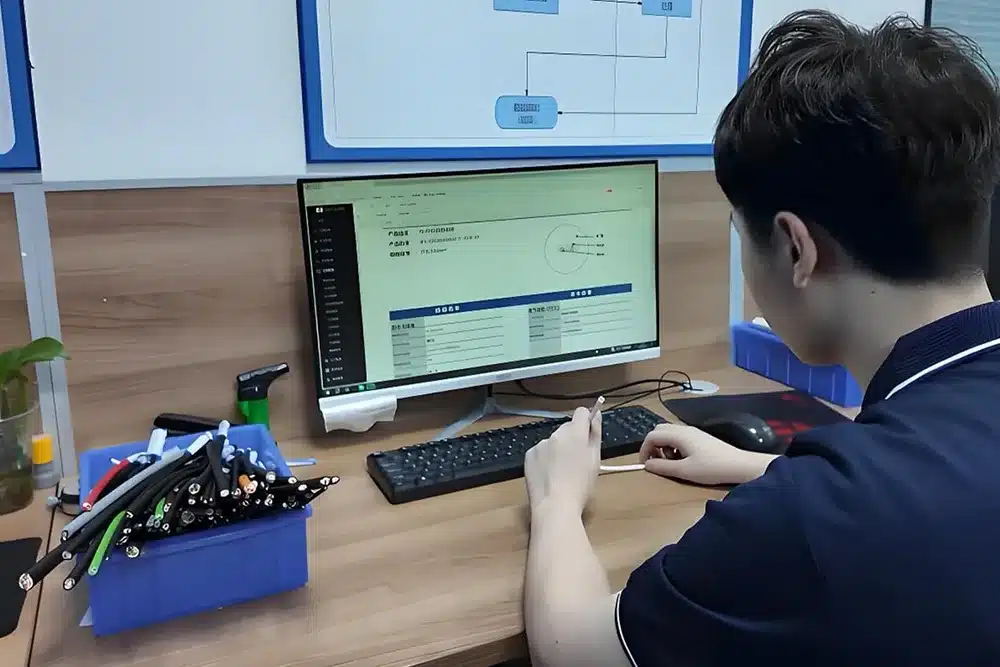
Request detailed flex and torsion test reports matching your duty cycle, bend radius, and speed. Pilot testing on representative robot cells or AGVs reveals issues before full rollout.
Monitoring Cable Health and Planning Replacements
Regular visual inspections for jacket wear, connector integrity, and unusual motion help predict failures. Many operators schedule replacements based on calculated cycle life rather than waiting for breakdowns.
Calculating Downtime Costs and Justifying Better Cable Designs
A single hour of robot downtime in a busy fulfillment center can cost thousands in lost throughput. Investing in properly specified custom cables often pays back quickly through reduced maintenance and higher availability.
Practical Design Checklist for Custom Robotics and AGV Cables in Warehouses
Use this checklist when preparing specifications or RFQs:
Key Questions About Motion, Environment and Signals
- What motion types (flex, torsion, static) and minimum bend radii apply to each cable path?
- How many cycles per day/year are expected, and what safety factor is needed?
- What are the environmental conditions (temperature range, dust, oils, cleaning) and required IP rating?
- Which power, control, feedback, and data functions share routes, and how will shielding and separation be handled?
What to Ask Custom Cable Manufacturers for Warehouse Robotics/AGV Projects
- What flex life and torsion ratings (cycles and degrees) have your cables achieved in similar applications?
- Which jacket and insulation materials do you recommend for our specific warehouse conditions?
- Can you provide test data, reference installations, and sample harnesses?
- How do you design modular harnesses for fast field replacement?
Answering these questions thoroughly leads to cables engineered precisely for warehouse demands.
Selecting and designing custom cables for robotics and AGV systems requires balancing mechanical endurance, electrical performance, and environmental resilience specific to warehouse automation and material handling. By addressing motion profiles, material choices, and testing early, engineers can dramatically reduce failures and support higher productivity.
At Hulk Electric, our robot & torsion cables, high-flex servo cables, industrial Ethernet solutions, and custom harness capabilities are built for exactly these demanding applications. Share your project parameters—motion cycles, environmental conditions, and signal requirements—and our team will deliver tailored, high-reliability cable solutions that keep your warehouse systems running smoothly.