In compact machines where every millimeter counts, choosing and designing the right continuous-flex cable and drag chain system becomes critical. Small footprint machines like miniature CNCs, lab automation, desktop robots, and compact packaging lines require cables capable of high-cycle performance and ability to bend at very small angles, low chain heights and limited space.
At Hulk Electric, we can solve these space constraints with advanced high-flex cable constructions and intelligent use of drag chain design in conjunction with OEM engineers. This guide provides hands-on advice for effectively utilizing drag chain cables in extreme conditions and in the limited space available without compromises on durability or uptime.
Why Small Footprint Machines Push Drag Chain Cables to Their Limits
The modern compact automation system puts emphasis on small size of the total machine, the ease of integration, the decrease of material expenses and the increase of machine density in production floors. But these designs still need to provide continuous linear motion with thousands of cycles per day.
The problem is that with smaller machines, bend radii must be greater and the envelopes of the chain must be smaller. A high minimum bending radius cable that is used in a normal installation could fail rapidly if it does not fit in the space available, resulting in conductor fatigue, jacket abrasion or unexpected downtime.
Continuous-Flex Cable Basics in the Context of Tight Spaces
What Continuous-Flex / Drag Chain Cables Are Optimized For
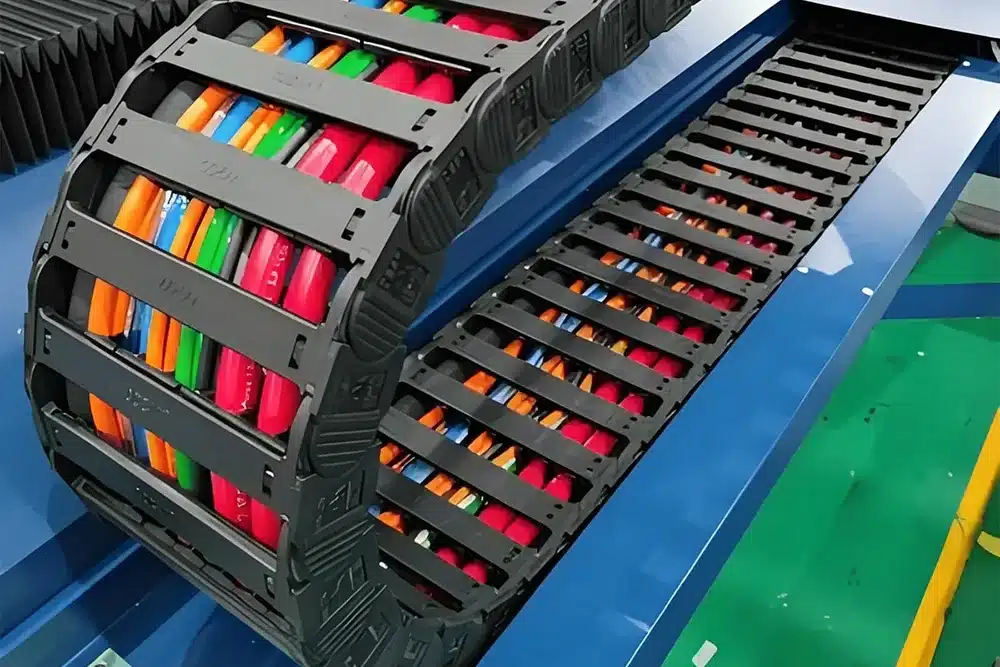
Continuous-flex cables, or drag chain cables, are made with fine-stranded conductors and special core designs and offer strong, flexible jackets that are designed for repeated bending in one plane. They are electrically and mechanically sound in continuous movement in cable carriers, as opposed to standard cables.
These cables are designed to be extremely flexible, with a minimum outer diameter (OD) to fit into small spaces, and capable of reliably carrying power, signals and data through small footprint machines.
Minimum Bending Radius as a Core Design Driver
The limiting factor is usually the minimum bend radius which is usually measured as a multiple of the cable’s OD. A good rule of thumb for many continuous-flex uses is that you should have a ratio of about 10× OD, but for specific high flex designs use the lower ratio, if possible. The minimum bend radius of the drag chain must always be greater than that of the tightest bend radius of any cable within the chain, with a safety factor.
Designing Cable Geometry for Small Bend Radii
Fine Stranding and Conductor Geometry
High-flex cables from Hulk feature super thin wire stranding and specially formulated lay lengths that enable each strand to bend independently within the cable. This means that the internal stress is minimized and smaller bend radii can be used without affecting current carrying capacity and signal integrity.
In confined areas, we suggest choosing cables that are compact conductor class, designed for dynamic applications.
Insulation and Jacket Choices That Support Tight Bends
Flexibility and diameter are directly related to material selection. Polyurethane (PUR) and specific TPE jackets provide the best flexibility, resistance to abrasion and bend radii achieved. These materials are also chemically resistant which is appropriate for industrial applications.
The engineers have to compromise the jacket thickness for durability and the need for minimum OD for small chains.
Sizing Drag Chains for Tight Spaces – Height, Width and Radius
Inner Height – Largest Cable OD + Clearance
Inner height should be sufficient enough to allow for the largest cable’s OD plus about 10% clearance for free movement and compression free. If you have very tight machines, consider cables with less OD, or combine functions into hybrid cables, to save the height you need.
Inner Width – Sum of Adjusted ODs + Dividers
Determine inner widths from sum of all cable diameters (with adjustment factors), and separator space. Small chains wear faster if they are overfilled, due to the friction. Try to keep cables moving independently; seek out a fill factor that allows them to do so.
Bend Radius – Driven by the Thickest or Stiffest Cable
Always use the size of chain bend radius for the cable that has the greatest minimum bend radius requirement. In most tight designs this means either using or adapting cables that offer greater flexibility or avoiding the use of standard cables in undersized chains.

Layout and Separation Strategies for Small Chains
Fill Factor and Free Movement
Ensure cables are not stretched beyond recommended fill percentages (usually 60-80%, as advised by the manufacturer) so they can move fluidly when in use. If you need to use chains in tight areas, think about using multiple small chains or hybrid cable designs so that you don’t get too crowded.
Separators and Compartment Design
Well-designed separators keep cables from getting tangled and from wearing out unevenly when used with various-sized or power/signal cables. For compact chains, the minimum number of dividers required to keep the chain in order without consuming space in the middle.
Handling Different Diameters in Tight Spaces
As much as possible, use larger or stiffer cables on the outside of the chain, and keep cables of different diameters apart to assure even load distribution and smooth operation.
Motion and Load Considerations Specific to Compact Machines
Short Travel, High Speed and Acceleration
Although the distance traveled by small machines, such as those used in the Home Office, is generally brief, the acceleration and speed of the machine can still be a major source of dynamic stress. Record precise motion parameters (travel, velocity, acceleration) for each axis and use that to determine cable and chain specifications.
Load-Bearing Capacity and Combined Weight
Move as little mass as possible – use high flex cables that are light. It will lower chain tension and help to extend the service life for small, high-duty applications.
Example Design Patterns for Small Footprint Machines
Compact Cartesian Axis with Limited Height
If you need vertical envelopes that are tight, choose a small OD continuous-flex cable from Hulk’s high-flex series and match the chain height precisely to the largest cable and the clearance. Use the minimum number of separators for alignment if you need to use them.
Small Robotic Wrist or Rotary Device
For applications involving both rotary and short linear motion, choose cables that are highly flexible and have very small bend radius, while at the same time being torsion resistant. Minimize and shorten turns.
Miniature CNC or Desktop Machine
Ensure that all cables are counted and ordered, heavier cables should be located close to chain edges, fill factors must be respected, and drag chains should be selected with the optimized small bend radii for precision and reliability.
Design and Documentation Checklist for Continuous-Flex Cables in Tight Spaces
- Write down the correct length, speed and acceleration of each moving axis.
- Give OD and minimum bend radius on all cables and hoses.
- Use cables that are specifically designed for continuous flexing and that can be bent tightly.
- Use the largest OD and total adjusted diameters to calculate chain inner height/width.
- Check to ensure that chain bend radius meets or exceeds the most stringent cable requirement.
- Use separators where appropriate and keep proper fill factor.
- Assess combined dynamic loading and emphasis weight reduction.
Final Guidance – When Machines Shrink, Continuous-Flex Cable Design Needs to Get Smarter, Not Just Smaller
As machine sizes shrink, so does the significance of carefully designing continuous-flex cable and drag chain. A too-simple reduction of parts without considering bend radius, geometry and layout can often result in early failures.
OEMs can leverage from an experienced manufacturer like Hulk Electric, which can provide them with a high-flex cable that is uniquely designed for the performance in tight spaces. Tell our engineers about your machine and we’ll work to provide you with solutions that ensure consistent motion even in the most demanding of spaces.