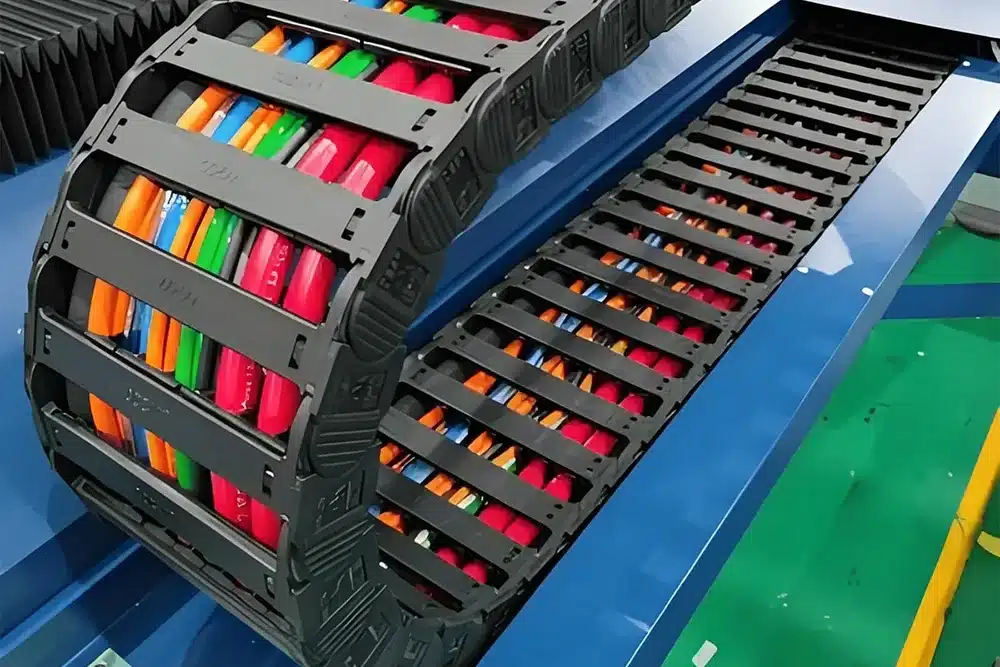
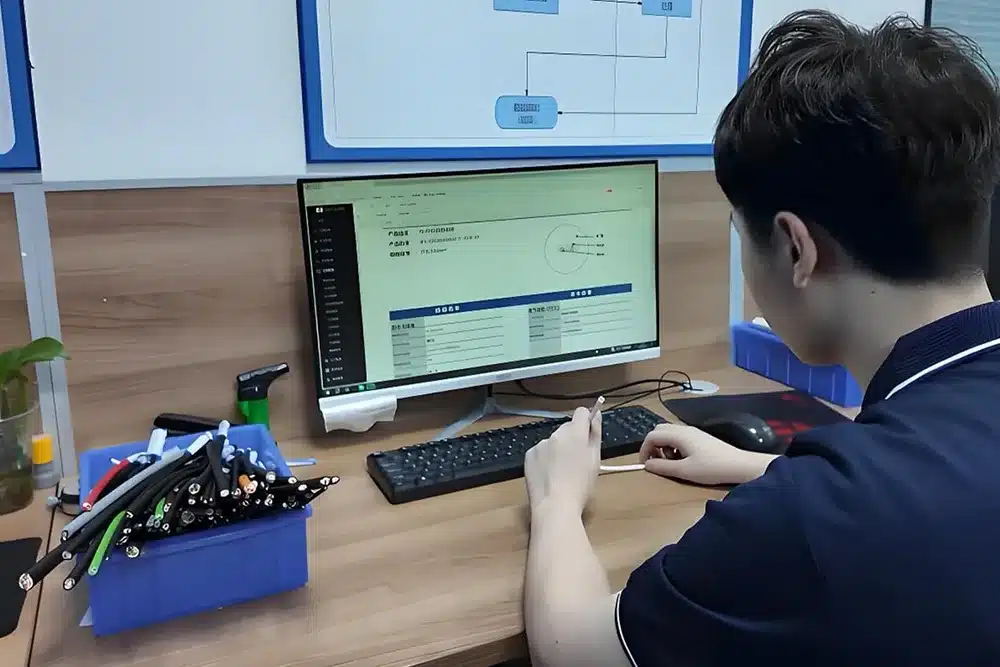
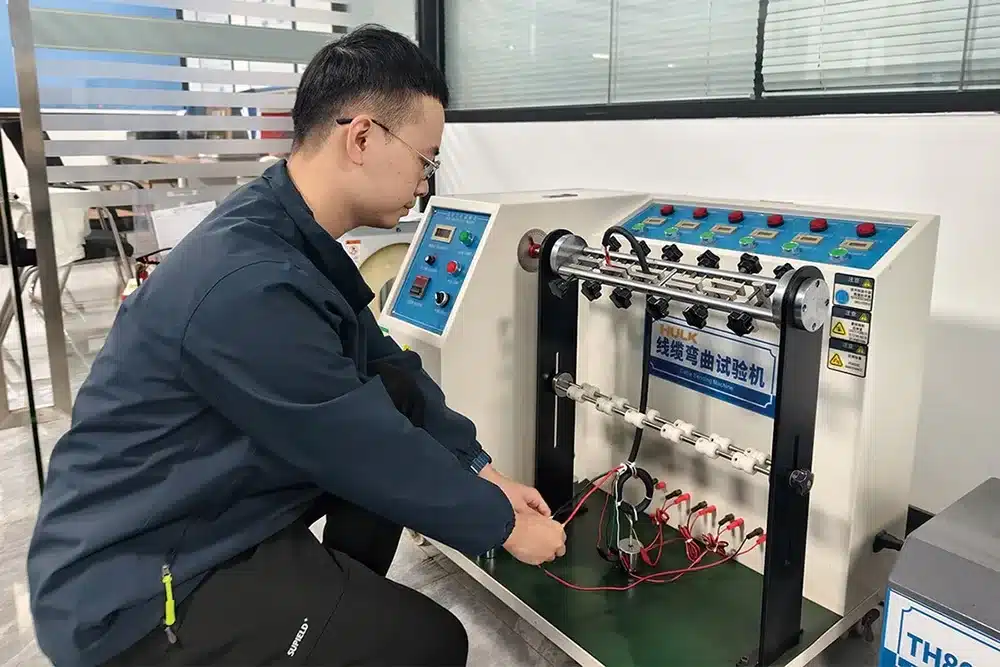
Torsion cables are highly vulnerable to extreme twisting and repeated bending in industrial robots and are essential to multi-axis robots. In industrial robots, failure of the torsion cable can occur over a period of time and lead to the distortion of the jacket, fatigue of the conductor or damage to the shields, all three scenarios resulting in expensive downtime. We’ve experienced at Hulk Electric for the last 15 years, the benefits of early diagnosis in high cycle applications to prevent unplanned stops.
This hands-on reference book provides maintenance, reliability, and integrators with descriptions of failure modes, signs and symptoms, and step-by-step diagnostic routines of practical application in the real world of robot cable behavior.
How Torsion Loads Stress Robot Cables Differently from Simple Flexing
When robot torsion cables are used in 6-axis arms (wrist and forearm joints rotate widely), they are subjected to bending in addition to rotational twisting along the cable axis. Torsion-rated cables are different from regular drag chain cables, which are designed to run back and forth in the chain.Torsion rated cables are not the same as drag chain cables which are designed to run back and forth in the chain, and will allow for more than ±360° of cumulative twist to occur in tight sections.
Torsional Motion in 6-Axis Robots—Where the Cable Suffers Most
Axes 4, 5 and particularly 6 create the maximum torsional stresses. During complicated paths, these types of joints tend to twist in different directions, which can lead to twisting in short sections of cable close to the robot wrist. The recognition of these high stress areas enables the inspections to be concentrated in the areas where failure often starts.
Design Differences Between Torsion-Rated and Linear Flex Cables
Torsion cables are made with longer lay lengths in conductors, special shielding braids to adjust for changes in conductor diameter when being twisted, and strong jackets designed to prevent the cable from corkscrewing. Linear flex cables don’t have these capabilities, and when used in rotational situations, they will eventually be stressed, broken, and fatigued.

Mechanical Failure Modes in Torsion Cables—What You Can See and Feel
There are numerous problems that become apparent during normal maintenance or inspection of the cable.
Corkscrewed or Spiralled Jackets
If the jacket’s twisted or spiraled along its length, trapped torque, or a wrong type of cable, has occurred. The distortion means that there is an excessive stress to the internal elements and is commonly a precursor to more serious conductor or insulation failure.
Jacket Abrasion, Cracking and Notching at Contact Points
Unpredictable rubbing of robot surfaces, energy chains or guides due to torsion motion. Keep an eye out for localized wear, cuts or notched edges, as these are some early signs that the protective sheath is damaged, and internal components will soon be exposed.
Fatigue Fracture of Conductors and Internal Elements
The individual strands have a tendency to split apart internally when repeatedly twisted and bent. The external cues are confined localised stiffening/swelling/kinks. These fractures result in intermittent power or signal failure, but not total failure.

Electrical and EMI-Related Failure Modes—When Noise Becomes a “Mechanical Problem”
Often the physical torsion damage is the primary cause of electrical symptoms.
Shield Damage and EMI-Induced Signal Faults
Shielding braids can break under torsion, resulting in the transmission of EMI. This causes encoder drift, bus communication errors or noisy signals that worsen at certain arm positions.
Intermittent Encoder and Sensor Errors
Common symptoms include position errors, false homing, or only the sensor reading flickers in some movements. They are commonly caused by broken conductors or broken insulation at the torsion points, and are generally mistaken for electronic problems instead of cable problems.
Connector and Strain Relief Failures at High-Stress Points
Stresses are concentrated at terminations. Too tight of clamps, inadequate strain relief or weakened solder joints result in intermittent opens or shorts, particularly when subject to dynamic torsion.

Installation-Related Failure Modes—When the Cable Was “Bad” Only Because It Was Installed Wrong
Failure issues are often caused by handling or routing problems, rather than material limitations.
Twists Imported During Installation and Locked-In Torque
When cable is pulled straight off the reels with no rotation, pre-twist will be added in. This locked torque increases the corkscrew rate and greatly reduces service life.
Over-Clamping, Over-Tension and Over-Filling Chains
Restrictive ties, or over-filled energy chains, will reduce natural movement and increase the torsional stress. For long-lasting cables, they should be laid out with enough side-by-side space and loose ends.
Wrong Cable Type—Linear Flex Cables in Torsion-Dominant Axes
Using non-torsion-rated cables in rotary joints predictably leads to the mechanical and electrical failures outlined above.
Early Warning Signs and Inspection Routines—How to Catch Problems Before the Robot Stops
Proactive checks identify problems at an early stage.
Visual Inspection Checklist for Torsion Cable Harnesses
- Check for corkscrewing, spiraling or unequal twist.
- Inspect areas of abrasion, cracks, notched areas, or crushed areas, particularly in high-motion areas.
- Check for tightness and alignment of clamps, ties and strain reliefs.
- Check proper routing, allowing 10-15% slack; avoid crossing in chains.
Do these at regular intervals (cycle counts).
Functional Checks—Linking Motion Patterns to Fault Symptoms
Rotate the robot through full arcs, using diagnostics. Compare error log with joint positions to identify cable problems that may be due to torsion.
Basic Electrical Tests for Suspected Cable Problems
Use multi-meter for continuity and insulation resistance. Run gentle wiggle tests at suspected areas, while monitoring signals. Do not need to splice for consistency of performance.

Linking Cable Failures to Robot Downtime and Predictive Maintenance
Cable problems grow rapidly into complete shutdowns. Structured monitoring minimizes risk.
How Cable Failures Escalate from Minor Faults to Full Line Stops
Persistent faults can result from intermittent errors, causing safety stops and production downtime. This cascade can be prevented by early intervention.
Using Condition Monitoring and Fatigue Point Identification
Monitor trends in errors in relation to motion data. Implement cable checks within comprehensive predictive maintenance programmes with Cycle counting and Zone analysis.
RFQ and Design Feedback Loop—Preventing Repeat Failures
Record thoroughly to make future selections better.
What to Document After a Torsion Cable Failure
Document the problematic axis, cable specification, routing, environment and observed symptoms.
Questions to Ask Cable Suppliers After Failures
- When things fail what are some questions to ask cable suppliers?
- Is this cable the correct torsion angles and cycle requirements?
- What would be the best improvements (jacket, shielding, lay length) to our design?
- What are the installation best practices to avoid recurrence?
Our robot torsion cables are designed with quality conductors, an excellent torsion shield and high-flex jackets that undergo millions of flex cycles. Real Application Data is used to help optimize your harness designs.
Torsion cable failures tend to occur in a predictable pattern. Disciplined inspection of mechanical and electrical signs in the early stages can help your team properly diagnose problems in advance and keep robotic operations running at higher uptime.