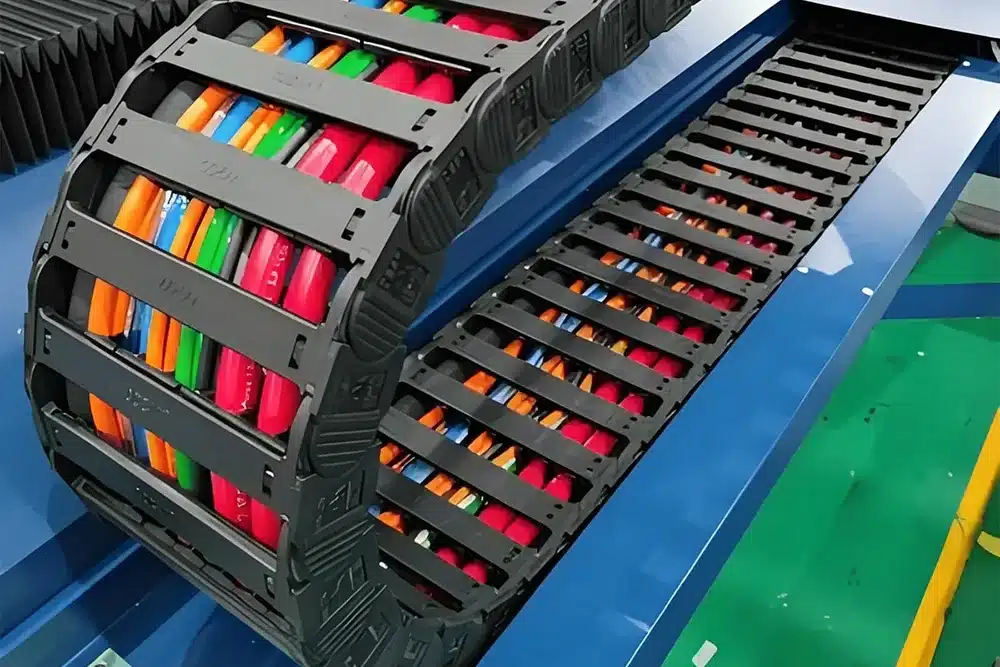
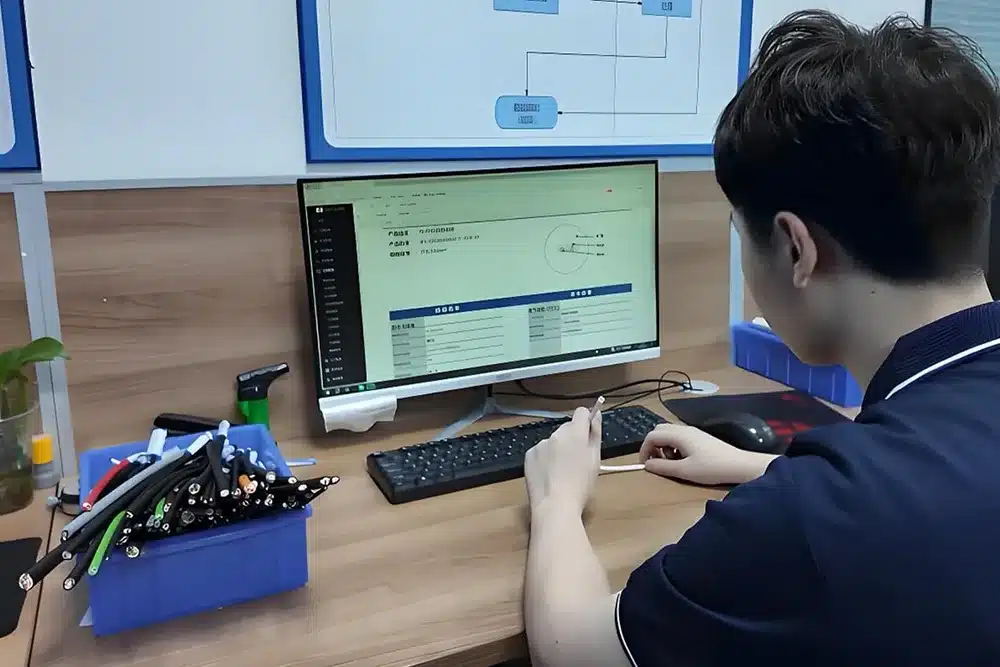
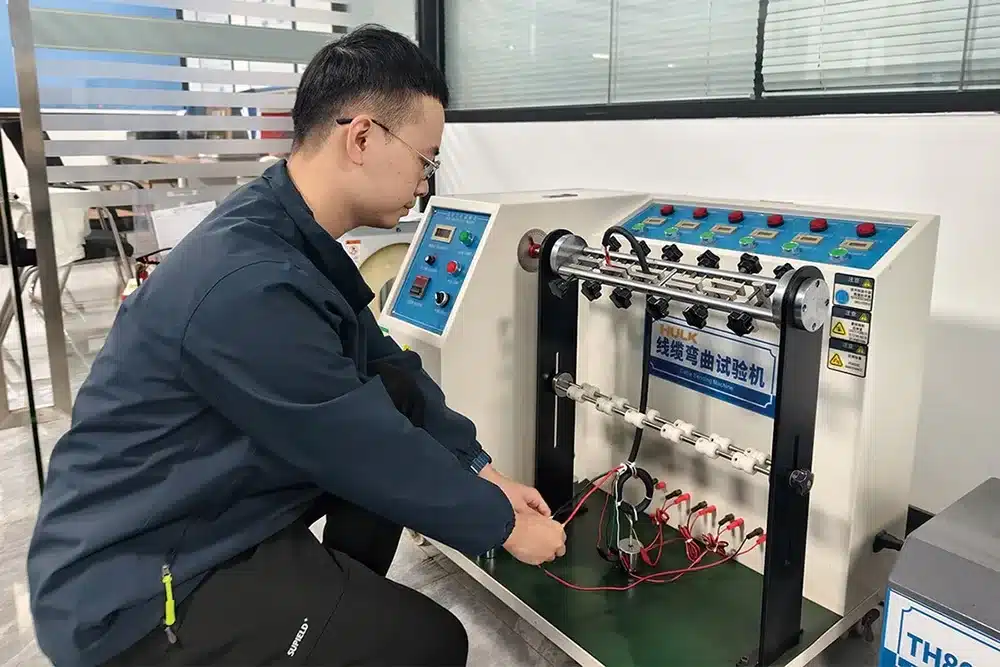
OEM engineers verify that high-flex cables meet millions of reliable bending cycles in real motion systems by using prototype drag chain cable testing. We’ve seen so many automation projects come to Hulk Electric that a proper validation testing captured design flaws at an early stage, avoiding costly failures in the field and helping to ramp up production more smoothly. This guide provides insight into the process of targeted prototype testing for validating flex life claims and minimizing overall risk on OEM equipment.
Why Flex Life Matters in OEM Motion Systems
Drag chain cables are found in various applications in robotics, such as CNC machines, material handling systems, and automated assembly lines, where they are subjected to continuous motion. One cable failure can cause an entire production cell to stop and result in downtime, safety problems and warranty claims. Manufacturers such as Hulk have high-flex cables designed for these applications, and of course the performance of the cable in real-world applications depends on the type of flex that matches the motion profile.
Prototype testing helps to complete the information between catalog ratings and duty cycle. It gives an empirical data that gives design teams confidence prior to the scaling up to production.
What Flex Life Really Means in Drag Chain Applications
Flex life is the number of cycles that a cable can bend and twist through without electrical or mechanical degradation. Typically, manufacturers will quote numbers of 5-20 million cycles or higher for high-flex drag chain cables, but this applies only when the construction is the same as your application.
From Lab Ratings to Real-World Cycles
While there are standard parameters used for generic lab testing, the combination of bend radius, speed, acceleration, travel distance and environmental stressors can be unique with OEM motion systems. Prototype testing in real-life conditions helps to see how the cable actually performs during its service life.
Matching Flex Life to Application Requirements
Estimate the number of cycles your machine will last by multiplying the number of days your machine runs (per year) by the number of days your machine is used (per year) times number of service years. For critical applications use a safety margin of 1.5-2x. In high duty automation applications, testing to or beyond this target helps to guarantee reliability.
Common Flex-Life Test Methods for Drag Chain Cables
There are a number of well-known techniques used to simulate the stresses that cables are subjected to within an energy chain.
Tic-Tock (Bend Radius) Tests
This repeated bending test is a variant of the linear motion continuous flexing done in one plane, repeated by rotating the cable around a fixed radius. They test the integrity of the conductor strand, cracking of the insulation, and the durability of the jacket with repeated stress.
Twist-Bend (Torsion) Tests
With torsion testing, in addition to bending, the robot cable or multi-axis system is also twisted, either in either direction or both directions, by a maximum of 180° or more. This is very important in drag chains where the cables are both moving in a straight line and rotating.
Custom Energy Chain Test Rigs
The most representative tests are performed on full cable assemblies in real drag chains of the same type, radius, stroke and speed as the OEM’s chain. These setups typically include temperature or media exposure or acceleration profiles for full validation.
Designing Prototype Test Setups That Reflect OEM Motion Profiles
Accurate real operating conditions are the first step in effective testing.
Define Motion Parameters: Radius, Stroke, Speed, Acceleration
Use a test bend radius at or just smaller than your application minimum to produce conservative data. Adjust the stroke length, speed and acceleration to match the machine’s motion curve to ensure that the service life is predicted accurately.
Define Target Cycle Count with Margin
Develop tests based on calculated life cycles and add a margin. The monitoring tools will check run continuity and resistance changes and mechanical wear throughout the run.
Include Environmental Factors Where Relevant
Use the test chamber when adding to applications that involve oils, coolants, temperature changes or humidity. This shows combined stress effects which are not detected by normal room temperature tests.

What Prototype Flex-Life Testing Reveals About Cable Design
Testing reveals hidden problems at an earlier stage than in the field.
Early Failure Modes: Broken Conductors, Insulation Cracks, Jacket Damage
Typical signs are conductor strand breaks at high stress areas, abrasion of the insulation or swelling of the jacket. Failure locations help to select areas for improvements with the stranding, shielding, or jacketing materials.
Shielding and EMC Performance Over Life
Braided or foil shields can be compromised with repeated flexing and affect signal integrity in Ethernet, servo or sensor cables. Prototype tests prove that EMC performance will not change over the cable’s lifetime.
How Prototype Testing Reduces Risk in OEM Motion Systems
There is a clear return on investment for validation testing.
Avoiding Field Failures and Warranty Claims
Unexpected downtime and recalling is avoided with early detection. Customers can be assured of machine reliability with reliable flex-life data.
Enabling Confident Use of Custom Cable Designs
Custom high-flex, robot torsion and servo cables can greatly benefit from prototype testing, demonstrating that engineered designs perform above and beyond expectations.
Informing Design Changes in Cable, Layout or Motion
Test results may result in optimizations such as optimized bend radius, cable routing, etc., or the selection of a different chain to improve the overall lifespan of the system.
Integrating Flex-Life Testing into OEM Development Processes
Integrate testing into your development process.
When to Test – Concept, Prototype and Pre-Production Stages
Start with candidate cable evaluations in concept stage, and progress to full prototype assemblies. Give adequate time for multi-million cycle runs
Working with Cable and Chain Partners on Test Programs
Work with seasoned vendors such as Hulk Electric. Provide comprehensive motion profiles, environmental information, requirements and collaborate on the development of optimized test programs.
Practical Flex-Life Test Checklist for OEMs
- Define motion envelope clearly: Min bend radius, Stroke, speed, acceleration, Target cycles.
- Aim to make test setup as close to (or more conservative than) application conditions.
- Introduce appropriate environmental stressors (temperature, chemicals, abrasion).
- Perform electrical continuity, insulation resistance and shielding effectiveness tests on a continuous basis.
- Record failure modes, cycle counts and location to drive design iterations.
- Discuss results with Engineering, Reliability and Purchasing before finalizing specifications.
Final Guidance – Use Prototype Flex-Life Testing as a Design Tool, Not Just a Certification Step
Prototype drag chain cable testing can be most powerful when viewed as an iterative engineering tool, not a “checkbox. OEMs can validate flex life under realistic conditions, minimizing risk, optimizing designs, and providing more reliable motion systems. Our team at Hulk Electric (Dongguan) Co., Ltd. assists customers to provide application-specific testing insights, custom high-flex cable development, and solutions to challenging automation environments. Tell us about your motion or request us to help you design your cables to work reliably and reliably for millions of cycles.