Complex Motion – Torsion and Multi-Axis Movements in Chains
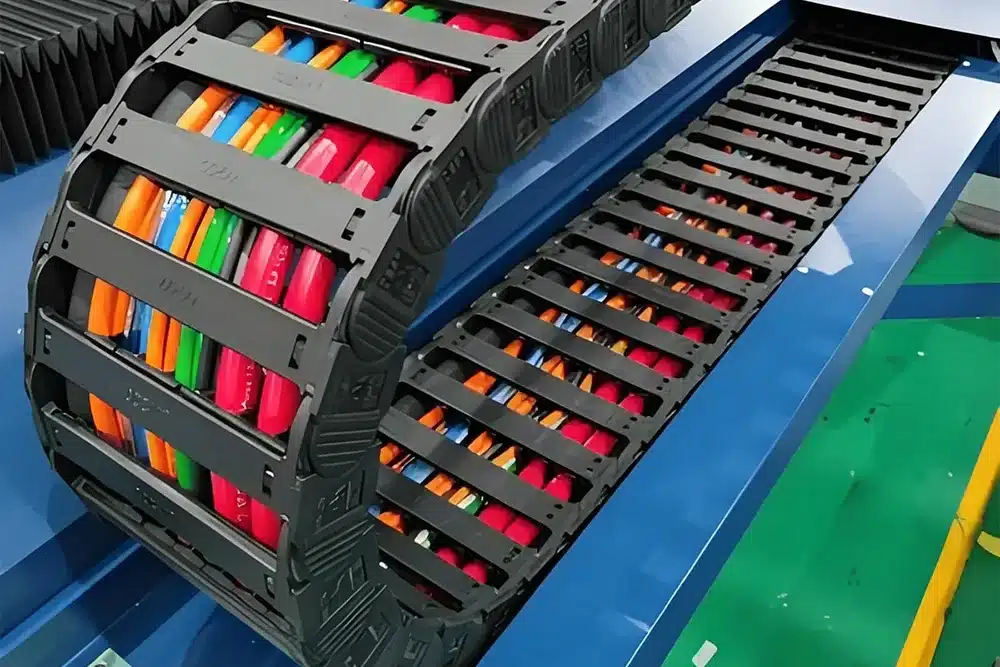
Many applications, including up to 600° twists, 3D paths and multi-axis robotic movement, frequently require flex cables that cannot be accessed by standard linear flex cable applications. The ability to customize torsion resistant designs for optimized stranding and shielding ensures integrity when catalog products risk twisting, kinking, and failing too soon.

If your motion profile involves several parameters from the catalog, it is a clear indication that you need custom drag chain cable design.
Red Flag #2 – Harsh Environmental Conditions Beyond Standard Specs
Aggressive Oils, Coolants and Chemicals
In the catalogs, resistance to common industrial media is frequently given, but in the food industry or in a chemical plant, a standard jacket may break down in a matter of time when subjected to chemicals not listed in the catalog. Targeted resistance with flexibility is achieved with the use of custom compounds.

High or Low Temperatures Outside Catalog Range
For extreme temperatures (less than -25°C or more than +125°C), flex demand required special silicone or elastomer jackets. Custom solutions are a classic example for high temperature flex applications which otherwise would crack or loose elasticity.
Combined Harsh Factors (e.g., Coolant + Chips + Heat)
Custom jackets, inner liners or hybrid construction that standard products do not necessarily match perfectly are successful in machine tool environments where there is coolant splash, metal chips, weld splatter or heat.
A custom drag chain cable may be a better option when a combination of factors or environment exceeds normal ratings.
Red Flag #3 – High-Speed Data, Sensitive Signals and Complex EMC Requirements
Mixed Power and High-Speed Data in One Carrier
Standard separation and shielding might not be sufficient in noisyEMI environments, such as near drives or welders, when using a compact drag chain that carries power and high-speed Ethernet.When using a compact drag chain that carries power and high-speed Ethernet in noisy EMI environments near drives or welders, standard separation and shielding may not be enough.

Custom Shielding and Impedance Needed for SI
For precision applications, tailored twist lays, hybrid foils/braids, and impedance matching provide improved noise immunity. Custom continuous-flex cables offer the best optimisation of these characteristics for a given EMI profile when catalog cables can only deliver a more or less approximate performance.
If they have tight SI/EMC requirements and a mixture of signals and data in motion, it is highly recommended that a custom drag chain cable be used.
Red Flag #4 – Packaging, Space and Integration Constraints That Standard Cables Can’t Meet
Extremely Tight Chain or Machine Envelopes
Compact equipment frequently has bend radius or out diameters that exceed normal cable minimum values, creating faster wear. These are honored by custom reduced diameter or high flex designs, which preserve performance.

Overfill or Crowding with Standard Cables
Several catalog cables can overload chains, break clearance guidelines and make maintenance more difficult. Hybrid custom cables combine conductors, minimize size and maximize layout efficiency.
The extra space constraints that require some violations of the rules for standard layouts indicate custom solutions.
Red Flag #5 – Mission-Critical Axes and High Cost of Failure
24/7 Production, Safety-Critical or High Downtime Cost Axes
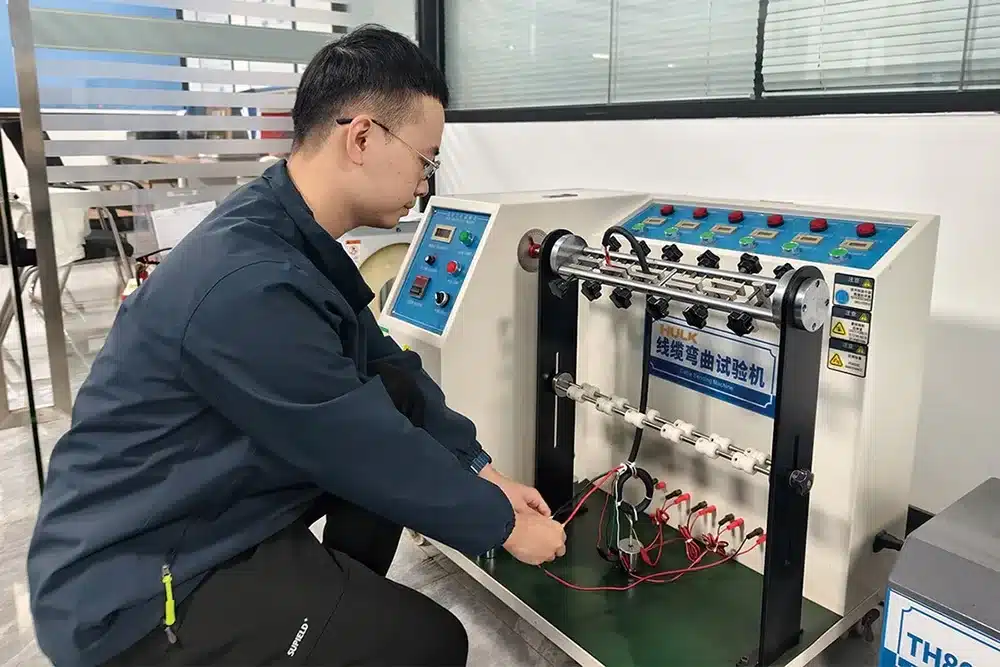
As cable failure can stop entire production lines, affect safety, and result in significant losses, more stringent reliability margins call for more custom-designed cable engineering, featuring better stranding, jacketing, and testing procedures.
Historical Evidence of Repeated Failures with Standard Solutions
If there are repeated problems even after proper installation, it indicates that the application is beyond the catalog’s expectations. Custom designs take a proactive approach to the problem instead of a reactive one.
Custom drag chain cables are a sound choice when their performance is crucial or if the cable is failing.
Putting It Together – A Five-Question Red Flag Checklist
Use this handy checklist at design reviews:
- Is your motion profile greater or surpasses several catalog limits in amplitude, velocity, acceleration and/or torsion?
- Does your environment require more complex specs than normal in chemical and/or thermal environments?
- Need to combine fast data and power in one carrier and have stringent EMC/SI demands?
- Are space or integration requirements causing tighter than normal bends or more than normal packing?
- Does the axis require the use of mission-critical or have suffered on-going failures from “normal” cables?
A positive response (particularly to questions 3-5) indicates the need to hire a custom cable partner early on.
Final Guidance – Treat Red Flags as Early Warnings, Not Post-Mortem Lessons
These five application red flags indicate that a custom drag chain cable may be needed, but do not signal the need for redesign later on. During initial engineering, OEMs and integrators can work with industry specialists, such as Hulk Electric, to create optimized high-flex solutions to improve reliability and lower overall cost.
At Hulk, we design and manufacture drag, servo, robot torsion and industrial Ethernet cables for the most demanding environments. Provide your application specifications and we will help you get cables that will work as they are supposed to when standard cables fall short.