Ensure system up-time, reduce maintenance, and provide long distance power and signal transmission. Heavy loads, high cycles, and harsh environments can cause fast wear or conductor fatigue, or expensive downtime from a mismatched cable or chain application in many applications that require tens of meters of length and significant cycles.
With more than 15 years of experience in high flexible industrial cables, at Hulk Electric we have supported engineers to optimise industrial cable systems for gantries, overhead cranes and automated material handling. This guide provides practical tips on geometry, cable selection, support systems and performance factors for the long term and how these can be used to achieve reliability.
What Makes Long‑Travel Gantry and Material Handling Axes Different?
There are very different differences between long-travel systems and short stroke applications. Gantries and cranes commonly have strokes of 10-50+ meters, at high speed, high acceleration and almost continuous operation. Cables and energy chains are subjected to heavy mechanical loads, significant weight over a distance, sliding friction and dust, oils, temperature changes or outdoor environment.
These demands call for more than just flex cables. Chain dynamics, cable weight distribution and environmental resilience need to be considered by the designers and they should not allow the cable to sag or wear or cause electrical failures that affect the production process.
Choosing the Right Drag Chain Geometry for Long Travels
Reliable long travel performance is built upon good geometry.
Gliding vs Unsupported Runs
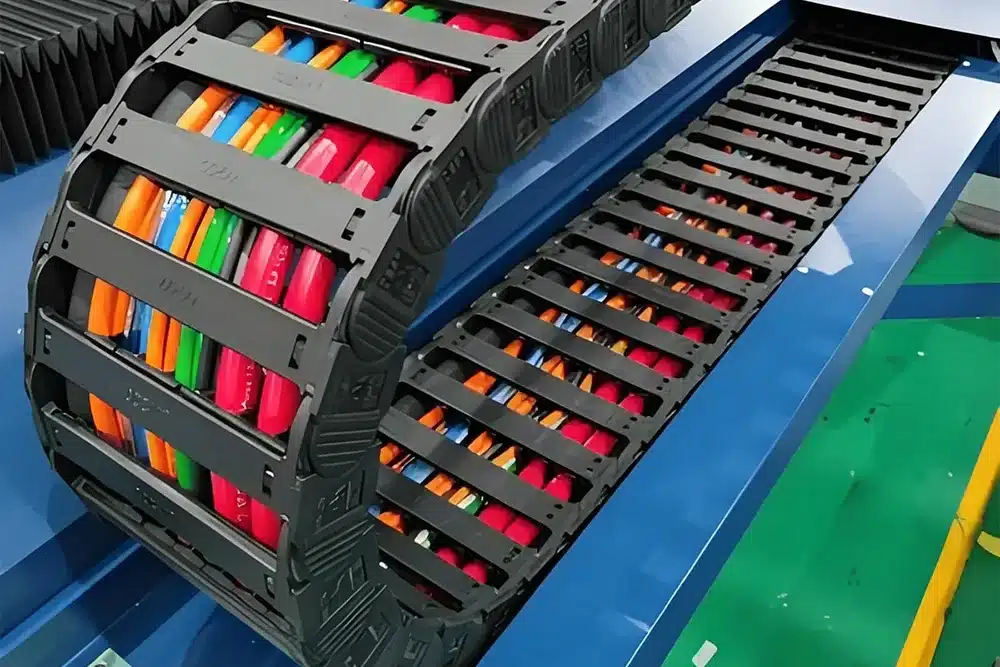
Unsupported chains are very quickly stretched beyond a few meters of travel. Where the upper run is required to glide smoothly over the bottom run the gliding energy chains become essential. This design has the function of proportionate load and relief of bending stress without support, which can operate stably over long distance.
Guide Troughs and Lateral Guidance
Guide troughs are necessary for lateral support and alignment to prevent the movement of the side to side, and to enable the gliding to be performed cleanly. Good trough design is one that ensures smooth transitions in and out of the trough area to prevent kinking and pinch points between cables and stationary equipment.
Vertical vs Horizontal Long-Travel Applications
Gliding and weight management are given greater priority in horizontal gantries. Vertical or inclined axes (e.g. lifts) require greater strain reliefs and the influence of gravity on cable sag and chain tension must be taken into account. Basic bend radius and material durability principles are observed in all directions.
Cable Selection Strategies for Long‑Travel Applications
Choosing the right cables is essential to the matching of system demands.
Heavy-Duty vs Light-Duty Drag Chain Cables
Heavy duty drag chain cables are well suited to long travel applications requiring a high number of cycles, with fine stranded conductors, strong jacketing (PUR or TPE) and reinforced shielding. Light-duty options might not be enough for more extended runs. Determine total lifetime cycles (daily cycles x operating days x years) and safety factors of 1.5 to 3x for maximum life.
Bend Radius and Flex Life
Always respect or exceed the cable’s minimum bend radius (MBR). In long-travel setups, the larger the radius, the longer the flex will last. Hulk’s high-flexible servo, motor, and robot cables are specifically designed for high cycle motion with signal integrity.
Environmental and Chemical Resistance
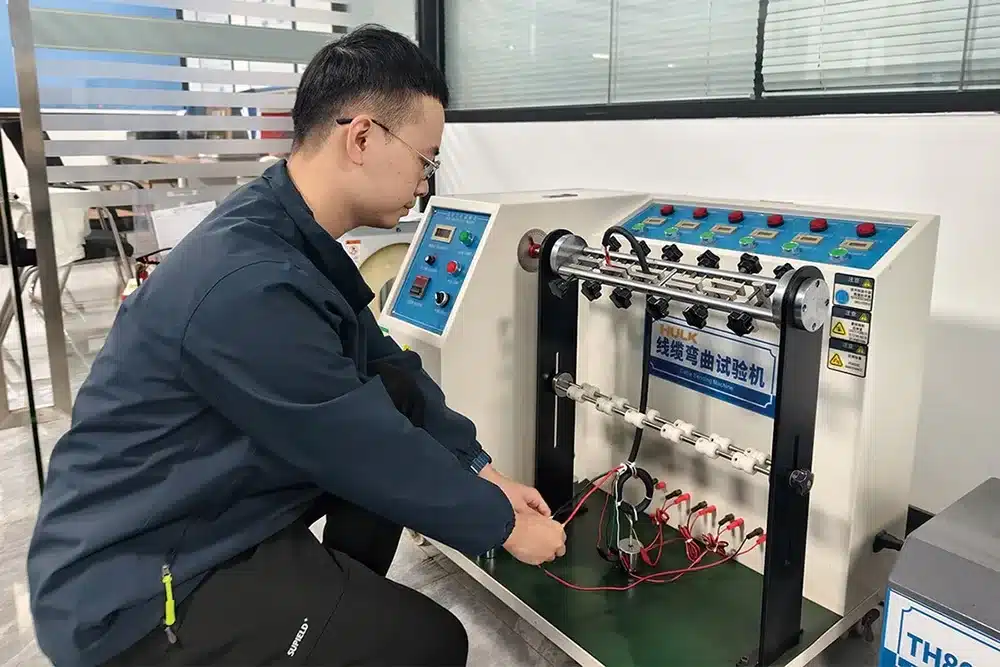
Long-travel gantries are usually exposed to UV, oils, coolants, moisture or temperature changes. Select jackets that are known to be abrasion and chemical resistant, or those with special compounds for harsh environments. Check compatibility via application-specific testing.
Managing Weight, Fill Factor and Segregation over Long Distances
Accelerated wear can be avoided by having proper internal chain management.
Fill Factor in Long-Travel Chains
Keep fill factor < 60%, to prevent friction and heat accumulation, particularly in gliding runs. Provide sufficient space (≥10% around cables) to move around without restriction.
Weight Balancing and Cable Segregation
Heavy power cables should be strategically positioned and kept away from delicate signal or Ethernet power cables with dividers. This helps to avoid long-distance entanglement, cross abrasion and electromagnetic interference.
Impact of Cable Weight on Long-Travel Performance
Lighter and stronger cables will help to decrease overall drag and dynamic forces. Optimised stranding and materials provide a balance between performance and weight for smooth operation and reduced energy consumption (Hulk).
Support and Strain Relief Strategies for Long‑Travel Systems
Failure points include transitions and relief points.
Strain Relief at Entry and Exit Points
Use good strain relief at chain ends and at transitions between chain and trough to reduce bending stress on connectors. This guarantees that bending takes place within the intended radius, avoiding damage to terminations.
Managing Unsupported Sections and Sags
Keep lengths short that are not supported and provide guide troughs for longer gliding distances. With proper support, the possibility of excessive sag is eliminated and thus reduces the risk of rubbing or fatigue.
Application-Specific Strategies for Gantry and Material Handling Systems
Overhead Cranes and Double-Girder Gantries
Strong gliding chains, UV-resistant heavy duty cables, are the advantages of these systems. For bridge and trolley motions, pay attention to low noise, high mechanical strength, convenience of maintenance.
AS/RS and Shuttle Systems in Warehousing
The automated storage/retrieval system demands high tolerance for acceleration and accuracy in signal transmission. In small gliding chains use low-MBR high flex cables with separate power/data cable routing.
Long-Travel Gantry Robots and Process Lines
Mixed motion with horizontal translation. Cables should be able to withstand torsion and composite bending, and custom-engineered cables from Hulk are perfectly compatible with robot lines and sensors.
Common Long‑Travel Mistakes and How to Avoid Them
- In service short-stroke cables in long-travel duty, leading to conductor fatigue and cracking of the jacket.
- Failure to use guide troughs, causing misalignment and abrasion.
- Overfilling of chains/poor segregation, increasing friction and signal problems.
- Failure to estimate the role of the environment, resulting in a run in the exposed runs being degraded.
These problems are avoided with proactive design and proper calculations.
Lifecycle and Cost Strategy – Designing for Fewer Cable Replacements
Replacing cables with long travel is costly and disruptive. Application-specific, heavy-duty solutions can help to lower TCO, as they minimize downtime and changeout. Monitor cycles and collaborate with knowledgeable suppliers for customised suggestions.
Final Guidance – Long‑Travel Performance Requires a System-Level Cable Strategy
The success of a long-travel gantry or material handling system depends on considering cables, energy chains, guide troughs, and environmental elements as a system. Reliable performance and lower lifecycle costs are achieved by early mechanical, controls and reliability team communication with the help of cable manufacturer expertise.
Our high-flexible cables, servo/motor lines, and custom solutions are used to drive heavy-duty automation throughout the world. Tell us your gantry setup and we’ll assist you in creating an ideal drag chain cable solution for your long travel requirements.