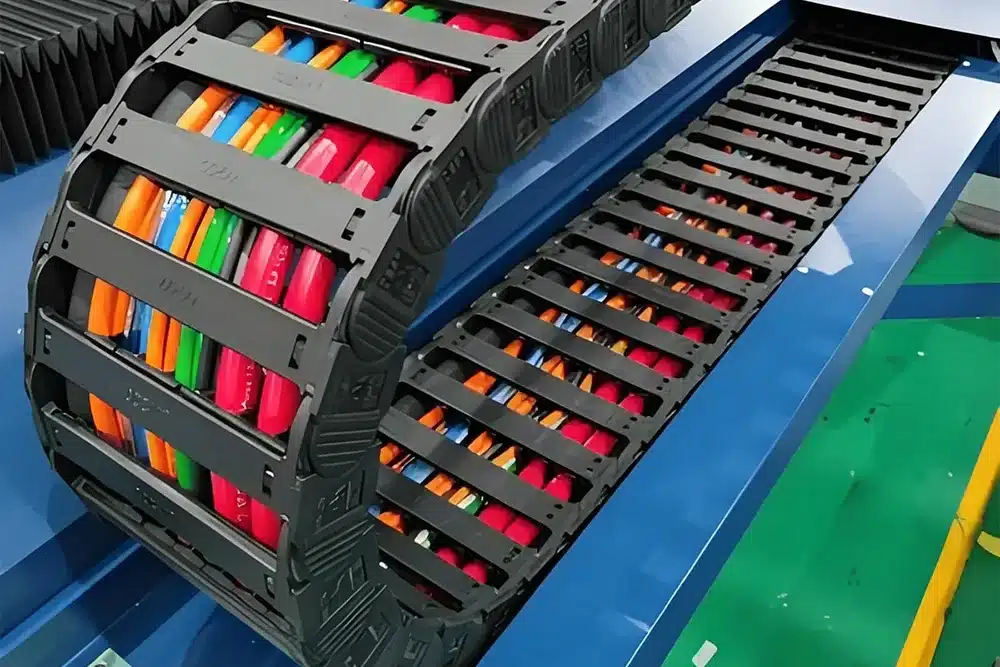
When it comes to drag chain applications, the durability of repeated bending, abrasion and oil or coolant resistance depends on the proper choice of drag chain cable jacket materials and insulation. Engineers and maintenance staff understand that the wrong choice can result in early cracking, swelling or flexibility loss within cable carriers, which can lead to unplanned downtime and expensive replacement costs.
Hulk Electric has been manufacturing high flex industrial automation and robotics cables for more than 15 years and can assist customers to select the jacket and insulation system that is appropriate to the actual motion profile and operating environment. This guide covers some practical factors to consider when choosing materials such as PVC, PUR, TPE, and TPU, which offer a variety of properties, ranging from flexibility to wear to chemical resistance.

How Jackets and Insulation Work Together in Drag Chain Cables
Continuous-flex cables have two very important components: jackets and insulation. Individually insulated conductors are insulated for protection against the mechanical and environmental forces within a drag chain, while the outer jacket is for overall protection of the core.
Insulation – Protecting Conductors and Supporting Flexibility
The insulation on drag chain cables should be capable of providing effective electrical isolation and at the same time should be able to transfer between the conductors during millions of bending cycles. High Quality Insulation is able to withstand and push pressure and heat without causing adhesion of the cores, which makes it difficult to move and causes the core to break internally.
Specialty PVC blends, TPE compounds or cross-linked materials designed for continuous motion are typical options. The insulations won’t cold flow or crack around fine stranded conductors and retain the same performance properties even when bent tightly. Typical building wire insulation does not last very long here because it is not the most elastic or non-stick material to be used in a continuous flex cable application.
Jacket – First Line of Defense Against Wear and Environment
The outer jacket protects the cable core from abrasion against chain components, cuts, oil, coolants, and temperature changes. It needs to be sufficiently flexible to follow the carrier’s movement and not notch or wear on the surface during drag chain service. Materials such as PUR and TPE are excellent for use here because they are tough and provide enough elongation to handle the large travel or high speed operation of the vehicle.

PVC, PUR, TPE and TPU – Understanding the Main Jacket Options
The duty level of a cable carrier depends on different types of jacket families. It’s often a matter of what flex cycles, exposure to media and temperature ranges are expected.
PVC – When General-Purpose Still Works and When It Does Not
For lighter applications PVC jackets are an economical compromise that provide acceptable flame retardancy and flexibility. They can do a decent job in a clean, still, indoor setting.
But, conventional PVC tends to be hard, brittle and can crack in cold weather and high cycle continuous bending. It has some resistance to a variety of cutting oils and coolants, as well. Use PVC for semi-static or light-duty drag chain applications where budget is the most important consideration and stresses in the environment are not severe.
PUR – Tough Jackets for Oil, Coolant and Abrasive Motion
Polyurethane (PUR) jackets offer high machine tool oil and coolant resistance and outstanding abrasion resistance. They are resistant to sliding contact in long travel drag chains, and have high flexibility in a broad temperature range, due to their mechanical toughness.
In the automotive industry, CNC machinery, and material handling systems, PUR is a common material used for oil resistant drag chain cable jackets. The cost is a little higher than PVC, but its additional lifespan and maintenance savings typically outweigh the expense.
TPE / TPU – High Flexibility and Abrasion Resistance for High-Cycle Motion
Thermoplastic elastomers (TPE/TPU) are characterized by high bending cycle counts and are flexible at low temperatures. They are generally used for tighter bend radius and are perfect for robotics, high speed packaging lines and compact automation applications where flexibility is of the utmost importance.
Halogen-free and highly abrasion resistant many TPE formulations are available. Under certain aggressive oil conditions, certain PUR grades can outperform TPE, however, it is always important to confirm compatibility with your specific media.

Balancing Flexibility and Wear Resistance in Drag Chain Environments
Faster wearing jackets are harder, but bend more easily, whereas softer jackets are more prone to wear down against hard edges of chain but may need improved carrier design to run smoothly.
How Jacket Hardness Affects Bend Behavior and Wear
Shore hardness will have direct impact on both minimum bend radius and contact pressure within the chain. The more TPE/TPU is softer, the better it will conform in short-stroke, high frequency applications, but the softer it is, the more sensitive it will be to excessive notching. Long travel gliding and abrasive conditions are better supported by harder PURs.
Drag Chain Layout Factors: Sliding vs Unsupported, Short-Stroke vs Long-Travel
TPE jackets, which are extremely flexible, are often preferable when the short stroke is not supported. PUR’s low friction, high wear characteristics provide an advantage for long travel gliding systems with constant sliding contact. When ordering abrasion resistant PUR jacket for drag chains, always take into account the complete mechanical arrangement.
Chemical, Oil and Coolant Exposure – Matching Materials to Media
Many drag chain failures are caused by swelling, softening or cracking due to chemical attack.
Common Industrial Media and Their Effects on Jackets
Standard PVC is more susceptible to attack from cutting fluids and synthetic coolants than PUR or correctly formulated TPE. The same issues exist with hydraulic oils and cleaning agents used in food plants. Knowledge of the specific media can prevent jacket deterioration before the actual time.
Reading Chemical Resistance Tables and Manufacturer Data
Ask suppliers for detailed compatibility charts. Pay attention to ratings for operating temperature and exposure time. The only way to be sure of the performance in chemical resistant cable jacket for cable carriers is to perform field trials.
Temperature, UV and Outdoor Conditions – When Material Limits Matter
Low-Temperature Flexibility and Cold Brittleness
PVC becomes brittle and fragile as soon as it gets cold, and cracks when moving. TPE and some PUR grades are more elastic in cooler environments and in colder winter weather and are therefore suited to use for low temperature, flexible drag chain cable applications.
High-Temperature and UV Exposure in Outdoor or Hot Environments
Many jackets age prematurely due to the effects of UV rays and heat. For outdoor cranes, solar trackers or near hot processes, specialized PUR, TPE or fluoropolymer options offer longer service life.
Insulation Material Choices Inside Drag Chain Cables
Mechanical and Adhesion Requirements for Insulation
Insulation should be strong but lightweight, not adherent to adjacent cores, and be able to withstand bending stresses that are spread over very small strands. High-performance TPE or special PVC insulations for flex service outperform generic insulations.
Matching Insulation Systems to Voltage, Environment and Motion
Insulation-jacket pairs are coordinated, e.g. TPE insulation and PUR jacket, and can provide performance proven across voltage classes, temperatures and motion profiles. Always specify insulation materials for continuous flex cables as part of an integrated system.
Practical Material Selection Framework for Drag Chain Cables
Step-by-Step Checklist: Motion, Environment, Compliance, and Cost
- Checklist: Motion, Environment, Compliance, and Cost series.
- Record the movement pattern, number of cycles, bend radius, travel length and supported or gliding.
- Record exposure to environment: oils, chemicals, heat, cold, UV.
- List regulatory requirements: Halogen free, flame, industry certifications.
- Choose the jacket family and matching type of insulation.
Questions to Ask Cable Suppliers About Materials
- What type of jacket and insulation compounds are used and what is their flex life?
- Will our oils or temperatures damage the materials?
- Is there halogen free or LSZH (Low Smoke Zero Halogen)?
- Do you have any references of similar applications?
Final Guidance – Design Material Choices Around the Real Application, Not Just the Catalog
The key to a successful drag chain installation is making realistic assessments of an existing operating situation, not applying a generic flexible cable specification. Custom designed solutions from a trusted manufacturing company provide the ultimate long term solutions when the standard catalog options are not a good fit for combined flexibility, wear and resistance, and chemical durability.
Our engineering team collaborates directly with OEMs and automation integrators to design some customized drag chain cables with optimized jacket and insulation solutions. Provide information about the parameters of your motion, the surrounding conditions and the performance goals and we will suggest or special order cables to ensure a reliable operation of your equipment.