In industrial automation, robotics, and machine tool systems, the choice of proper custom silicone cable for high-temperature use is crucial for reliable operation. However, there are many projects that fail due to the many common pitfalls of design, specification and installation and not necessarily the silicone product itself. As a manufacturer of high-temperature silicone cables for more than 20 years, Hulk Electric has seen what it takes to overcome these challenges at the beginning of a cable manufacturing process leads to extended service life, less downtime, and greater compliance.
It reviews the most common pitfalls that engineers and OEM’s encounter when designing custom silicone cables for use in high-heat applications, and offers some practical solutions to avoid them.
Why High-Temperature Silicone Cables Fail Prematurely—Even in “Good” Designs
The cables made by reputable manufacturers such as Hulk can be used safely in the temperature ranges of -60°C to +200°C (plus 200°C with special compounds). They are very flexible, chemically resistant and thermally stable, making them perfect for use in servo motors, robotic arms and control systems in hot zones.
But in practice, failures can occur due to design and application parameters failing to meet the specifications of a given material as opposed to its inherent limitations. These mistakes can be avoided by plant engineers and procurement staff to cut the total cost of ownership, and prolong the cable’s lifespan.
Mistake 1 – Underestimating Real Operating Temperature and Duty Cycle
Designing to catalog ratings instead of measured conditions
Among the biggest reasons silicone cables from the catalog fail, is using the standard temperature rating without considering the specific operating conditions. Polymer degradation, hardening and cracks occur with continued exposure at or above the insulation’s rated temperature.
Always measure and record the actual temperature gradients, including those of sustained loads close to the oven, heaters or enclosed panels, and be sure to add a safety margin.
Ignoring thermal cycling and hot spots
Rapid temperature changes during operation and hot spots due to placement near terminations or in confined areas can also cause aging to occur. When selecting a compound and the construction itself, it is important to consider these dynamics in order to gain the best performance from the silicone. Hulk’s engineering team regularly supports clients in profile validation for the right selection of compounds.
Mistake 2 – Overlooking Insulation Thickness and Construction Complexity for Harsh Service
Treating extreme high-temperature service as “just another silicone cable”
A simple structure may not be sufficient under high heat conditions. To sustain the dielectric strength and mechanical strength under sustained stress, a thick insulation wall, reinforced jacketing and added protection are often needed.
Selecting the wrong insulation or jacket combination
When chemical or abrasion attack is combined, silicone insulation performs well in heat but requires additional outer jackets (such as special high temp types). Any mismatches cause the jacket to crack or insulation failure. Custom engineering provides for making every layer work together for the application.

Mistake 3 – Ignoring Environmental Factors: Chemicals, Moisture, UV and Mechanical Abuse
Not matching cable build to chemicals, moisture and weathering
Silicone has good resistance, but will lose resistance with continuous exposure to oils, highly corrosive cleaners or moisture if not properly jacketed. Custom silicone cables must be ordered with the necessary environmental factors.
Underestimating mechanical damage in high-temperature silicone cables
A lot of failures stem from physical abuse, such as abrasion against sharp edges, crushing in trays and vibrations, which is more significant at higher temperatures because materials become slightly soft. It is important to have proper routing and protective elements.
Mistake 4 – Poor Mechanical Design: Bend Radius, Strain Relief and Routing
Violating minimum bend radius and forcing tight corners
When the recommended bend radius is exceeded, hidden stress points are formed that will greatly reduce the life of the cable in high-temperature applications.
Inadequate strain relief and termination design
Poor crimping, a lack of strain relief or incorrect glands are the reasons failures often occur at terminations. Custom assemblies from Hulk are also strong and offer high quality, robust strain relief designed to suit the movement of the application.
Bundling and derating mistakes in hot environments
Excessive bundling with insufficient derating decreases current capacity and adds to the thermal stress by increasing the internal heating.
Mistake 5 – Insufficient Prototyping, Testing and Standards Consideration
Skipping prototypes and realistic testing
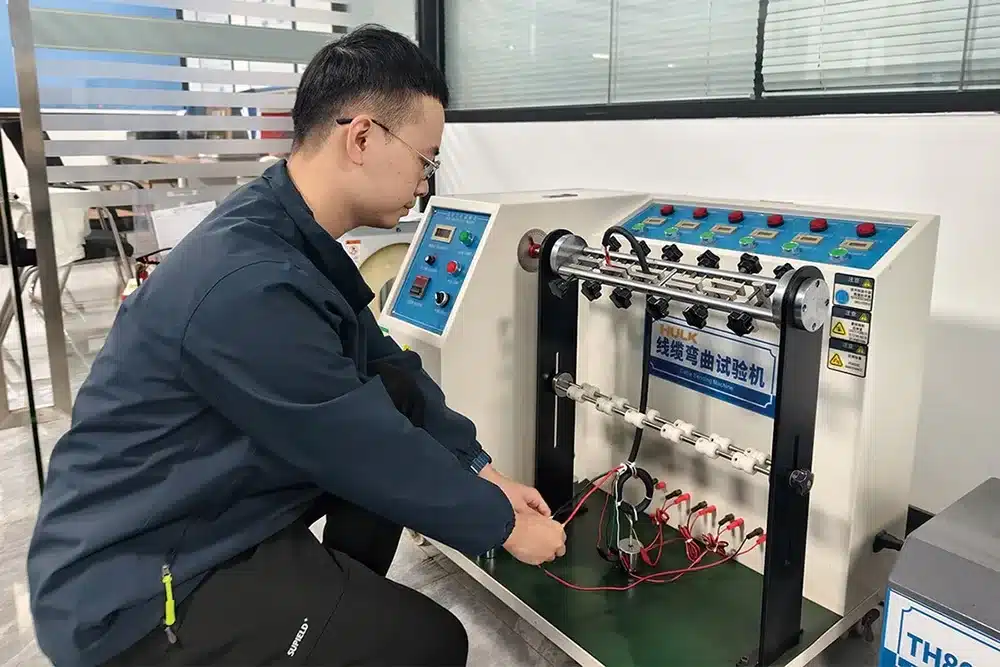
It is very common and expensive to rush into production without testing samples for combined thermal cycling, flexing and environmental stress. Early prototyping identifies problems in advance of deployment.
Ignoring relevant standards and workmanship criteria
Reliable assemblies are achieved with products that meet UL, IEC and IPC/WHMA-A-620 standards. Hulk’s cables are conform to various international certifications, which are suitable for global OEM requirements.

Mistake 6 – Incomplete or Ambiguous Custom Cable Specifications
Vague requirements for conductor, shielding and jacket
Terms without clarity on gauge, stranding, shielding, or specific environmental requirements result in inferior builds and constantly revised designs. .
Not starting from the application and environment
The first step in making the best custom silicone cables is identifying the duty cycle, movement (linear, torsion, robotic), chemicals and installation limitations. Hulk’s staff collaborates closely with clients to transform them into accurate and dependable designs.
How to Avoid Premature Failure – A Design and Installation Checklist
- Check actual operating temperatures (continuous and peak) and give a good margin.
- Choose silicone compounds, thickness and layered designs depending on the harshness.
- Correlate the insulating and jacketing materials with chemicals, moisture, UV and mechanical stresses.
- Adhere to minimum bend radius, strain relief and routing guidelines.
- Design and test in realistic heat, mechanical and electrical environments.
- Follow industry standards and certifications in relation to the work.
- Give a detailed specification to your custom cable maker.
Manufacturers are able to avoid these common pitfalls, thus delivering better performance with their high-temperature silicone cables. With 15,000㎡ factory and a professional engineering team, we are specialized in providing you with accurately designed solutions for demanding tasks in industrial automation and more.
Give us your application requirements, and we will help you design custom silicone cables for future use.