Electromagnetic interference (EMI) is a source of frustration in reliable sensor signals in busy industrial plants. One level sensor in the vicinity of a VFD pump suddenly reads erratically or an encoder feedback loop causes nuisance alarms that stop production. These problems can either be kept in check or go out of control and result in expensive downtime, depending on whether the sensor cables are shielded or unshielded. As an automation engineer or panel builder, we see you looking for the right sensor cable for your application, but not for general specifications.
This guide outlines the real-world benefits of shielding when it comes to sensor cabling and provides guidance on the smart choices that combine performance, cost and installation.
What Shielding in a Sensor Cable Actually Does
Shielding wraps a conductive layer around the signal conductors to prevent interference from external electromagnetic sources from affecting low level signals and to prevent noise which the cable may produce from interfering with the other cables. It is best used in conjunction with a complete system of routing, twisting and grounding. These are essential in guaranteeing the optimum performance of the best protected sensor cable.
Shielded vs Unshielded Cable Construction Basics
Unshielded sensor cables use twist, physical separation and insulation to control noise. Shielded versions will include one or more layers of aluminum foil, tinned copper braid or both, in addition to a drain wire for grounding. The conductive envelope effectively works as a “Faraday cage,” to deflect interference from sensitive cores.

In the case of IO-Link cables for hulk sensors and hulk actuators or proximity switches or analog loops, this construction directly contributes to stable operation in automated machines.
Shield Types – Foil vs Braid and Hybrid Shields
Foil shields provide an effective barrier against high-frequency noise from switching electronics, and are low cost and lightweight for termination. Braided shields are better in terms of mechanical strength and offer protection at lower to mid frequency levels, making them ideal for cables in motion or in areas where heavy equipment will operate. Hybrid designs include a combination of both for EMI control on wide band coverage in the most stringent industrial automation applications.
When Unshielded Sensor Cables Are Good Enough
Not all applications require shielding. Wrapping defaulted cables anywhere is unnecessarily costly and slow to install with no resulting benefit.
Clean Environments and Well-Separated Routing
Unshielded sensor cables may be used in small machines, short run applications, and when power lines are not near the machine, and where there is a dedicated cable tray. Here discrete digital signals can be handled properly by using good plant grounding and twisting.
Short Runs and Low-Sensitivity Signals
Unshielded inputs provide adequate noise margin for robust 24V digital inputs or for simple on/off sensors over shorter distances. They make stripping, termination, and panel work easy and cost effective for projects.
Installation Simplicity and Cost Considerations
Unshielded cables save time and material costs. These practical benefits are more important than the theoretical shielding benefit in low-EMI environments, which allows teams to focus the engineering effort on the areas that matter most.
When Shielded Sensor Cables Become a Necessary Risk-Control Tool
Some scenarios increase the risk of EMI to the level of a need for signal integrity and uptime protection, where shielding is required.
Proximity to Motors, VFDs, Switchgear and High-Power Wiring
Strong fields will be picked up by cables that are parallel to motor feeds, the variable frequency drives or the contactors. These areas have many sources of noise coupling, which can cause erratic readings on vibration or proximity sensors, but shielded sensor cables significantly reduce noise coupling in these areas.
Sensitive Signals – Analog, Instrumentation, Encoder Feedback and Communication
The 4-20 mA loop, thermocouples, strain gauges and encoder signals are particularly vulnerable. In industrial automation, sensor cable shielding prevents PID loop instability, communication errors and maintains resolution.
Long Cable Runs and Distributed IO Architectures
Long runs on the plant raise the likelihood of pick ups. Shielded designs ensure that clean signals are returned to the control room from remote tanks or distributed IO nodes.

Grounding and Terminating Shielded Sensor Cables Correctly
A shield’s effectiveness is dependent on its grounding. Bad practices can cause new issues.
One-End vs Both-End Shield Grounding – Practical Guidelines
Most analog applications will require the use of ground shields at one end, usually the control panel side, to prevent ground loops. Both-end grounding with 360° clamps may be required by the high-frequency or specific EMC standard. Always follow manufacturer’s recommendations and plant standards.

Avoiding Shield Misuse – Don’t Tie Shields to Sensor Housings
Use defined ground terminals instead of sensor metal housings for connection to drain wires. This helps to avoid unwanted noise injection and to ensure uniform reference potentials.
Clean Termination Practice – Stripping, Drain Wires and Avoiding Exposed Braids
Trim and strip strip jackets, braids and land drain wires with minimal and clean cuts. Ensure that document terminations are documented for consistency when maintaining.
Foil vs Braided Shield in Sensor Cables – Which One for Which EMI Profile?
Foil Shields for High-Frequency and Strong EMI Fields
The foil does a great job at high frequency noise from power supplies and drives. More easily broken off but not as strong when bent over and over.
Braided Shields for Mechanical Robustness and Low/Mid-Frequency Noise
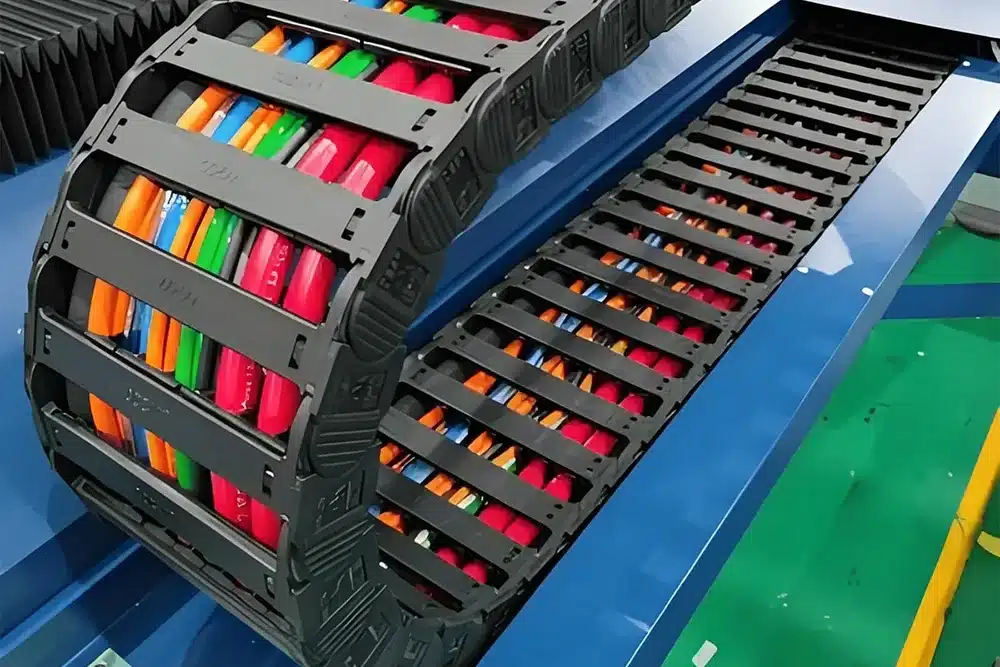
Braided copper is more durable for drag chains, robotic arms and low frequency interference found in high-motion environments where motors are located.
Hybrid Shields – Combining Coverage and Robustness
Hybrids provide best of both worlds for most challenging environments.
Practical Scenarios – Choosing Shielded vs Unshielded Sensor Cables
Simple Machine with Local IO and Clean Routing
When discipline is high, unshielded cables are ideal for local IO on a small conveyor.
Plant-Wide Analog Measurement and Encoder Feedback
Plant-wide systems with mixed trays require shielded sensor cables to assure analog and encoder signals are protected.
Retrofitting New Sensors into Existing Noisy Cable Trays
Minimizing faults with careful routing and shielded options in noisy retrofit applications.
Selection Checklist – When EMI Control Justifies Shielded Sensor Cables
Apply questions to guide decisions:
- Located close to motors, VFDs or high power lines?
- Are signals analog, encoders or sensitive instrumentation?
- Do runs take place on the long or in mixed trays?
- If so, is the cost of faults high for this process?
- Are there strong grounding and routing practices?
Consider total ownership costs: shielded sensor cables may come with an initial higher cost, but reduce the time and expense of troubleshooting and downtime in noisy plants.

Our sensor & actuator cables, such as shielded models for industrial Ethernet, Fieldbus and analog, are designed to meet the demands of the field for EMI. UL, CE and TÜV certification and extensive customization helps OEMs and integrators specify the correct solution for reliable performance.