The selection of the proper sensor cable size and termination method may appear as inconsequential issues in a large automation project, but the wrong choice can cause problems with installation, commissioning and subsequent operation. Compact sizes around the sensors often require M8 sensor cables and standard machine wiring or more severe environments require the more robust M12 sensor cable. Open-end options provide flexibility for field termination in panels or junction boxes. This guide explains the true trade-offs so that engineers, OEM designers, and panel builders can select the appropriate sensor cable for their industrial automation application requirements.
The Role of Sensor Cables in Industrial Automation
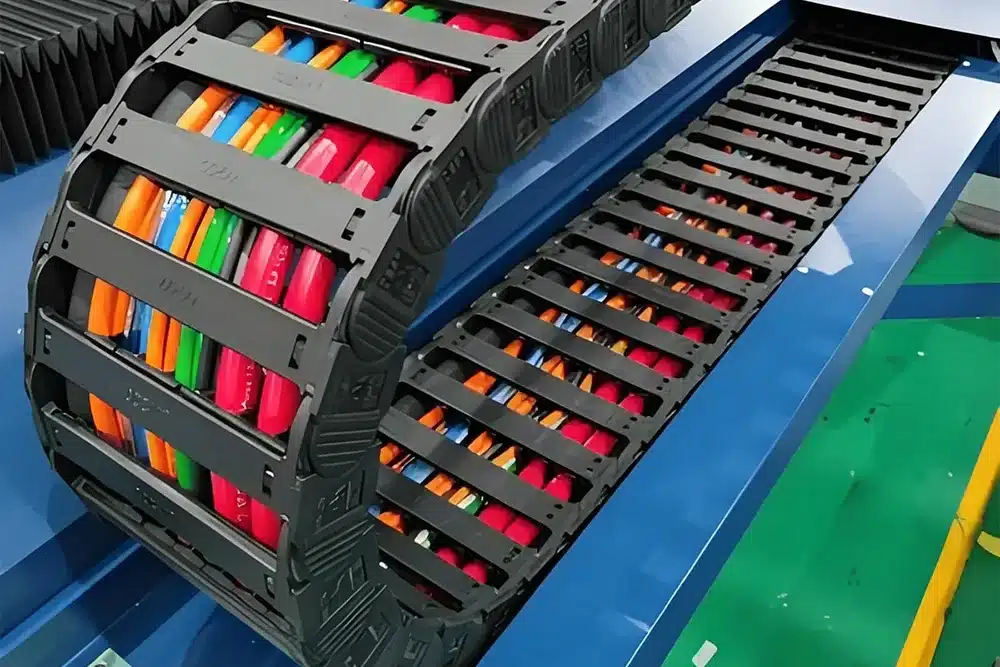
Proximity switch, photoelectric sensor, actuator and other field devices are connected to the control system with the help of sensor cables, which is a reliable link. They transmit signals with precision, and can withstand vibration, water, oil, and repeated flexing on moving machinery. The type of connectors you use has a direct impact on future wiring, service options and future expansion.
From Field Devices to IO Modules – A Quick Wiring Overview
The standard route is from the sensor, through an M8 or M12 cordset or open-end cable to a junction box or distributed I/O module and to the PLC. Many cables will converge in confined spaces and connecting footprints, cable diameter and the type of termination are key for clean panels and troubleshooting.
Why Connector Size and Termination Style Affect Reliability and Serviceability
Smaller connectors may reduce the number of pins available and/or mechanical strength. They are bigger and provide better sealing and handling but may not fit in all situations. Open end cables provide flexibility of wiring on the cabinet side but must be terminated carefully in the field to prevent loose connections and miswiring. By achieving this balance, downtime and maintenance work are minimized.
M8 Sensor Cables – Strengths, Limitations and Typical Applications
The compact circular connectors in M8 sensor cables are perfect for installations where space is limited. They are also smaller threaded (M8) which makes them the perfect size when every millimetre counts.
When M8 Is the Right Answer
Install M8 sensor cables in compact proximity sensors, photoelectric switches on close brackets, machine vision and end of arm tools on robots. They are good in dense sensor arrays, and in lightweight applications where the weight and footprint of the machine are enhanced if the sensors are reduced.
Limitations of M8 – Pin Count, Cable Diameter and Handling Margin
M8 options tend to accommodate 3 to 4 pins (or 6 to 8 for restricted design), and have smaller diameters than cables which restrict conductor size and shielding. Can be more difficult to hold with gloved hands during service, and may have a lower mechanical margin if subjected to vibrations at high amplitude or frequent mating.

Practical Tips for Specifying M8 Sensor Cables
Always use coding (usually A coded), pin count and pin assignment, cable length, jacket material (PUR for flexibility), shielding requirements (required) and IP rating. Have clear documentation to avoid discrepancies in procurement.
M12 Sensor Cables – Strengths, Limitations and Typical Applications
The M12 sensor cable is the common standard for most industrial automation systems. They have a larger M12 thread, which offers more space for pins, strong strain relief and enhanced environmental protection.

When M12 Is the Better Choice
Use M12 sensor cables for typical sensors and actuators in conveyors, packaging equipment, robot cells and I/O blocks. They are more resistant to mechanical loading, vibration and multiple connections compared to M8 versions.
Advantages of M12 – Pin Options, Ruggedness and Future‑Proofing
M12 connectors have a larger number of pins (typically 3-8, up to 12+), multiple coding options (A, D, X for Ethernet), larger cables and better degrees of ingress protection. This makes them perfect for use with IO-Link, power delivery and future expansion.
When M12 Might Be Oversized or Impractical
The higher M12 footprint may cause problems if the enclosure is very small or if weight is important in robotic tooling.
Open‑End Sensor Cables – Where Field Termination Makes Sense
Open end sensor cable usually comes with a pre-molded M8 or M12 connector and stripped leads on the other end for the termination to the terminal blocks, junction box or custom designed panel.
Typical Uses for M8/M12 to Open‑End Cords
They are compatible with existing control cabinets, legacy systems or systems with shared junction boxes which need to be mapped within the custom structure.
Advantages – Wiring Flexibility and System Integration
Open-end designs allow installers to adjust to individual wiring conventions on panels without having to make a custom harness—making expansions and mixed legacy and new installations easier.

Risks – Dependence on Good Field Termination Practices
The success is dependent on the correct stripping/crimping/labeling and strain relief. When practices are poor, signals occur intermittently, there is corrosion, or there are audit failures.
Comparing M8, M12 and Open‑End Options for Real‑World Scenarios
Tight Device Enclosures and Compact Sensors
The card’s small size makes M8 sensor cables the ideal choice. When using panel side open-end, use with this for custom routing.
General Machine Wiring and Harsh Environments
In most cases, M12 sensor cables are the safer bet as they are more rugged and come with the flexibility of future changes. They look very good in combination with open-end for cabinet landings.
Mixed Legacy Systems and Custom Junction Boxes
Link M8/M12 connectors to open end cables at the device end without needing an adapter, to connect contemporary sensors to legacy panels.
Practical Selection Checklist for Engineers and Panel Builders
Step‑By‑Step Questions to Choose M8, M12 or Open‑End
- What is the actual space available at the device and in the panel?
- How many of each type (Ethernet, power, sensor) of pins are needed?
- What kind of vibrations, flexing, moisture and chemicals will the cable be subjected to?
- Will the connection be serviced or disconnected frequently?
- Does the side of the panel have terminal blocks or is it pre-wired with cordsets?
Map accordingly: M8 for space sensitive light-duty applications, M12 for robust general use, and open end if field flexibility is required.
Documentation and Specification Items to Freeze Before Ordering
Secure the type, gender, coding, pinout, cable jack and OD, shielding, length and IP rating of the connectors. Clear specs avoid errors and help to accelerate delivery from manufacturers such as Hulk.
Final Guidance – Choosing Sensor Cables with Enough Margin, Not Just Fit
The best sensor cable for industrial automation is one that will fit the application, have the required electrical performance, and be serviceable over the long term. Wherever you can, use M12 connectors the same way, use M8 connectors only when there’s an actual lack of space, and use open-end connectors in strategic spots for panels. Hulk Electric specializes in high flex sensor and actuator cables designed for use in challenging automation applications. Tell us about your application and we can help you to ensure that your lines are kept running with a dependable M8 or M12 solution or an open-end solution.