BizLink Factory Automation & Machinery | Cable Management Systems for Robotic Applications
In high-performance robotic systems and multi-axis automation, data and control cables face unique stresses that go far beyond simple linear movement. Many engineers discover this the hard way when standard Ethernet or bus cables fail prematurely in robot wrists or rotating assemblies, leading to signal noise, intermittent faults, or complete mechanical breakdown. Torsion-rated data and control cables are specifically engineered to handle combined bending, twisting, and 3D motion while preserving signal integrity for critical applications like Profinet, CANbus, servo feedback, and sensor networks.
At Hulk Electric, with over 15 years of expertise in robot and torsion cables, we help system integrators and OEMs select designs that deliver long-term reliability. This guide explores the essential elements—pair twisting, shielding strategies, and mechanical constraints—that make these cables perform reliably under demanding 3D torsion conditions.
What Makes Data and Control Cables “Torsion-Rated” in 3D Motion Applications?
Torsion-rated data and control cables are purpose-built for applications involving axial rotation combined with flexing, unlike standard cables optimized primarily for back-and-forth bending in energy chains.
Torsion-Rated vs Standard Flex Data/Control Cables
Standard continuous-flex cables excel in linear or unidirectional bending but often lack the internal architecture to withstand repeated twisting. Torsion-rated variants incorporate specialized conductor stranding, optimized lay lengths, reinforced shielding, and flexible fillers that allow the cable to absorb torsional forces without damaging internal components. This distinction is critical in robotics, where cables experience simultaneous multi-axis stresses.
3D Motion in Robots and Rotating Systems—Bending Plus Torsion
In 6-axis industrial robots, cables routed through wrists and rotary joints endure ±90° to ±360° torsion per meter alongside tight bend radii. Torsion ratings are typically specified in degrees per meter (e.g., ±180°/m) alongside cycle life expectations, often exceeding several million cycles. Proper selection prevents conductor strain, shield breakage, and impedance changes that degrade bus communication or encoder signals.

Pair Twisting and Conductor Layout—Protecting Differential Signals Under Torsion
Effective pair twisting is foundational for maintaining signal quality in dynamic environments.
Twisted Pairs for Differential Signals and Noise Immunity
Data and control cables for automation frequently rely on twisted pairs to support differential signaling in protocols like Ethernet, Profinet, or RS-485. The twisting balances electromagnetic fields, reducing crosstalk and external interference. Under torsion, preserving this geometry is vital to avoid impedance fluctuations and signal degradation.
Pair Lay Length and Symmetry in Torsion Applications
Optimal pair lay length balances electrical performance with mechanical durability. Too tight a lay can increase stress during twisting, while optimized symmetry in torsion-rated designs keeps pairs aligned, minimizing stretching and maintaining consistent performance across millions of cycles.
Core Winding and Pair Shield Structures for Moving Applications
Advanced constructions use layered or bundled cores with tailored winding to accommodate 3D displacement. Pair shields combined with overall shielding enhance protection while allowing flexibility.

What are ethernet cables? Their features and classifications
Shielding Strategies for Data and Control Cables Under Torsion
Shielding must balance EMI protection with torsional resilience.
Shield Types—Foil, Braid and Combined Shields
Foil shields offer excellent high-frequency coverage but can fatigue under repeated torsion. Braided shields provide mechanical strength, while combination (foil + braid) designs deliver both EMI performance and durability—ideal for noisy industrial environments with servo drives and motors.
Spiral and Torsion-Friendly Shields for Robot Data Cables
Torsion-rated cables often employ spiral-wound or specially angled braids that maintain coverage during twisting. These designs prevent shield tearing and ensure consistent signal quality in robot applications.
Maintaining Shield Integrity and Signal Quality Over Millions of Twisting Cycles
Reinforced multi-layer shielding and buffer tapes stabilize components, reducing failures like noise spikes or encoder faults that occur when shields break in non-rated cables.
Mechanical Constraints—Torsion Angle, Bend Radius and 3D Routing Limits
Mechanical limits directly influence cable longevity and performance.
Specifying Torsion Angle per Meter and Cycle Requirements
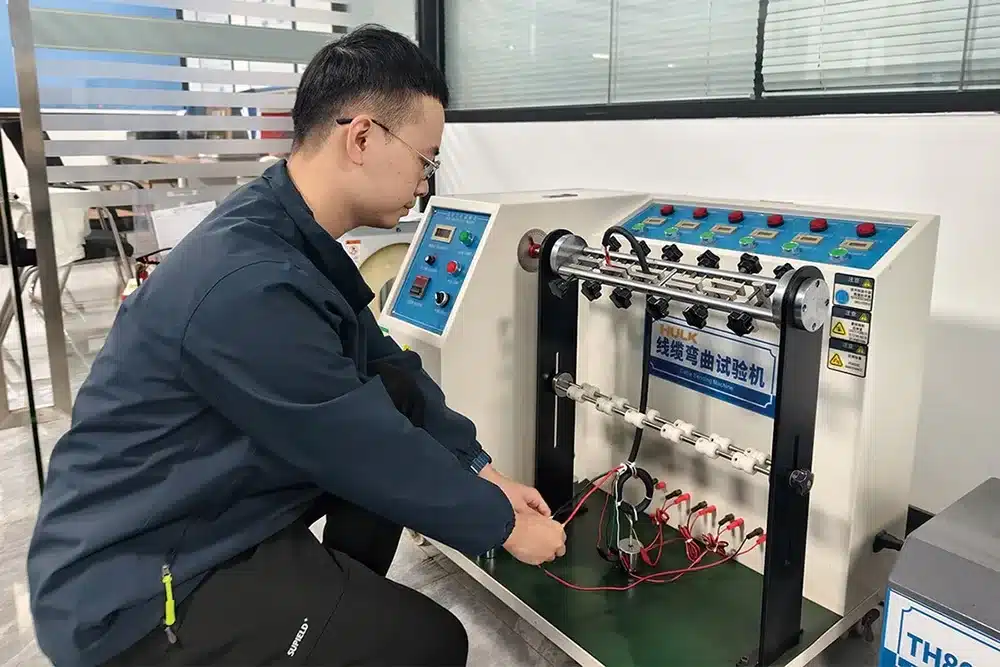
Always match the cable’s rated torsion angle (e.g., ±180°/m for 3+ million cycles) to your application’s actual motion profile. Hulk’s torsion-rated robot cables are tested under realistic combined stresses for reliable deployment.
Combined Bending and Torsion—Impact on Bend Radius and Flex Life
Simultaneous bending and twisting accelerates wear. Torsion-rated designs specify minimum dynamic bend radii under these conditions to prevent premature conductor or jacket damage.
Space Constraints in Chains, Dress Packs and Through-Arm Routing
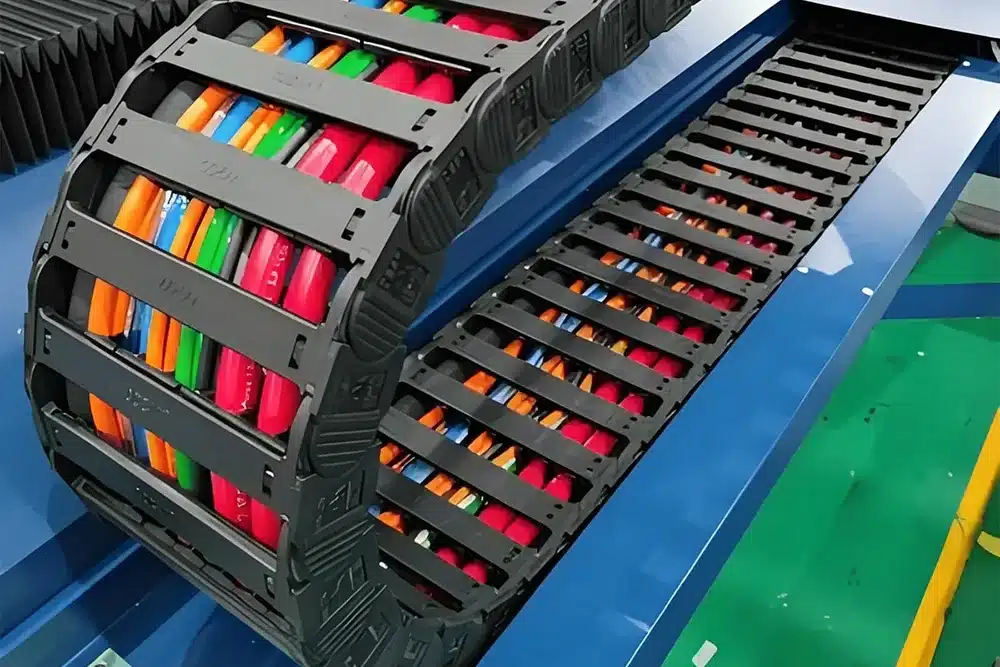
Proper fill ratios in cable carriers and dress packs allow internal movement, reducing abrasion and torsional binding. Consider overall diameter and jacket materials early in design.

EtherCat communication 6 axis robot 30kg payload industrial Robot Supplier,EtherCat communication 6 axis robot 30kg payload industrial Robot Manufacturer- Troysupply.com
Putting Electrical and Mechanical Design Together—Layered Architecture of Torsion-Rated Data/Control Cables
Typical Layer Stack for Torsion-Rated Data/Control Cable
From the inside out:
- Fine-stranded conductors in twisted pairs
- Optimized insulation and pair lay
- Individual pair shields where needed
- Fillers and tapes for stability
- Overall torsion-friendly shield
- Robust yet flexible jacket (often PUR or TPE for abrasion and chemical resistance)
Each layer works synergistically to handle both electrical demands and mechanical stresses in 3D motion.
Design Choices to Prevent Typical Torsion Failure Modes in Data/Control Cables
Optimized twisting and shielding mitigate shield tearing, conductor fatigue, and signal issues common at rotary joints. Hulk’s engineering ensures these cables maintain performance in real-world robotic deployments.
Specification and Selection Guidelines for Torsion-Rated Data and Control Cables
Matching Cable Type to Application—Control, Bus and Feedback
Differentiate needs: control cables for power signals, bus/data cables for Ethernet/PROFINET, and feedback cables for encoders. Choose explicit torsion-rated versions for multi-axis systems.
Key Parameters to Check in Datasheets
Focus on torsion angle/cycles, dynamic bend radius, shield configuration, stranding details, and environmental ratings (oil, temperature, etc.).
Questions to Ask Suppliers About Torsion-Rated Data/Control Cables
Inquire about test conditions (pure torsion vs. combined), pair/shield behavior under twist, and application references similar to your setup. Hulk’s team provides detailed support for custom solutions.
Closing Guidance—Treat Data and Control Cables in Robots as Mechanical Components, Not Just “Signal Wires”
Engineering torsion-rated data and control cables requires integrating pair twisting, advanced shielding, and precise mechanical constraints from the outset. By doing so, robotics engineers and integrators achieve superior signal reliability, extended service life, and reduced downtime in demanding 3D motion applications.
At Hulk Electric (Dongguan) Co., Ltd., our robot & torsion cables are manufactured with deep expertise in high-flex designs, supporting global automation leaders. Contact our engineering team to discuss your specific 3D motion requirements—we deliver customized, high-performance solutions backed by rigorous testing and certifications.