Torsion cables are vital in today’s robotics and automation, but many engineers think that they are “more flexible” versions of the standard high-flex cable. In fact, their repetitive twisting strength is due to the strategic design of internal structures (stranding pitch, buffer materials, and special shield designs) that control torsional stress, diameter changes and shears.
The robot torsion cables we design and manufacture use at Hulk Electric provide reliable performance in 6-axis arms, rotary joints or dynamic applications. This guide introduces you to the inside of a torsion cable so you can understand how these features work together to prolong the service life, and eliminate common failure modes.
How Torsion Loads Stress Cables—Diameter Changes, Shear Forces and Internal Movement
Now, when one reads about the mechanical needs of torsion, it may be possible to give an explanation and see how this is related to the failure of standard flex cables in twisting applications.
Torsion Versus Linear Bending in Robotic Applications
For linear drag chain applications, the main kind of cable bending is repeated bending in one plane. However, robot cables are required to perform complex 3D movements such as large amounts of back and forth torsional motion, particularly at the end-of-arm tooling and wrist of 6-axis robots. This is a twisting action which results in longitudinal torque that is not sustained by traditional bending optimized cables.
Diameter Changes Under Torsion—The “Wet Towel” Analogy
A wet towel shortens slightly and its diameter changes upon being twisted (fibers compress and move). Internal compression, shear, and friction between layers occur when the overall diameter of a cable changes due to torsion within the cable. This can cause crushed insulation, broken shield wires or corkscrewed jackets if it is not designed correctly.
Stranding Pitch—Why Torsion Cables Use Longer Pitch Than Linear Flex Cables
One of the most important, but underrated design considerations for torsion is stranding pitch.
What Stranding Pitch Is and How It Affects Motion
Stranding pitch (or lay length) is the distance along the axis of the conductor—the axis of the cable—that is needed for every complete turn that the conductor strands make around the cable. It has a direct effect on how the cable shares the mechanical stress when moving.
Why Torsion Cables Use Longer Pitch
Linear bending high-flex cables usually employ short (tight) pitch to ensure smooth motion of the strands during bending cycles. By contrast, the torsion cables need a longer pitch. This will reduce the internal twist on individual strands and help to avoid stress that might lead to flaring or fatigue in the strands.
Fine Stranding and Torque-Balanced Designs
Premium torsion cables involve the use of smaller conductors and other tension balancing designs including counter-lay directions in layers. The geometry of these designs enables even distribution of the lateral forces, preventing the production of any net torque and thereby eliminating the possibility of any permanent deformation or conductor breakage.

Buffering Materials—Soft Layers That Absorb Diameter Changes and Protect Inner Elements
Buffering layers fill the “shock absorbers” in a torsion cable.
Where Buffers Sit in the Cable Structure
Generally, these soft materials are positioned between the conductor bundle and shield, around the shield and underneath the outer jacket, and serve to retain the structural integrity during dynamic motion.
How Buffers Absorb Torsional Stress and Diameter Changes
Buffers are compressed when the cable twists and the diameter of the cable changes to allow for a little sliding between each buffer. This avoids conductors and shields being damaged by hard compression. They would otherwise crush the insulation or puncture shield wires and other nearby materials.
Common Buffer Materials—Mesh Tapes, Fleece, PTFE Films
Some of these materials include mesh tapes and fleece for load distribution, low-friction PTFE films to minimize abrasion and allow for movement, and more. The materials also are useful for maintaining the round geometry of the cable when repeatedly twisted or torqued.

Shield Design—Maintaining EMI Protection While Allowing Controlled Twist
Protection is essential for signal integrity in servo cables, encoder cables, and bus cables, but it has to be torsion optimized.
Why Linear Braid Shields Can Fail in Torsion
Standard tight braided shields (high coverage) are effective in linear applications, but are not easily twisted. Braid wires may break, flare or pierce the jacket and inner layers under torsion causing EMI and mechanical problems.
Shield Braiding Techniques for Torsion Cables
Torsion-rated cables are made by employing unique braiding methods, ensuring the angles and weaves are adjusted for optimal performance, while still providing only about 85% coverage and possibly spiral elements. These designs offer effective EMI protection, while allowing the shield to go with the twist instead of against it.
Shields Plus Buffers—PTFE Films and Layered Protection
With the help of the torsion-friendly braids and the PTFE buffer films, the shield wires can slide gently, absorbing the forces without damaging adjacent parts. This multi-layer system not only ensures durability but also provides electrical performance.

Putting It Together—Layer-by-Layer Look Inside a Torsion Cable
The well-designed torsion cable is a precisely orchestrated system.
Typical Torsion Cable Layer Stack
Inside out:
- Conductors: Fine stranded, torqued and optimised for longer pitch.
- Insulation: Compounds that are durable and flexible and do not crack.
- Bundling and fillers: Keep the geometry and differentiate core from fillers.
- Shield(s): Torsion optimized braids, sometimes with single pair shielding.
- Buffer layers: Mesh, fleece or PTFE to control the stress.
- Outer jacket: Abrasion resistant with outer jacket made of tough and elastic material such as PUR or TPE.
How Design Choices Prevent Specific Failure Modes
Fine stranding and longer pitch lead to less conductor fatigue. Buffers keep out compression damage and protect punctures. Specialized designs of the shield prevent corkscrewing and preserve EMI performance. These features combined, dramatically increase the life of cables in challenging robotic applications.
What Engineers Should Look For in Torsion Cable Specifications
If you’re looking at options from a supplier such as Hulk Electric, delve deeper than just flex ratings.
Stranding and Pitch Information
Request information regarding conductor stranding class, pitch/lay length and confirmation of torque balanced design. When only short pitch is specified, it could refer to bending optimized cables that are not recommended for heavy torsion.
Buffering and Shield Design Notes
Check for the inclusion of buffer tapes, PTFE layers and torsion-specific braiding. Ask for test data of shield performance against torsional cycles.
Torsion Ratings and Testing Standards
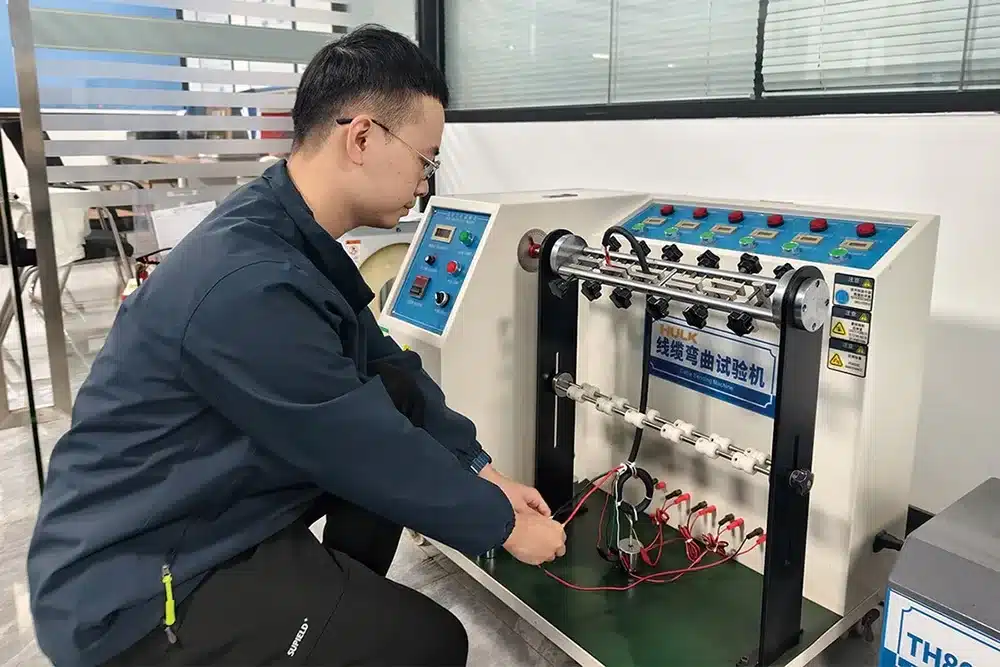
Look for cables that have a specific torsion rating (such as number of cycles, which is a number, or degrees per meter) and torsional fatigue testing.
Closing Guidance—Twisting Performance Comes from Design Discipline, Not Magic Materials
The superior torsion performance is not the result of a generic flexibility, but is achieved through careful stranding pitch, buffering materials and shield design. If robotics engineers and system integrators know these internal attributes, they can choose cables that are exactly what they need for their applications and minimize costly down time.
We apply these successful design ideas to our robot torsion cables, supported by a comprehensive test and customized process at Hulk Electric (Dongguan) Co., Ltd. Talk to our team about your unique twisting angles, cycle needs and environmental factors… we will help you to define the solution that will meet your long term reliability requirements.