Many engineers and integrators use the softest, most limply flexible cable they can get, reasoning it will perform best in applications where there is a lot of torsion. However, the same cannot be said of maximum “feel-good” flexibility and durability in robot torsion cables. The flexibility refers to the bending or twisting of the cable at this moment; flex life is the number of motion cycles the cable can endure before breaking. In high axes-of-motion robotic arms, the softness on its own can result in premature conductor fatigue, jacket cork screwing or shield breakdown.
We have encountered this confusion at Hulk Electric, where we have been designing high-f flex and torsion cables for automation giants all over the world for more than 20 years.We’ve seen this misunderstanding lead to unplanned downtime and expensive replacement at Hulk Electric, a company that has been designing high flex and torsion cables for automation leaders worldwide for over 20 years. This guide explains the important distinction and how to set up robot torsion cables to endure millions of cycles of real torsion.
Flexibility vs Flex Life—Defining Two Very Different Properties
Firstly, one must understand these two things before smart cable selection in robotics.
What “Flexibility” Means for Robot Cables
Flexibility is the ease with which the cable bends, routes, and twists during installation and when first moved. A very flexible cable is floppy, unraised and easy to install. These are made with conductors of fine strands, soft insulation and jacket compounds, thin walls, and internal spaces for components to slide against one another.
This simplifies initial handling and tight routing but can have limitations in continuous operation.
What “Flex Life” Means—and How It’s Measured
Flex life: Number of times a cable can bend or twist before failing electrically or mechanically. Typical industry benchmarks for standard flexible cables are in the thousands of cycles, and for true high-flex robot torsion cables, in the 10+ million cycle range.
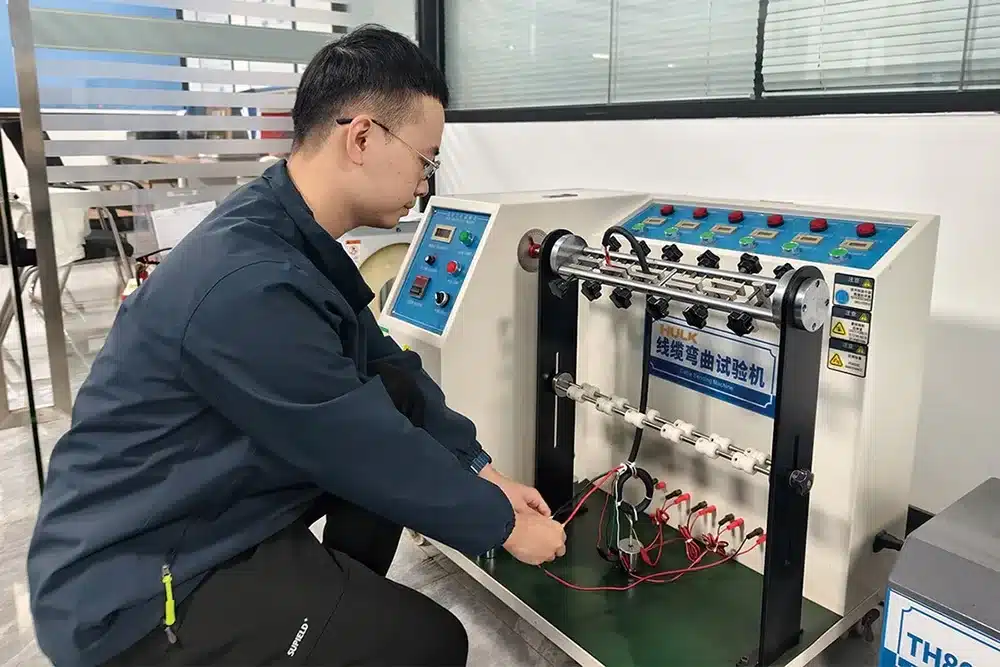
The ratings are not based on how soft the cable is in your hand, they are based on the test rigs that are used to test them to simulate real motion profiles. The construction, materials, bend radius and test (bending, rolling, torsion) all have a significant impact on flex life.

How Robot Torsion Cables Achieve Flex Life—Beyond Just Feeling Soft
An engineered internal design is the key factor in real-world robotics use, not softness.
Internal Structure—Bundled Conductors, Symmetry and Support
Quality robot torsion cables employ carefully bundled and symmetrically laid conductors, optimised lay lengths. This design spreads out the twisting force and keeps individual wires from shifting or rubbing against each other as they are twisted over and over again. Pressure-extruded inner layers further regulate micro-movements, making potential weak points into a stable system.
Materials and Micro-Movements—Where Flexibility Helps and Hurts
The same micro-movements that make for a soft feel can eventually become destructive friction sources if not controlled. Flexibility and fatigue resistance are achieved by using premium materials, including high-purity copper with defined stranding classes, special insulation and robust outer jacket materials. These ultra-soft compounds might perform well in static or low cycle applications, but usually do not have the ability to withstand continuous torsion, like in 6-axis robots.
Torsion Mode Makes the Trade-off Even Tougher
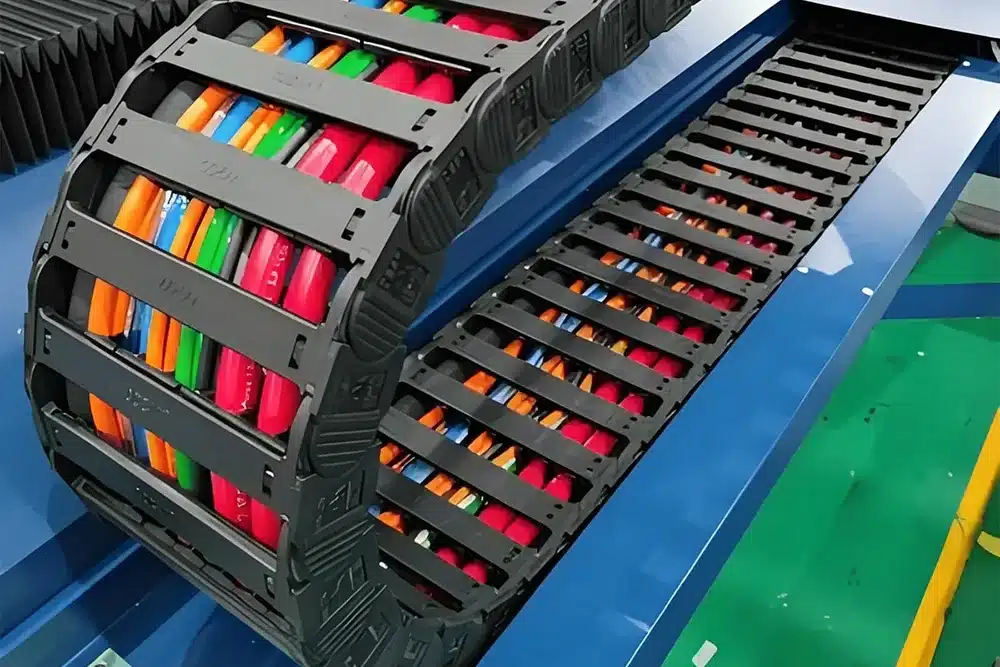
In drag chains, linear bending occurs along the length of the cable, while in torsion, it twists along the cable axis, involving all cross-sections. The torsion cables in robots need to be specially shielded and designed for maximum pitch while also being jacketed with a torsion rating in order to not corkscrew and/or damage the cable when ±180° or more per meter of twist is applied to it. The “flexible” cable that is used in a generic way doesn’t last long in the long term.

Why Softer Is Not Always More Durable in Robot Arms and Torsion Applications
A lot of real world failures are due to the importance placed on initial softness over engineered durability.
Small Gauge, Ultra-Soft Cables—More Flexibility, Less Flex Life
Very fine strands and ultra-soft insulation gives excellent short-term flexibility but wears out after the millionth of torsion cycles. A cable that fits snugly at the robot wrist could begin to fail by breaking strands or becoming harder to pull after just a few years of use.
Flexible But Not High-Flex—Cables Meant to Bend Once, Not Millions of Times
Most common flexible cables are intended to be routed for one use and not dynamic use. They could be softer and easier to handle than a purpose built torsion cable, but may not be reinforced internally for robot use.
Torsion Damage in “High-Flex Feel” Cables Without Torsion Ratings
When cables are selected only for their looseness, they can suffer well-known problems of “jacket corkscrewing,” “shield breakage,” and “conductor fatigue.When cables are selected for only their looseness, they can suffer from “jacket corkscrewing,” “shield breakage,” and “conductor fatigue” that are well known. The problems still occur if the cable worked well under just bending.

Flex Life Depends on Bend Radius and Motion Mode—Not Just Cable Feel
The real duration of service is very sensitive to both installation and operating conditions.
How Bend Radius Can Cut Flex Life by an Order of Magnitude
A 10 million cycle rated cable that is recommended for a 100 mm bend radius can only be expected to last 1-2 million cycles if used at a 50 mm radius. For compact robot cells, using manufacturer-specified radii is important.
Flex Life Ratings Are Mode-Specific (Bending, Rolling, Torsion)
Always check the test mode. High bending cycle rating does not guarantee good torsion characteristics. Mode-specific data for robotic applications from leading suppliers.

Practical Selection Rules—Choosing Robot Torsion Cables for Flex Life, Not Just Flexibility
Avoid common specification mistakes here by following these guidelines.
Start from Motion Profile and Required Cycles, Then Look at Flex Life
Establish the specifications of the application first: Torsion angle, RPM (revolutions per minute), Minimum Bend Radius, and Total Application Life. Then purchase cables that have been tested for flex life in accordance with those specifications.
What to Ask Vendors About Flex Life and Torsion Performance
- Which motion modes were flex life ratings set for (torsion, bending or both)?
- What radius and angle of twist per meter was used to test it?
- What is the best tradeoff for the conductor stranding, bundling, and jacket design for flexibility vs. long term durability?
- Do you have case studies or application references of robotics in other similar environments?
When Softness Matters—and How to Avoid Over-Prioritising It
Flexibility is also useful for installations that are easier and have less mechanical drag in moderate motion. Check flex life, torsion ratings, and construction of the wrist or arm before considering other factors, particularly for robot wrists that move a great deal, and multi-axis arms.

Closing Guidance—Think in Cycles and Stress, Not Just How the Cable Feels Today
The key point for successful robot installation is that reliability is considered more important than initial handling comfort. Knowing the difference between flexibility and flex life of the robot’s torsion cable can help avoid mis-specification and millions of trouble-free cycles.
These are the high performance robot torsion cables and high-flex solutions which have been the specialty of Hulk Electric, optimized for the world’s most demanding automation applications with an optimized stranding, symmetric design and rigorous testing. Our team of experts collaborate with you to ensure that the cable construction is tailored to your specific motion profile and environmental needs.
Discuss your robot arm parameters and we can advise you on or even build torsion cables to suit your installation requirements as well as your production life requirements.