Shielded torsion cables for encoders, feedback signals, Ethernet, and fieldbus lines are the key to smooth operation in high-EMI situations in robotics. During welding operations, when the robot arm is twisting through welding arcs or powerful servo drives, or dense electrical fields, mechanical torsion conflicts with electromagnetic noise, which can be a cause of low-level signal distortion and disrupt production. When these cables are properly specified (and with smart grounding and routing), the signal integrity is maintained both under motion and interference stress.
This guide is based on practical experience working with robotics integrators and plant engineers. It includes the principles of evaluating shielding structures, identifies torsion rated structures, discusses grounding considerations and the potential pitfalls of poor grounding that can result in encoder jitter, bus errors and intermittent servo alarms.
This course will offer insight into the characteristics of environments where a robot is expected to operate which may have high EMI levels, as well as signal integrity risks.
Understanding High-EMI Robotic Environments and Signal Integrity Risks
In welding, plasma cutting, material handling and high speed assembly, signal cables are frequently placed adjacent to large noise sources in robotic cells. Fast arm motion and high-powered electrical equipment combine to make a poor cable exposed to naturally dirty signals in no time.
Common EMI Sources Around Robots (Welding, Drives, RF, Switching)
The welding arc and current produce very loud high-level broadband noise that can couple into systems that are close by, particularly when moving where cables move in and out of position. Fast transients and harmonics are generated by high power servo drives and switching power supplies and impact on neighbouring signal paths. Control cabinets with large contactors, relays and motors create additional inductive spikes and RF equipment close by or wireless systems create additional interference.
These sources add noise via capacitive or inductive coupling, causing what is supposed to be accurate data pulses from the encoder or Ethernet packets to become corrupted. The result? Random stops of the robot, glitch in vision, position errors that only occur under certain motion profiles.
Signalling Types Most Sensitive to EMI in Robots
Low-level signals with strict timing requirements need to be carried by encoders and resolver feedback cables, which are extremely vulnerable. Clean transmission is required for reliable communication between high speed digital busses such as Ethernet, CANopen, Profibus or RS-485. When noise increases the noise floor or causes jitter to analog sensors and machine vision links, it also has a negative effect on their performance.
Shielded torsion cables are best suited for these lines as they have low signal levels and high data rates, so there is little room for error. Signal paths need to be consciously protected against interference while power cables can generally withstand more interference.

Shielding Basics for Moving Robot Cables – Structures and Trade-offs
Shielding provides a conductive layer that helps to reroute external electromagnetic field away from the conductors of the signal and allows noise currents to move to ground. For dynamic robotic applications, the shield needs to be effective even after repeated torsion and bending of the cable.
Foil, Braided, and Spiral Shields – Pros and Cons in High-EMI Torsion Applications
The foils (usually aluminum or copper, on a polymer film) provide good protection at high frequencies but are easily torn when subjected to continuous torsional forces, creating gaps which diminish protection over time. Braided shields have good mechanical strength and strong overall EMI attenuation, the coverage percentage and stiffness will vary according to the angle of braid and the density of wires. Spiral-wrapped shields are ideal for torsion-rated designs due to their helical design that can be twisted without cracking or loss of continuity.
In torsion sensitive sections, don’t just use foil alone for shielding in high-EMI applications. Braided or spiral designs cope better with mechanical stresses and offer good noise rejection.
Combined Shields and Pair Shielding for Bus and Encoder Lines
Many high quality robot cables feature two level shielding (foil and overall braid) for protecting against low and high frequencies. Individually shielded twisted pairs (screened pairs) provide even greater crosstalk immunity between lines in the same cable, particularly for multi-axis encoding feedback or a mix of analog/digital lines.
If you are using shielded torsion cables, be sure to articulate the required shield structure to the type of EMI profile and types of signals you are handling.

Torsion-Rated Shielded Cables – Balancing EMI Protection and Mechanical Flexibility
“shielded” alone is not sufficient for the use of a robot. The cable should be able to endure thousands of torsion cycles without compromising the integrity of the shield and electrical properties. Shielded cables with high-quality torsion ringings use special lay lengths and buffer layers and optimized shield geometries to minimize fatigue.
Shield Designs That Survive Torsion Without Early Failure
High quality TPE or PUR jackets and flexible stranding with spiral-wound shields ensure coverage in extreme twists. The optimized braid angles minimize the strain concentration and internal slip layers enable components to move independently without harming the shield. These features ensure the cable’s EMI performance remains consistent, regardless of how long it operates.
How Vendors Test Shield Integrity in Torsion Environments
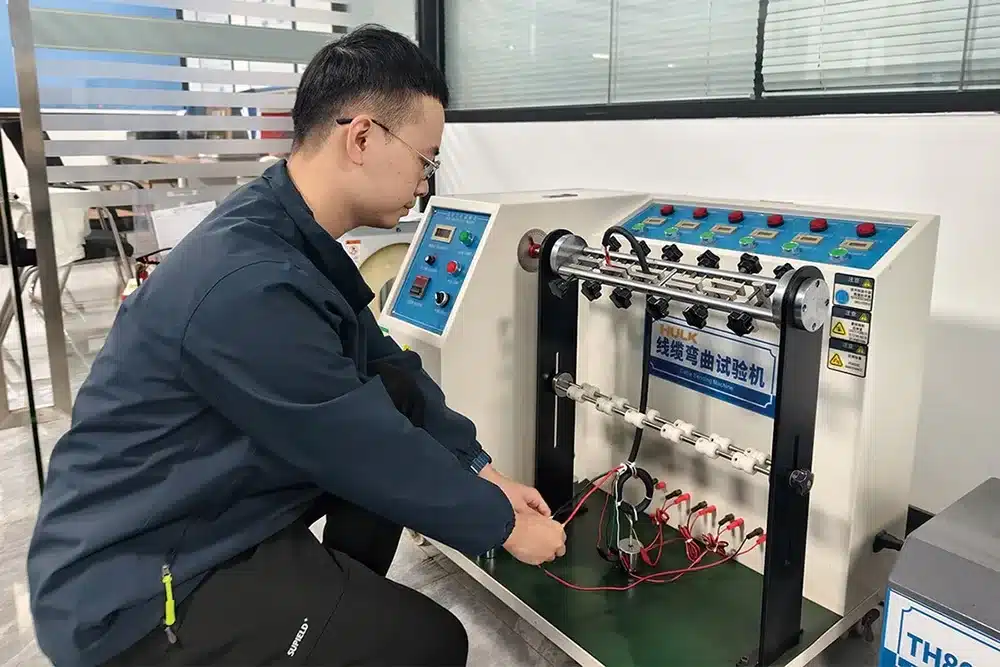
Responsible manufacturers employ specialized torsion test rigs to simulate robot motion profiles, tracking shield continuity, impedance stability and signal quality for a specific number of cycles and twist angles. Request test reports with performance testing in environment similar to the application, not just flex tests.
Grounding Strategies for Shielded Robot Cables – Getting Noise Currents Out of the System
A shield only works when properly connected to ground. Poorly terminated shields or shields floating in space can be antennas, which may cause noise issues in robot cells.
Single-End vs Both-Ends Shield Grounding in Robots
Single end grounding (usually at the control cabinet or drive end) can help eliminate ground loops, and still drain noise out of the system in many industrial robotic systems. In some high-frequency or EMC-critical designs, both-ends grounding can be necessary, but must include very good equipotential bonding to prevent the creation of loops. When selecting, follow the guidance of the robot OEM and system EMC requirements.
360° Shield Termination and Low-Impedance Ground Paths
The shielding effectiveness drops drastically at higher frequencies with pigtail connections. Connectors and backshells that make a complete 360° circumferential contact with the shield. The low impedance path for noise currents consists of the short, wide ground straps and appropriate bonding between the robot base, the cabinet and the earth ground.

Routing and Separation – Keeping Shielded Torsion Cables Away from Noise
The best torsion cables, even when shielded, will work best when physically removed from noise sources.
Physical Separation Between Power and Signal Cables in Robot Harnesses
Where possible layout high power servo motor cables and sensitive signal lines in separate bundles or compartments. Do not run parallel, unless they are truly parallel; cross noisy lines at right angles when necessary. Ensure encoder and bus cables are not near power cables on robot arm.
Dress Pack and Cable Guide Design for EMI and Torsion
Well designed dress packs include partitioned channels or extra protection sleeves for critical lines. Ensuring proper strain relief and controlling bend radii eliminate the possibility of mechanical damage and movement of the cable orientation that may lead to increased coupling. In one typical scenario, a change in a dress pack configuration which increased separation halved the number of persistent CAN bus errors without changing any cables.

Typical EMI-Related Failure Modes in Shielded Torsion Cables (and What They Reveal)
Common problems are not a result of the absence of shielding in cables, but as a result of specification or installation problems.
Shield Present but Not Grounded or Poorly Terminated
Encoder noise, Ethernet CRC errors or noise bursts may be observed during welding cycles. Most of these are due to pigtail terminations or floating shields, not due to faulty cable.
Shield or Pair Damage Due to Torsion Mis-Design
Incompatible shield construction over time causes cracks and tears or loss of coverage, making it more vulnerable to EMI. This is because it emphasizes the need for torsion specific testing as opposed to static or simple flex ratings.

Specifying Shielded Torsion Cables – RFQ and Design Checklist for High-EMI Robot Cells
Communicate your needs with your vendors in a clear and concise manner.
Key RFQ Inputs for Shielded Torsion Cables
List robot model and motion profile with torsion angles per segment, detailed description of the EMI environment, type of signals to be transmitted, data rate requirements, necessary robot torsion protection and pair protection, target number of cycles, preferred grounding method, and connector specifications.
Questions to Ask Vendors About Shielding, Torsion and Grounding Support
- How is the shield made and what is tested for it to be suitable for our motion profile?
- Which torsion angles and cycle ratings ensure complete shield continuity and signal performance?
- Are connectors and backshells available that allow for true 360° termination?
- What routing and grounding rules are appropriate for those installations with high EMI levels?

The best way to ensure reliable robot performance is to view shielded torsion cables as a part of your total EMI and motion solution, instead of just a commodity part of your system. The early involvement of controls, EMC and cable specialists helps to prevent costly field problems, and ensures long-term uptime for demanding applications.
Our engineers at Hulk Electric design custom shielded torsion cables that have optimized shielding structures, high-EMI rigorously tested for torsion, and complete support of proper termination and routing in your high-EMI robotic environment. Provide your robot cell parameters and we will be able to help you specify solutions that will keep the signal integrity in real operating conditions.