Oil exposure will reduce the life of cable long before there is an electrical failure. To make the right choice of cable materials in the industrial environment, one needs to match the actual fluid, temperature, contact method, mechanical duty, and complete construction of the cable—not just the highest priced jacket that is ‘oil resistant’. The outer jacket or conductor insulation of a cable may be swelling, softening, hardening or losing strength and the cable still be carrying current. Before making any materials selection decisions, determine the type of oil or coolant, exposure type, temperature, movement profile and associated test needs.
The term “oil resistant” is not universally specified. Compatibility is influenced by fluid chemistry, concentration, temperature, duration of contact, mechanical stress and by the polymer formulation. The outer jacket and the conductor insulation should both be considered; a tough jacket will not protect insulation which has penetrated through damage, through terminations or through capillary paths into the jacket.
How Oil Damages Industrial Cables
The oils and coolants react with the polymer compounds in the jackets and insulations of cables. Under certain conditions, exposure can leach plasticizers, absorb liquids, alter hardness, expand the volume, decrease tensile strength, and cause surface cracking, depending on the material. The cable may appear fine initially and then break down over time or when flexed over time.
Swelling and Softening
Some oils and water-soluble coolants migrate into the polymer matrices, which affects the dimensional stability and increases the volume. The outer diameter expands, the cable starts rubbing against drag-chain guides, cable carriers or machine surfaces and the jacket becomes soft or elastic. This dimensional change is a common occurrence in CNC and hydraulic systems long before electrical issues occur.
Hardening, Brittleness, and Cracking
In other instances the oil affects the plasticizing material and makes it harder and more brittle. The surface cracks at the bend points, the jacket tears and the insulation is exposed and then breaks. Mechanical failures create opportunities for additional fluid infiltration and conductor damage. There are more detailed discussions on why cable jackets crack in our article.
Discoloration and Surface Changes
Changes in color, stickiness or loss of gloss may indicate additive migration, additive-chemical interactions or thermal aging. Don’t consider discoloration as a fail symptom. Inspect for hardness, dimensions, cracks, surface tack and insulation-resistance readings simultaneously.
Electrical Degradation After Material Damage
After polymer structure is degraded, electrical performance reducing. Insulation resistance decreases, leakage currents flow, the shields become discontinuous, intermittent fault and total breakdown will occur. Typical field symptoms include servo feedback errors, encoder faults, sensor noise, motor insulation leakage and control-circuit instability. Failure analysis should be used in conjunction with electrical testing, unless a visual inspection is sufficient.
Why Oil Damage Is Often Irreversible
There is significant chemical or structural change of the polymer that cannot be reversed by wiping the surface clean. The only sure way is to prevent it, that is, by choosing the appropriate material and ensuring that the routing of the material is done in an appropriate manner, by protecting the material connections, and by verifying the actual exposure of the material.
Define the Oil-Exposure Conditions Before Selecting a Material
The term “oil-exposed environment” is too general to be used to make a reliable recommendation. Accurately describe the exposure first.
Identify the Exact Fluid or Chemical
Identify which chemical the cable will come into contact with, including cutting oil, water solutions, hydraulic fluid, lubricating oil, grease, synthetic oil, mineral oil, cleaning solvent or other chemicals. Additives can alter the properties of fluids that appear to be the same as the fluid that has the same name in everyday use. Give the name of the product, manufacturer or safety data sheet or chemical composition if possible.
Splash, Mist, Immersion, or Continuous Contact
Different risk levels are provided by occasional splash, oil mist, surface film, pooling and partial immersion and continuous immersion. A cable that is sprayed by coolant is subject to different duty than one that is immersed in oil or that passes through a hydraulic reservoir.
Temperature and Exposure Duration
The compatibility of oils varies on both temperature and time. Materials that work well in normal room temperature may fail when exposed to heated oil or when subjected to repeated thermal cycling. Understand the difference between continuous operating temperature, fluid temperature, short term peaks, and installation temperature and storage temperature.
Mechanical Stress During Oil Exposure
The cable’s oil damage progresses further when bent, twisted, stretched, compressed or abraded. A drag-chain cable that is immersed in a coolant or a hydraulic connection that bends during operation are subjected to both chemical and mechanical stresses, which are not adequately replicated in a pure immersion test.
Cleaning and Maintenance Chemicals
The jacket may be susceptible to detergents, degreasers, disinfectants, solvents and high pressure washdown that affect it in other ways than the process oil. Incorporate into the review frequency of cleaning, drying, water temperature, chemical concentrations, and pressure.
Which Cable Materials Are Suitable for Oil-Exposed Applications?
There is not one polymer family that can be used for all oil-contaminated tasks. Both have advantages and disadvantages which need to be compared with the specific fluid and conditions.
PVC Cable Materials
Some PVC compounds offer good oil and chemical resistance characteristics for moderate exposure and for installations that are basically fixed or have only light flexing. Performance is highly dependent on the plasticizer system, temperature and type of fluid. Standard PVC is not a material that is typically first choice for continuous immersion or for severe dynamic machine-tool duty.
PUR Cable Materials
When considering applications that require oil or coolant contact coupled with abrasion, ozone and repeated motion, polyurethane is often the choice of material. PUR jackets are widely used as machine tools, automotive equipment, drag chains or automation lines. Each PUR compound has its own response to certain oils and temperatures, so please check the product datasheet and product test results.
TPE Cable Materials
Thermoplastic elastomer grades have been selected for their flexibility, abrasion resistance, chemical resistance and good low temperature properties. TPE is a family of compounds so the specific compound needs to be verified in the oil, coolant, temperature profile and for flame and halogen-free performance.
Fluoropolymers and Specialty Materials
When the chemical, temperature or electrical requirements of standard materials are not practical, FEP, PTFE and related fluoropolymers are considered. They generally increase the cost, have different mechanical properties and processing limitations and are only suitable if there is a specific performance requirement.
Rubber and Other Elastomeric Compounds
For outdoor or high flex applications, rubber and elastomer compounds can provide flexibility, toughness, impact resistance and specific oil resistance. Analyze the specific compound and application information, not consider that the term “rubber” has universal oil performance.
| Material Family | Potential Strengths in Oil-Exposed Applications | Important Qualification |
| PVC | Cost-effective general industrial performance in selected conditions | Oil, temperature and dynamic performance vary by formulation |
| PUR | Often strong oil, coolant, abrasion, ozone and flex performance | Exact fluid, temperature and motion conditions must be verified |
| TPE | Can combine flexibility, chemical resistance and low-temperature performance | Broad family with grade-specific behavior |
| Fluoropolymers | Strong chemical, thermal and electrical performance | Higher cost and possible mechanical or processing trade-offs |
| Rubber / elastomers | Flexibility, toughness, impact and selected environmental resistance | Compound-specific oil and temperature behavior |
How to Evaluate the Complete Cable Construction
The jacket alone does not determine how resistant to oil it is. All conductor insulation, conductor shielding, conductor fillers, inner jackets, connectors, glands and strain reliefs should be considered as a system.
Outer Jacket and Conductor Insulation
The jacket is the first external barrier, insulation is the electrical separation inside the cable. Even if a jacket still appears to be in good shape, oil can penetrate the jacket into the insulation via cuts, terminations or capillary paths.
Shielding, Filler, and Inner Layers
Oil may get into shields, drain wires, fillers and separators by mechanical damage or improper assembly. Servo, motor, encoder, Ethernet and fieldbus cables which are exposed to oil and require electrical and mechanical integrity are particularly vulnerable to damage to the shield.
Cable Diameter, Bend Radius, and Movement
Swelling or hardening alters the dimensions of the jacket and the stiffness of the jacket, and impacts bend radius, cable-chain fit, and friction. These mechanical changes can cause failure to occur faster than any electrical symptoms in drag-chain and robotic applications. Also refer to our flexible cables copper stranding design and high flexible cables.
Connectors, Glands, and Cable Entries
Oil will often get in at the ‘weak points’ in the system such as connectors, glands, stripped ends and poorly sealed transitions. Discuss connector materials, sealing, IP rating, strain relief, gland compatibility and installation orientation with the cable materials.
Flame, Smoke, Halogen-Free, and Certification Requirements
Resistance to oil is just one compliance factor. UL, CE, IEC, VDE, TÜV, RoHS, REACH, Flame Retardant, Low smoke, Halogen Free performance can also be required for projects. Determine if a specified test is for material, finished cable or entire assembly.
Oil-Exposed Applications and Material Selection
CNC Machine Tools and Machining Centers
Typical include cutting fluids, coolants, metal chips, abrasion and tight routing. The fluid chemistry, motion profile, temperature, and desired certifications may be one of the criteria used to evaluate PUR, selected TPE or specialty PVC constructions. Additional PVC to PUR comparisons are provided in our materials article.
Drag Chains and Moving Machine Axes
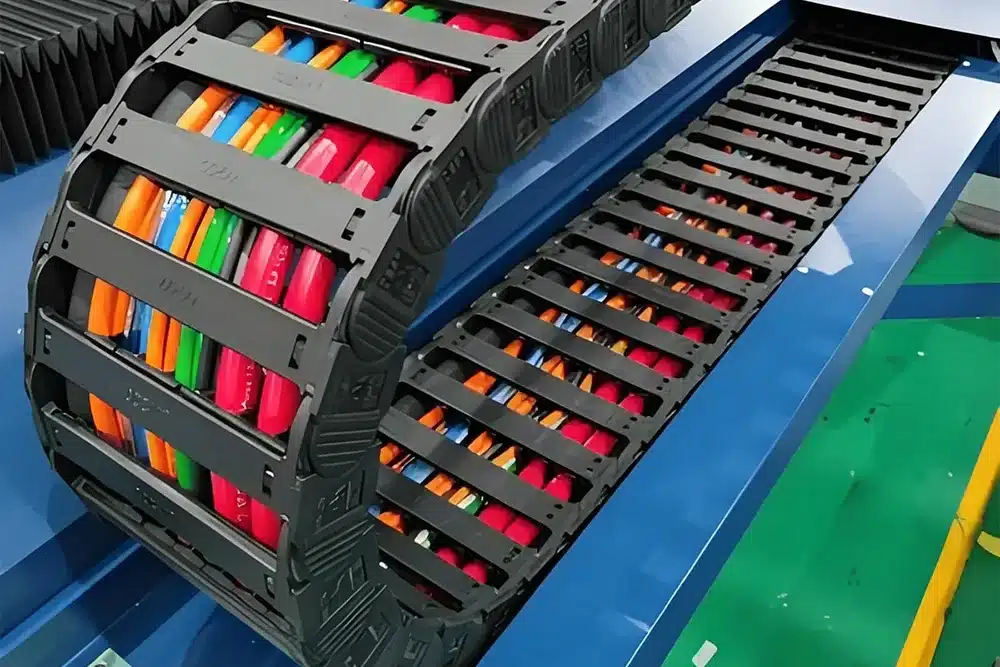
The construction should ensure chemical and mechanical properties of both the jacket and the conductor and ensure controlled movement under simultaneous chemical and mechanical stress.
Servo, Motor, and Encoder Cables
Insulation, shielding, grounding and connector interfaces need to be protected for power, feedback and encoder cables in areas where they are likely to come into contact with oil. Typical field symptoms are: drive faults, intermittent feedback and Insulation leakage.
Automotive and Metal-Processing Equipment
Oil, grease, coolants, weld spatter, abrasion, heat, vibration, robot motion are frequently present. The selection of materials should be based on the combination, not on any one of its properties.
Hydraulic and Mobile Industrial Equipment
The hydraulic oil, vibration, repeat motion and outdoor conditions and temperature cycling all require material compatibility and mechanical support. The materials that are selected survive by routing, the spacing of the clamps, the bend radius, and the sealing.
Washdown and Food-Processing Environments
Use of process oils can be used in conjunction with detergents, disinfectants, hot water, steam and repeated cleaning. Detail the cleaning process and ensure that jacket, connector and installation are clean and comply with hygiene and regulatory standards.
How to Verify Oil Resistance With Testing and Documentation
Label or supplier claims are not enough for critical uses. Support for oil resistance shall be provided through an appropriate test, documentation or application validation.
Review Oil-Resistance Test Standards
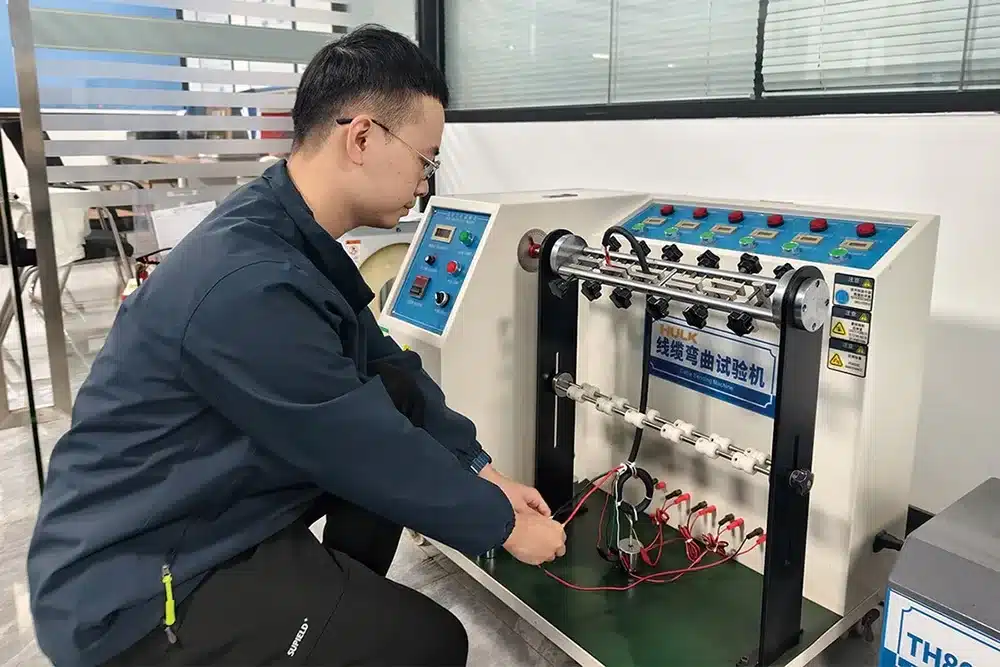
The two commonly cited oil resistance tests for cables are UL Oil Res I and Oil Res II. They are based on the controlled immersion of a sample in a reference oil (usually IRM 902 or ASTM Oil No. 2), at a controlled temperature and time, then measuring retention of tensile strength and elongation. Common differences include a shorter, higher temperature exposure for Oil Res I with a 50 % retention and a longer, moderate temperature exposure for Oil Res II with a 65 % retention. Resistance to a specific industrial oil, coolant or solvent depends on the applicable standard and cable category, and only one test result indicates resistance to a particular oil, coolant or solvent.
Understand What the Test Measures
Oil resistance tests assess physical alterations, including cracking, swelling, surface damage and elongation, following exposure to oil. A lab test does not guarantee that the cable will not suffer from any damage in the field. Test temperature, immersion time, type of oil and sample construction as well as acceptance criteria should all be considered.
Compare the Test With the Real Application
Compare the test condition with the fluid type, temperature, exposure time, splash or immersion, mechanical motion, abrasion and pressure. In cases where the cable is critical, the fluid is unusual or oil is being mixed with high flex, heat or torsion, application specific testing is warranted.
Inspect Samples and Field Failures
Monitor for swelling, cracking, hardening, softening, discoloration, surface tackiness, dimensional change, conductor corrosion, and damage to the shields and changes in insulation resistance. Don’t look at a single symptom to diagnose the root cause, as oil damage, heat aging, chemical attack, mechanical stress and installation errors can have similar appearances.
Common Mistakes When Selecting Oil-Resistant Cable Materials
Choosing a Cable Based Only on the Words “Oil Resistant”
The word is worth nothing without the type of oil, method of test, temperature, duration, and product category. Ask for specific test standard, data sheet and application restrictions.
Testing Only the Jacket
Even if the outside jacket looks good, it can be damaged by oil in insulation, shields, fillers, connectors and cable ends. Assess the entire construction and connectorized assembly.
Ignoring Oil Temperature and Exposure Duration
Different results from warm oil, thermal cycling and long duration of exposure to room-temperature oil. Record the fluid’s temperature, cable’s temperature, exposure time and cleaning process.
Using a General-Purpose Cable in a Dynamic Oil Environment
Failure is hastened when oil is combined with repeated bending, abrasion or torsion. Choose a cable for the chemical and the desired motion profile.
Ignoring Cable Routing and Pooling
Low points, unsealed entries and poor drainage results in longer or more severe contact than anticipated. Things like correct routing, support, drip loops, glands and edge protection are important.
Selecting Materials Without Considering Temperature
The properties of polymers and oils vary with temperature. Check continuous, peak, installation and storage temperatures.
Replacing a Failed Cable Without Finding the Root Cause
When the same material is installed without addressing problems with pooling, abrasion, sealing, bend radius and overheating, it is an invitation to repeat the failure. Note the condition and have the cable maker partake in the review.
How to Select the Right Cable Material for Oil Exposure
Step 1—Identify the Fluid and Exposure
Take note of fluid type, manufacturer, composition, concentration, temperature, frequency, contact method (mist, splash, pooling or immersion) and cleaning chemicals. This information is much more valuable than the catchy term “oil exposed machine.”
Step 2—Define the Electrical Requirements
Designate conductor size, current, voltage, frequency, length, voltage drop, signal type, shielding requirements and certification requirements. This material should have the same electrical performance in the environment.
Step 3—Define the Mechanical Requirements
Indicate fixed or dynamic installation, bend radius, travel, speed, acceleration, torsion, vibration, wear and tear, support method and service life. Indicating the oil resistant material does not ensure flex life.
Step 4—Choose the Material Family for Review
Screen PVC, PUR, TPE, rubber, fluoropolymers and specialty compounds, based on prevailing risks, and then proceed to product specific data and application testing as needed.
Step 5—Verify the Complete Cable and Connection System
Check jacket, insulation, shielding, connectors, glands, strain relief, sealing, bend radius and installation. The connection system is a source of oil often entering at transitions or terminations and should be included in the approval process.
What to Include in an Oil-Resistant Cable RFQ
Fluid and Environmental Information
- Oil or coolant name & manufacturer or product code
- Chemical composition, safety data sheet.
- The focus and temperature of the fluid.
- Frequency of exposure and route of contact (splashing, misting, pooling, immersion)
- Cleaning chemicals, water, humidity, UV or ozone exposure
These are not enough – the terms “machine oil” or “harsh environment” are too vague.
Mechanical and Installation Information
- A fixed or dynamic installation.
- Bend radius, travel distance, speed, acceleration, torsion, cycle frequency
- Exposure to abrasion, cutting, drag-chain or robot configuration
The cable must withstand oil exposure and mechanical stress together.
Electrical and Cable Construction Information
Founded by Harry T. Liles for the benefit of the cable and electrical industries.
Conductor material and size, current, voltage, signal type, shielding, insulation, length, voltage drop, diameter, connector type and termination method. It would be difficult to imagine jackets without internal construction.
Testing & certification & supply information
Testing, Certification, and Supply Information
Minimum requirements, oil resistance testing, intended use, certifications, sample size, validation testing, annual quantity, packaging, marking and lead time. As a direct manufacturer, Hulk Cable will be able to discuss the applications that have been exposed to oil and create customized insulation, jacket, shielding, conductor and testing solutions.
Summary Guidance—Choose Materials for the Actual Oil Exposure
When choosing cable materials for use in oil exposed environments, you can’t just go by a cable that’s labeled “oil resistant.” Determine exact type of fluid, temperature, exposure type, duration, mechanical stress, electrical requirements and certification requirements. Other materials such as PUR, TPE, specialty PVC, rubber and fluoropolymer may be suitable depending on the circumstances. Each phase of the cable’s construction should be verified as part of a complete cable—insulation, jacket, shielding, connectors, glands, strain relief, installation and testing.
For CNC machines, machine tools, drag chains, servo systems, hydraulic equipment or other applications where the cables will come in contact with oil, state the fluid type, motion profile, temperature range, electrical needs, and installation conditions. Hulk Cable can suggest and prove the appropriate duty cycle oil resistant construction.