It is not just a matter of a TPU cable jacket being better than a PUR cable jacket, or vice versa. Both materials can yield a consistent performance in industrial cable, but the suitability of the material depends on the compound and hardness of the cable, the movement it will experience, the chemical environment, and the anticipated service life. When abrasion, tear, impact, moisture or dimensional stability is most important, TPU (thermoplastic polyurethane) is often assessed. Frequently chosen for flexible cables requiring resistance to oils, abrasion, ozone, and repeated bending, PUR (polyurethane) is a popular choice. These are simply the general trends. When choosing a jacket, always check the jacket formulation and finished-cable information.
What Are TPU and PUR Cable Jackets?

They are both members of the polyurethane family but are not used interchangeably among manufacturers or datasheets.
TPU: Thermoplastic Polyurethane
TPU is a thermoplastic elastomer, with both the characteristics of rubber and being melted and reshaped during processing. It is also a good source of chemical, oil, moisture and low temperature resistance, as well as being extremely resistant to abrasion, tear and impact in cable jackets. Specific characteristics of its behavior depend on hardness (typically Shore A80-95), polymer chemistry (polyether grades tend to have better hydrolysis resistance), and on additives but also on the manner of extruding the jacket onto the cable core. Not all TPU jackets have the same temperature range or flex-life.

PUR: Polyurethane Cable-Jacket Compounds
PUR is commonly used as a catchall term for polyurethane sheaths on cables. These compounds offer flexibility, resistance to abrasion, oil and coolant, ozone and resistance to continuous or intermittent movement. Common applications are machine tools, drag chains, robotics, automation systems and mobile equipment. A datasheet with only the term “PUR” requires the buyer to provide the compound grade, hardness, temperature rating, chemical-resistance data and dynamic-performance results.
Why the Terms TPU and PUR Can Be Confusing
A supplier could choose to call polyurethane jackets “PUR” or another supplier to choose the term “TPU” which refers to a particular thermoplastic polyurethane formulation. Abbreviations don’t necessarily mean the same chemistry and performance. Look at hardness, tensile strength, elongation, tear strength, abrasion test method, chemical exposure condition, temperature range, bend radius and motion profile. A reliable selection can only be made with the completion of the construction of the cable and the verification of test data.
TPU vs PUR Cable Jackets: Key Performance Differences
This is a comparison of typical industrial tendencies. Each entry should be accompanied by the grade and cable construction.
Abrasion and Tear Resistance
Drag chains, machine tools, conveyors and robotic systems frequently come into contact with guides, edges and other cables. Surface abrasion is the process of the material being removed over time; Tear Resist is resistance to the propagation from a cut or sharp edge. High abrasion resistance can be achieved in both TPU and PUR. Some TPU grades are more specifically selected when the properties of tear and impact strength are needed. A surface resistant jacket may be inadequate if the cable is not supported with a sharp edge.
Flexibility and Repeated Bending
The overall construction (fine-stranded conductors, core lay, insulation, shielding, and jacket) is such that PUR jackets are often used on flexible industrial cables. TPU can also be used in dynamic applications and flex performance is dependent on the hardness, formulation, cable diameter and minimum bend radius. The results of all this depend on the design of the cable, as well as on the tests conducted on the jacket material. Copper stranding design and flex life are related to the guidance included in our article.
Oil, Coolant, and Chemical Resistance
Both materials are resistant to many industrial oils, cutting fluids and some solvents. There are no absolute guarantees of resistance. All the chemical, concentration, temperature, duration of exposure (splash, immersion, vapor), and mechanical stress acting at the same time should be known. Compatibility data or specific testing is often needed for CNC machine tools, automotive lines, or hydraulic systems, and is not a blanket term for “oil-resistant.”
Moisture, Water, and Hydrolysis Resistance
Surface water resistance is just one aspect of the picture. The jacket can be impacted by repeated immersion, hot water, steam, washdown, condensation and high humidity whereas the insulation or the connector interface may not be. However, when there are concerns for long-term exposure to moisture or microbes, selected grades of polyether TPU are considered and the entire assembly must be sealed and validated. The material of a jacket is not waterproof by itself!
UV, Ozone, and Outdoor Weathering
Aging of outer jackets is caused by sunlight, UV, ozone, rain and temperature cycling. Cables are subject to these conditions outdoors, such as on conveyors, port equipment, water-treatment systems, and mobile machinery. Check all UV or weather ratings to the actual cable, not just the base polymer. Even the installation details, such as glands, connectors and mechanical support, are as important.
Temperature and Low-Temperature Flexibility
The operating ranges depend on the formulations. Either material is flexible at low temperatures; either becomes hard or weak when exposed to temperatures below the range. Understand continuous operating, intermittent exposure, installation, storage and surrounding heat sources. The published numbers are only valid for the test grade and construction.
Processing, Termination, and Cost
TPU is thermoplastic and is suitable for reprocessing under controlled conditions; PUR compounds used in cables can be extruded and cured in various ways depending on the PUR system. It is important to verify stripping, connector compatibility, overmolding and gland sealing with the manufacturer. That’s not the only consideration when it comes to material. The life of the service, replacement manpower and downtime are frequently more valuable than the upfront cost difference. .
| Selection Factor | TPU | PUR |
| Material description | Thermoplastic polyurethane | Polyurethane-based jacket category; confirm exact formulation |
| Abrasion resistance | Often very high, grade-dependent | Commonly high in industrial compounds |
| Tear and impact resistance | Often strong | Strong, depends on compound and hardness |
| Flexibility | Formulation- and construction-dependent | Commonly used for flexible industrial cables |
| Oil and chemical resistance | Often strong, exposure-specific | Often strong, exposure-specific |
| Moisture and water exposure | Can perform strongly in selected grades | Depends on compound, construction, and exposure |
| Low-temperature behavior | Grade-dependent | Grade-dependent |
| Processing | Thermoplastic | Depends on specific polyurethane system |
| Typical applications | High-wear, outdoor, wet, impact, specialized use | Flexible automation, machine tools, drag chains, robotics, oil-exposed machinery |
| Cost | May be higher in specialized grades | Varies by compound and application |
When PUR May Be the Better Choice
If flexibility, oil resistance, abrasion resistance, and repeated industrial movement are the key requirements, PUR is still a viable and popular choice.
Drag Chains and Continuous Industrial Motion
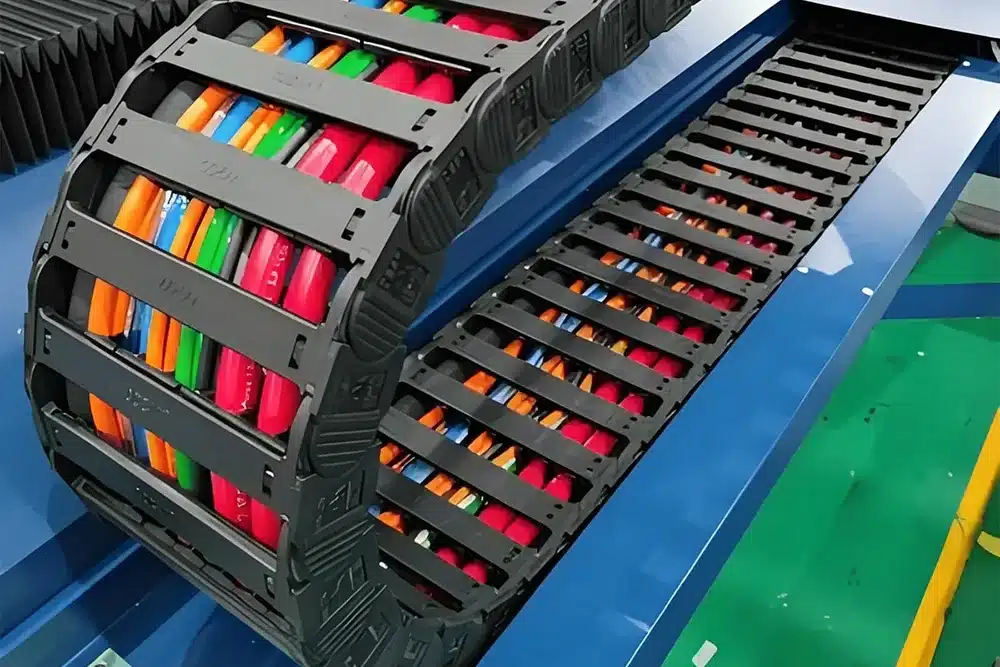
Choosing the right jacket is a key decision to make in conjunction with conductor stranding, cable lay, insulation, shielding, bend radius, travel distance, speed, acceleration and cycle frequency. The cable must be validated for the motion profile for continuous-flex duty and a PUR jacket does not automatically qualify for continuous-flex duty.
Machine Tools and Oil-Exposed Equipment
PUR constructions that are both abrasion resistant and oil and coolant tolerant are often preferred in CNC machines, cutting fluids and automotive production lines. State the exact type of fluid, concentration, temperature, and method of cleaning prior to final approval.
Flexible Sensor, Control, Servo, and Robot Cables
PUR jackets are commonly used in sensor, actuator, servo, motor and robot cable applications. Jacket choice is combined with conductor design, conductor shielding, conductor torsion, minimum bend radius, and connector strain relief. Check our sensor & actuator cable, servo & motor cable and robot & torsion cable ranges.
When PUR May Offer the Better Cost-to-Performance Balance
If there is no special abrasion, moisture or impact properties associated with a specific TPU formulation, a well designed PUR cable can achieve the desired service life at a more favorable TCO.
When TPU May Be the Better Choice
TPU should be considered where abrasion, tear, impact, long term exposure to moisture, outdoor durability or dimensional stability is the dominant risk. It is not necessarily better in all dynamic applications, and it needs to be grade-specific even if it is continuous bending, torsion and chemical exposure.
Severe Abrasion, Cutting, and Impact Risk
The higher tear and impact resistance of many TPU grades is beneficial for cables in contact with sharp edges, chips, tooling or repeated impact. Surface abrasion resistance does not mean cut or puncture protection, mechanical routing protection might still be required.
Prolonged Moisture, Water, or Washdown Exposure
Specific grades of TPU can be selected for food-processing lines, outdoor machinery, water-treatment systems and humid production areas. The entire cable assembly (connectors and glands included) must still be sealed and tested for the actual washdown or immersion conditions.
Outdoor and UV-Exposed Equipment
Weathering conditions in combination with mechanical wear occur in outdoor conveyors, cranes, ports, in agricultural automation systems, and externally in machine wiring. TPU can provide solutions for both, but testing UV, ozone, temperature cycling and water performance of the completed cable is required.
High Mechanical Strength and Dimensional Stability
Some grades of TPU are available that provide high wear resistance, high tensile strength and dimensional stability that are beneficial in compact routes, mobile equipment and high wear areas. Check the hardness, tensile strength, elongation, tear strength and abrasion method of the particular grade.
Common Mistakes When Comparing TPU and PUR Jackets
Treating TPU and PUR as Completely Separate or Interchangeable Terms
Do not accept only the abbreviation for the polymer; ask for an exact polymer description and formulation family, and its hardness and applicable standard, as well as the finished-cable specification.
Assuming TPU Is Always More Durable Than PUR
Although a high performance TPU grade might perform well in abrasion, tear or moisture resistance, a well-designed PUR cable may be more suitable for continuous flex, oil resistance or cost requirements. The results are dependent on the conditions of application and the test data.
Choosing a Jacket Without Checking the Conductor and Cable Lay
All of these can not be solved with an excellent jacket. The jacket selection and conductor design should be taken into account.
Relying on Generic Chemical-Resistance Claims
The terms “Oil resistant” or “Chemical resistant” are missing. Adjust chemical type, concentration, temperature, contact time and exposure method (splash, vapour, immersion, repeated cleaning). The certain approach for critical environments is application-specific testing.
Ignoring Low-Temperature and High-Temperature Behavior
A jacket which is flexible in a cold warehouse will have different properties at hot machine surfaces and when subjected to outdoor temperature cycling. Discuss the temperature requirements for continuous, intermittent, installation and storage.
Choosing by Jacket Material Without Reviewing Termination
Stripping force, crimp compatibility, overmolding, sealing, cable glands, and strain relief must work with the selected jacket. Request manufacturer guidance for cable preparation and connectorization.
Selecting Based Only on Initial Cable Price
It must be compatible with the selected jacket in terms of stripping force, crimp compatibility, overmolding, sealing, cable glands and strain relief. Ask the manufacturer for directions on how to prepare the cable and how to connect it.
How to Evaluate TPU or PUR Before Cable Approval
Review the Complete Material and Cable Datasheet
Define the Mechanical Duty
Record and report fixed or moving installation, bend radius, travel, speed, acceleration, cycle frequency, torsion, impact and abrasion exposure and support. Conductor, insulation, shielding, installation method are all related to the choice of jackets.
Define the Chemical and Environmental Exposure
Specify exact type of oil or coolant, chemical name and concentration, cleaning agents, water/steam/humidity/washdown conditions, UV exposure, continuous and peak temperatures, and low temperatures. This is not enough information: harsh environment.
Evaluate the Complete Cable Assembly
Jacket material should be taken into account in conjunction with conductor, insulation, shield, connector, gland, strain relief, sealing and installation practices. If a jacket is machine routed, it doesn’t necessarily prevent water ingress if a poorly sealed connector is used.
Request Application-Specific Testing or Samples
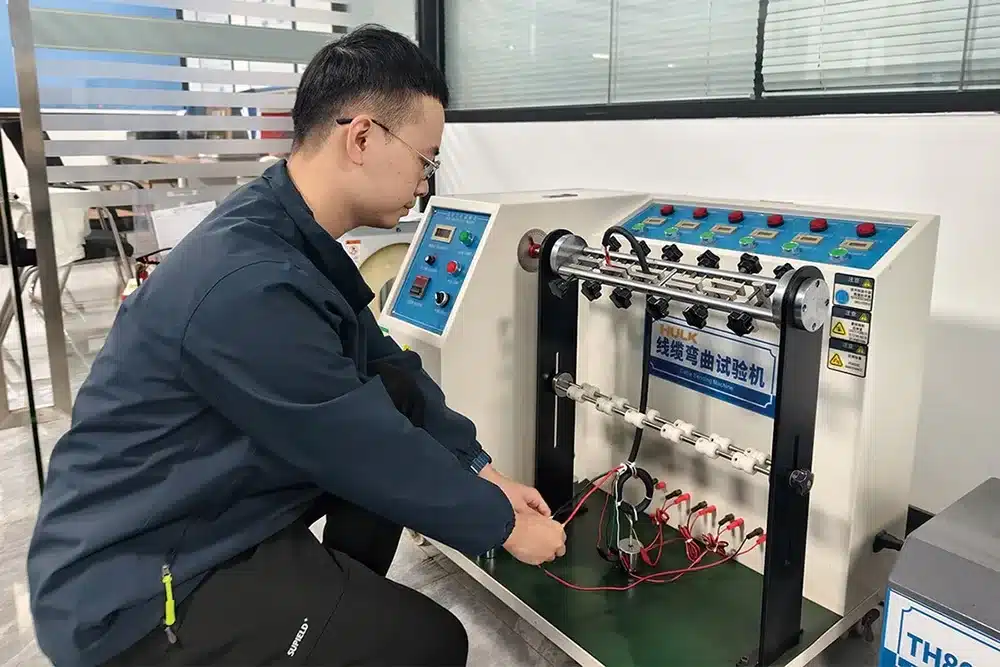
Request samples, abrasion testing, repeated-bend or drag-chain testing, chemical exposure testing, thermal cycling, water or washdown validation, or connectorized evaluation as needed. Ask for the test method, how the sample was made, the test conditions, the acceptance criteria and the failure definition.
What to Include in a TPU or PUR Cable RFQ
Mechanical Requirements
- Installed or not installed in a particular place (either permanently or removably).
- Bend radius
- Travel distance, speed, acceleration
- The spring torque and frequency
- Abrasion, cutting or impact exposure
- The drag-chain or the robot configuration.
- Cable support and routing information.
- Chemical and Environmental Requirements
- Type and concentration of oil/coolant.
- Chemical name, concentration, temperature, duration of contact
Chemical and Environmental Requirements
- Cleaning agents and frequency.
- Conditions of exposure resulting from water, steam, humidity, or washdown
- Exposure to UV and ozone.UV and ozone exposure.
- The continuous and peak temperature and low-temperature operation were the key factors.
- Adhere to flame, smoke and halogen-free standards
Electrical and Construction Requirements
Conductor size and material, current and voltage, type of insulation, shielding, overall diameter limits, cable length, signal or power type, connector style and type of termination.
Compliance, Testing, and Supply Requirements
Required standards and target markets, certification requirements, sample quantities, validation testing, annual volume, packaging, colour, marking, and lead-time requirements. Hulk Cable is a direct manufacturer, which can provide custom TPU, PUR, PVC, TPE, silicone, halogen free and application-specific constructions under full traceability and testing support.
Summary Guidance—Choose TPU or PUR Based on the Actual Application
PUR is an excellent practical cable solution for repeat motion, oil, abrasion and ozone resistance in flexible industrial cables. TPU is often recommended when abrasion, tear and impact, outdoor durability, or dimensional stability are more important in the risk profile. The abbreviations in all cases need to be verified with supplier’s actual compound and data sheet. Selection takes into account total life cost, testing, installation, connectors, chemicals, temperature, movement profile, shielding, conductor stranding, cable lay, jacket formulation and hardness.
Discuss your motion profile, environmental exposure and chemical exposure information, temperature range, bend radius, and service-life goals with our engineering team. Different types of jacket construction (TPU or PUR) will be suggested depending on the application.