One of the first decisions made in building an industrial cable that will last is the selection of stranded vs. solid copper conductors. Stranded conductors provide a good flexibility and fatigue resistance for reliable operation in most moving or vibrating applications when designed appropriately. A solid copper, on the other hand, is a practical and economical choice for fixed installations where the cable is not meant to move after routing. The secret is to use the conductor construction to match the actual motion profile and not to think that one type is always superior.
Not all stranded conductors come with the capability of being flexed continuously. A standard multi-strand design can be easier to route but still be prone to failure in a drag chain or robot axis. The difference is due to strand count, strand diameter, lay, annealing and the entire cable construction which surrounds the copper.
What Is the Difference Between Solid and Stranded Copper Conductors?
Solid copper conductor is a continuous wire and no separate wires are used. A stranded conductor is the combination of several smaller copper wires to create a single electrical conductor. These two constructions have a significant influence on the mechanical properties of the finished product and for stranded conductors, on the size and placement of the strands.
Solid Copper Conductors
Solid conductors have one solid copper conductor. They have a good shape after installation and will not be easily bent under normal handling. This stability is beneficial when the cable must be left to remain stationary after termination, such as in protected machine sections, fixed conduit runs and inside control cabinets. It is easier to construct, and, for the same nominal cross-section, slightly less resistant than equivalent stranded designs, and cheaper than equivalent designs. The restriction is mechanical fatigue. Bending or vibration repeatedly will cause stress to be concentrated at one point in the metal path and may cause damage at the bend or termination point of the bend.
Stranded Copper Conductors
Stranded conductors are made by putting together several small conductors of copper. When the cable bends the individual strands may vibrate with respect to each other, which decreases the force on any particular wire. This construction is therefore used for routing in small spaces, connecting vibrating equipment and for limited or continuous motion. The strands are important in terms of quantity and size of the diameter. A hundred or two hundred or even a thousand fine strands is not the same as seven relatively large strands.
Standard Stranded, Flexible, and Fine-Stranded Construction
Stranded” is a general term. Standard stranded conductors (usually 7 or 19 strands) offer increased flexibility during installation than solid conductors, but are not designed for high-cycle motion. Many, small strands are required in flexible and fine-stranded constructions and are also bent repeatedly. For even greater flexibility, controlled lay lengths and soft-annealed copper with particular characteristics are used for continuous-flex or torsion duty. When ordering a quote, ask for the number of strands, strand diameter/class, and the intended motion (not “stranded copper”).

How Conductor Construction Affects Cable Flexibility
The copper itself does not give flexibility. It’s caused by the combination of strand geometry, conductor lay, condition of copper, insulation, shielding, fillers and jacket.
Strand Count and Strand Diameter
The smaller the diameter of the strands, the more freedom of bending. A basic 7-strand conductor will move more readily than a solid conductor of similar size, but will not be as flex as a fine-stranded conductor that has been designed for continuous motion in a drag chain. Ultimately, the final performance relies on the full cable and the specific bend radius, speed and number of bends/cycles required by the application.
Conductor Lay and Strand Movement
Strands may be twisted together in various patterns, which affects the distribution of stress during bending or twisting of the cable (the lay). A lay that is suitable for forward flexing may produce greater friction or strand movement when used in multi-axis or torsional types of flexing. Designing a sound cable that matches the conductor lay to the expected motion profile is part of sound cable design.
Annealing and Copper Condition
For use in situations where flexibility is desired, soft-annealed copper is generally employed because the annealing process lessens the work hardening, making the copper more ductile. While annealing is an important process for long flex life, the strand construction, insulation system and tested bend radius must also be appropriate for the duty.
Insulation, Shielding, and Jacket Effects
With two cables having equal conductor stranding, two different cables can feel and perform very differently after the inclusion of insulation thickness, type of shield, type of fillers, and type of jacket compound. Often the shielded servo cable or industrial Ethernet cable will feel stiffer than an unshielded control cable of the same conductor size. The minimum usable bend radius and force to route the cable is also affected by the jacket material and overall diameter.
Bend Radius and Flex Life Are Not the Same Thing
The minimum bend radius is the smallest bend that a cable can sustain under given static or dynamic loads. Flex life is the number of motion cycles that the cable will last before it loses performance. Installing a cable to a certain radius doesn’t necessarily mean that it will perform at the same radius continuously. When using the application for continuous-flex or robot applications, ask for the tested motion conditions, which will be more representative of the application. These are the key differences that have been considered in the design and validation of Hulk’s High Flexible Cables and Robot and Torsion Cables.
Electrical Performance Differences Between Solid and Stranded Conductors
Electrical comparisons should be made on the measured resistance, cross section, temperature, length and frequency of the conductor and not on the terms “solid” or “stranded.”
DC Resistance and Conductor Cross-Section
A stranded conductor of the same nominal size can have a slightly higher resistance to the passage of d.c. than can a solid conductor, due to the spaces between strands and the geometry of the strand bundle. Do not assume that AWG or mm2 alone is enough to use the manufacturer’s published DC resistance, which is published for the specific construction.
Current-Carrying Capacity and Heat
The current which is allowed is dependent on conductor resistance, the insulation’s temperature rating, conductor installation, ambient temperature, conductor grouping, and applicable standards. These factors do not take precedence over the choice of solid or stranded. Refer to How to Select Copper Conductor Size for Industrial Cables: Current, Voltage Drop and Flexibility Considerations for detailed sizing guidance.
Signal Transmission and High-Frequency Behavior
In data and high-frequency applications, the construction can affect attenuation and the behavior of connectors at the interface. Do not directly apply results from structured network patch cables to power cables, servo cables, motor cables or control cables. The frequency range and performance criterion for each cable category should be considered independently.
Voltage Drop in Long Industrial Cable Runs
The voltage at the load depends on length of the cable and resistance of the conductor. You don’t need to calculate voltage drop on long motor, actuator or control runs when using either solid or stranded wiring. Apply accurate resistance data and appropriate circuit values.
Where Solid Copper Conductors Are Usually Appropriate
If the cable is installed and not tampered with, then solid conductors are still realistic.
Fixed Control Cabinet and Panel Wiring
Inside control cabinets and panels, solid conductors are easy to route, easy to work with a variety of terminal systems and maintain their shape. Always check terminal compatibility and wire/cable category.
Stationary Equipment and Protected Cable Routes
Solid conductors can be successfully used in fixed conduit, protected trays, and stationary machine parts where there is little movement after the installation. Ensure there is no unexpected movement due to vibration, thermal cycling or future access for maintenance.
When Cost and Simpler Handling Matter
The cost and complexity of specification may be lowered and the simplicity of construction may be realized where dynamic performance is not required. The choice should still be based on actual lack of motion or vibration, and not simply on price.
Where Stranded Copper Conductors Are Usually Required
Stranded conductors are typically the choice of conductor when the cable must pass through restricted areas, be attached to portable work machinery, or withstand vibration and maintenance handling.
Flexible Machine Connections
Stranded conductors apply to a fixed cabinet and motor, sensor, valve, actuator, or removable module, and result in reduced installation stress and easier access to service.
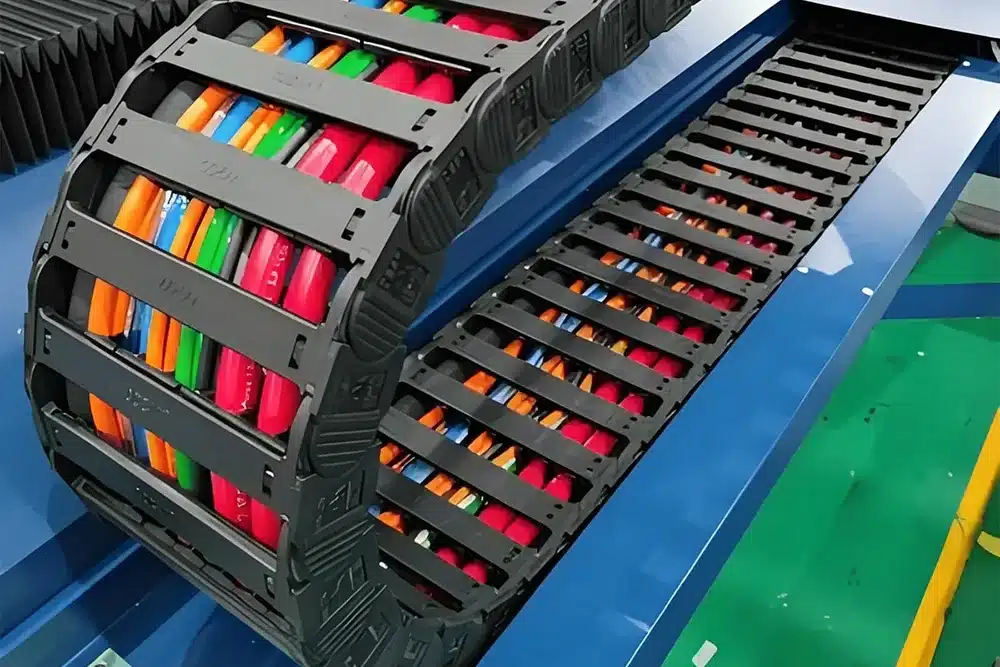
Drag Chain and Continuous-Flex Cables
Only special stranded wire is suited for drag chain duty. The following variables all affect the strand construction, insulation, shielding, jacket and cable lay: Continuous bending, controlled bend radius, travel length, bend speed, bend acceleration, bend cycle frequency. Hulk’s High Flex Cables are designed and tested for these applications.
Servo and Motor Cable Applications
Servo and motor cables are composed of the elements of power conductors, control cores, shields and grounds. The flexibility needs to be considered for the entire cable. If there is too much stiffness, shield fatigue or poor bend-radii control, service life will be shortened. Check out Hulk’s Servo and Motor Cables for constructions that comply with these requirements.
Robotics and Torsional Movement
Bending, twisting and multi-axis motions occur simultaneously in robot cables. A standard stranded conductor is generally inadequate unless the whole cable (strand design, lay, jacket and shielding) is designed and tested to resist torsion. Hulk’s Robot and Torsion Cables solve these multi-stresses.

Common Mistakes When Choosing Solid or Stranded Conductors
Treating Every Stranded Conductor as a Continuous-Flex Conductor
Ordinary stranded wire can ease the routing, but is not made for millions of bending cycles. Before installing the cable in a drag chain or robot always ask for intended application, conductor class, bend radius, movement conditions and supporting test data.
Using Solid Conductors in Areas With Vibration or Repeated Movement
When vibration or repeated movement (like machine doors, removable panels, motor connections) occurs, solid conductors can fatigue at bend points or terminations. Instead of using the original installation classification, review the actual duty.
Choosing by Strand Count Without Reviewing the Complete Cable
The long life of flex is not just due to high strand count. These include cable lay, insulation, shielding, jacket, fillers, bend radius, installation method and testing. Make comparisons between full constructions and not strands individually.
Ignoring Termination Compatibility
If the terminal, ferrule or crimp tool is not compatible with the conductor, the fine strands can splay, damage or pull out. Conform to manufacturer’s specifications for ferrules, strip length, crimping and strain relief.
Selecting a Flexible Cable Without Checking Voltage Drop and Heat
Electrical sizing isn’t mechanical flexibility. All the conditions in the current, resistance, voltage drop, and temperature limits are still in effect. Review the requirements with both sets.
Applying Communication-Cable Advice to Power Cables
Ethernet or patch cable rules do not necessarily carry over to servo, motor, control or fieldbus cables. Always consider the electrical function and performance of the particular cable.
How to Select the Right Conductor Construction for an Industrial Cable
Start With the Installation Type
Identify if the cable is fixed, occasionally moved, frequently handled, constantly flexed or subjected to torsion. The first choice is the installation type.
Define the Movement Profile
Record bend radius, travel distance, speed, acceleration, cycle frequency, torsion angle, vibration and expected service life. Application terms like “flexible” are not enough to make a reliable selection.
Check Electrical Requirements
Verify existing, minimum, maximum voltage, voltage drop, frequency, conductor size, shielding, insulation rating, ambient temperature and grouping. Requirements for electrical and mechanical must be met. Check back to the copper conductor sizing guide.
Check Termination and Installation Constraints
Take into account the type of terminal, ferrules, space for connectors, cable glands, cabinet layout, and minimum bend radius when installation.
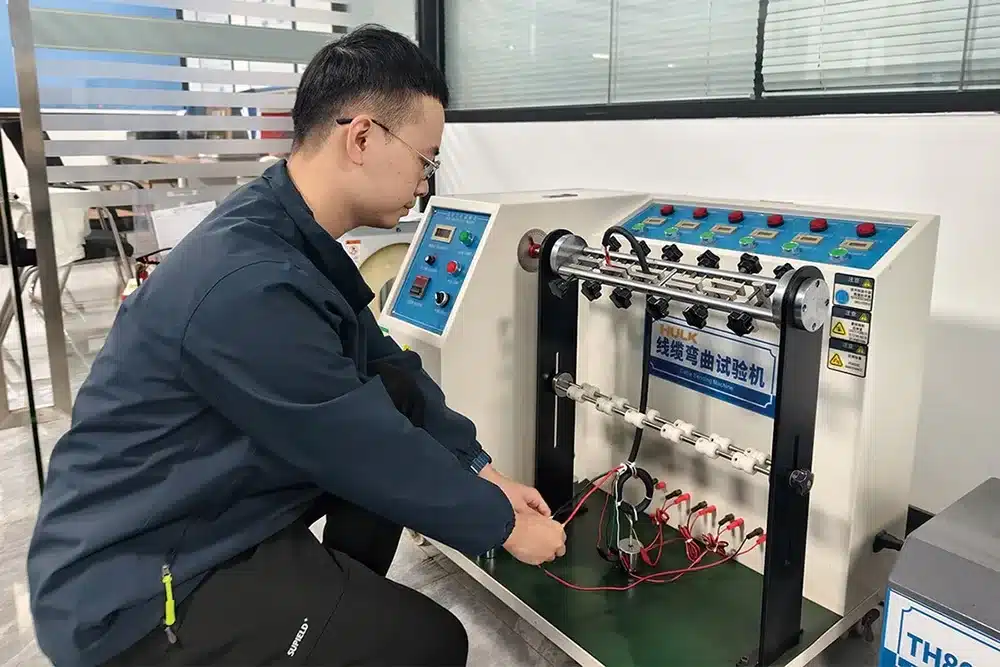
Ask for Application-Specific Test Evidence
Ask for conductor class, construction information, bend radius, motion testing conditions, torsion testing conditions and product specific results. While it is important to have a flexible label, it is not sufficient.
What to Include in a Cable Specification or RFQ
Electrical Requirements
State conductor material, cross sectional area/AWG, current, voltage, frequency, voltage drop limit, temperature rating, shielding, and circuit function.
Mechanical Requirements
Set the fixed (or dynamic) installation, bend radius, travel, speed, acceleration, torsion, vibration, cycle frequency and available routing space.
Environmental and Compliance Requirements
Include oil, coolant, chemicals, washdown, UV, temperature extremes, abrasion, flame performance, halogen free, and UL, CE, TÜV, etc. approvals for target markets.
Manufacturing and Validation Requirements
Ask for samples, construction drawings, conductor resistance data, bend radius data and motion test data, inspection records and approved application references. Hulk Cable can provide support for conductor selection, custom stranding, insulation and jacket development, and application specific testing as a source factory.
Summary Guidance—Solid or Stranded Copper?
For installations with little to no movement after installation and low use, solid copper conductors are often used. Stranded conductors are typically needed when the cable needs to be flexible around bends, vibrations, maintenance handling, continuous flexing or torsional movement. However, standard, flexible, fine-stranded and highly flexible construction provides significantly different performance within the same strand category, and the strand should be selected based on the strand geometry, electrical requirements, bend radius, movement profile, insulation, shielding, jacket, termination method and verified application testing.
For new machines, retrofit or series production, specify the current, voltage, cable route, bend radius, travel, speed, torsion angle, environment, and certification targets. Hulk Cable can then prescribe the right constructor of the conductor and complete cable design to you for the duty.